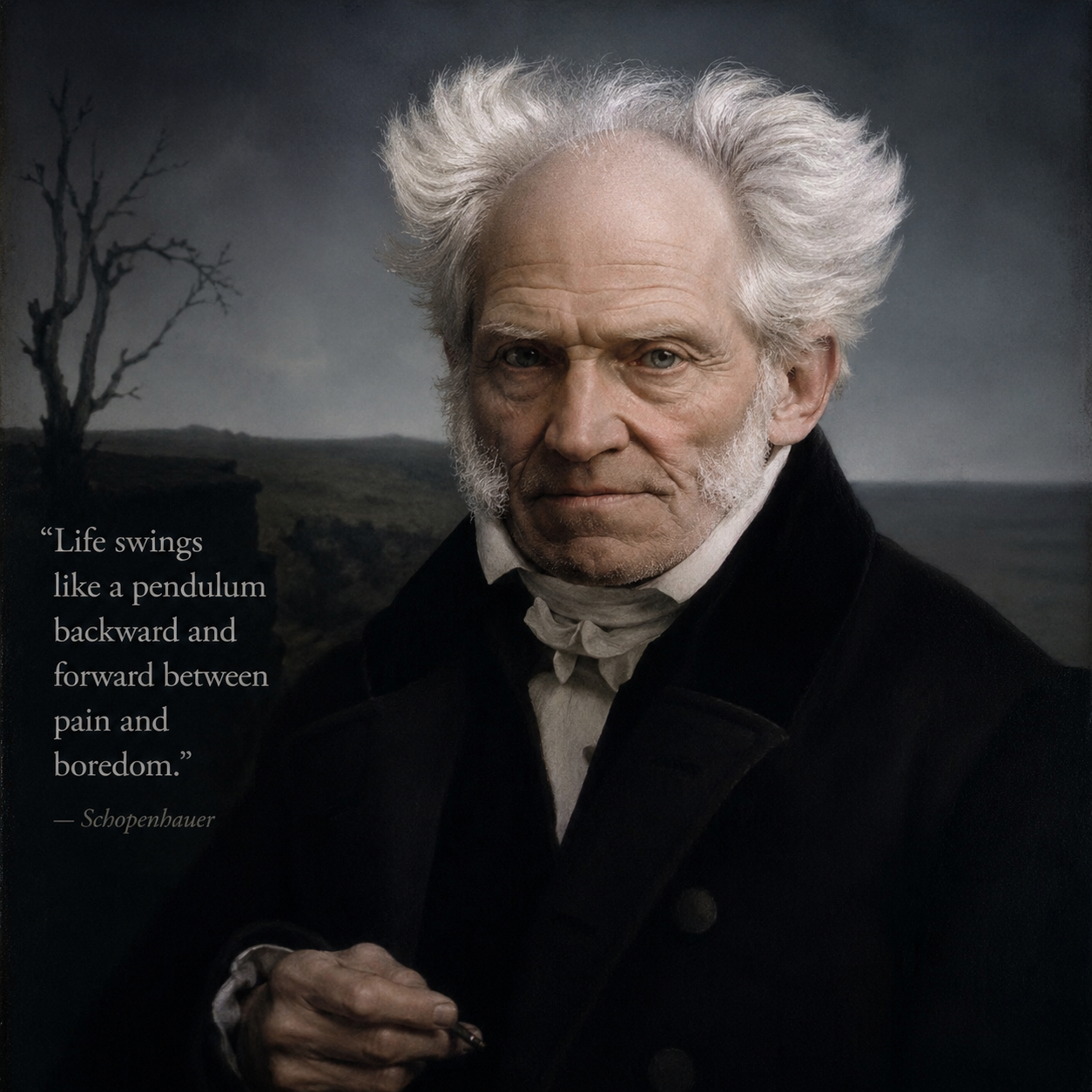
Arthur Schopenhauer — "The shortest follies are the best."
The shortest follies are the best.
The shortest follies are the best.
Click any product to generate a realistic preview. Up to 3 at a time.
* Initial load can take up to 90 seconds — revising the preview in another color is nearly instant.
"With women, nature has made a blunder."
"It is only the man whose intellect is clouded by his sexual impulses that could give the name of the fair sex to that undersized, narrow-shouldered, broad-hipped, and short-legged race."
"Women remain children all their lives, for they always see only what is near at hand, cling to the present, take the appearance of a thing for reality, and prefer trifling matters to the most importan…"
"We often find that people are most insolent and arrogant where they have least reason to be so."
"Man is the only animal that causes pain to others for the mere pleasure of doing it."
German philosopher of pessimism whose The World as Will and Representation (1819) defined the suffering-and-renunciation tradition. Closely associated with Immanuel Kant (the system Schopenhauer built on and revised). For an intellectual contrast, see G.W.F. Hegel, German Idealist of the rational unfolding of Spirit — Schopenhauer scheduled his Berlin lectures opposite Hegel's and spent decades attacking Hegel's optimistic system as deliberately mystifying nonsense — the foundational rivalry of 19th-century German philosophy.
The standard scholarly entry points to Arthur Schopenhauer's work: Bryan Magee (Oxford, populariser-philosopher) — The Philosophy of Schopenhauer (1983); Christopher Janaway (Southampton, Schopenhauer specialist) — Self and World in Schopenhauer's Philosophy (1989); David E. Cartwright (Wisconsin–Whitewater) — Schopenhauer: A Biography (2010). These are the works graduate seminars cite when teaching Arthur Schopenhauer.
Your cart is empty