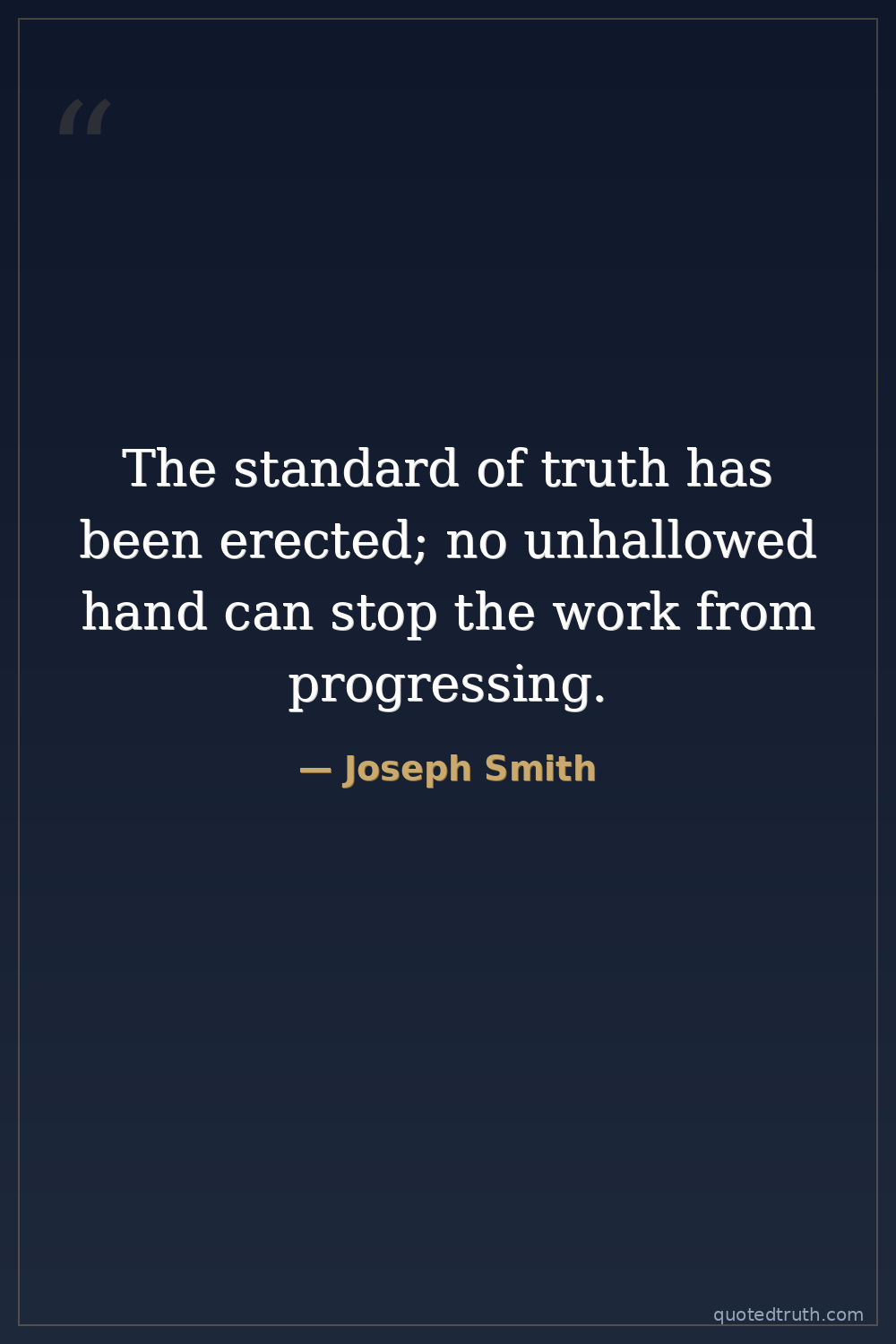
Joseph Smith — "The standard of truth has been erected; no unhallowed hand can stop the work fro…"
The standard of truth has been erected; no unhallowed hand can stop the work from progressing.
The standard of truth has been erected; no unhallowed hand can stop the work from progressing.
Click any product to generate a realistic preview. Up to 3 at a time.
* Initial load can take up to 90 seconds — revising the preview in another color is nearly instant.
"I have been raised up by the power of God to establish His Kingdom on the earth."
"I never told you I was perfect; but there is no error in the revelations which I have taught."
"Come on! ye prosecutors! ye false swearers! All hell, boil over! Ye burning mountains, roll down your lava! for I will come out on the top at last. I have more to boast of than ever any man had. I am …"
"I told them I was a good boy, and if I had done anything wrong, I was willing to be corrected."
"For hundreds of years the world was wrapped in a veil of spiritual darkness, until there was not one fundamental truth belonging to the place of salvation that was not, in the year 1820, so obscured b…"
Found in 1 providers: grok
1 source checked
Truth, once revealed, becomes unstoppable — no corrupt or opposing force can reverse its course. 'Unhallowed hand' means those lacking divine sanction or moral purity. A sacred mission launched with divine authority carries forward regardless of human resistance. Progress is inevitable and divinely protected — persecution, doubt, or enemies may slow but never defeat something rooted in absolute, revealed truth. Confidence in that foundation makes opposition irrelevant.
Joseph Smith wrote this amid relentless persecution — mobs, legal battles, expulsion from Missouri, and imprisonment. He founded the LDS Church in 1830 against fierce opposition and died by mob violence in 1844 at Carthage Jail. His core belief: God personally called him to restore primitive Christianity. This unwavering certainty defined every decision he made — the defiance here is the voice of a man who staked his life on divine mandate.
Early 19th-century America was ablaze with religious revivalism — the Second Great Awakening sparked competing denominations, camp meetings, and prophetic claims. Frontier communities were volatile; religious minorities faced real violence. Anti-Mormon sentiment ran so high that Missouri's governor issued an extermination order against Latter-day Saints in 1838. Smith's declaration came from within this storm — a nation expanding westward, religiously fractured, and deeply suspicious of new movements claiming divine authority.
AI-generated insights based on extensive research and information for context. Factual errors? Email [email protected].
Your cart is empty