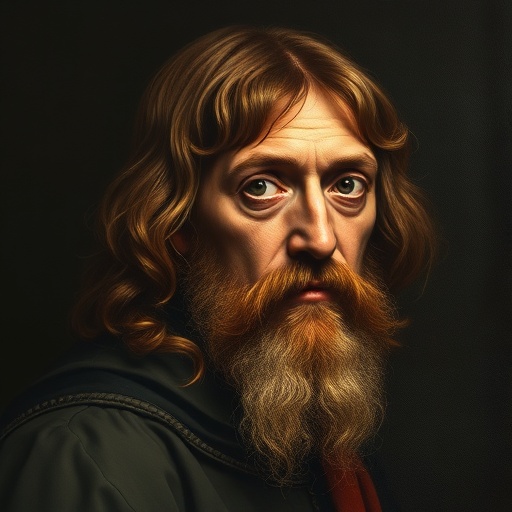
Nicolaus Copernicus — "The Sun is the center of the universe, and all the planets revolve around it."
The Sun is the center of the universe, and all the planets revolve around it.
The Sun is the center of the universe, and all the planets revolve around it.
Click any product to generate a realistic preview. Up to 3 at a time.
* Initial load can take up to 90 seconds — revising the preview in another color is nearly instant.
"Therefore, let us not be afraid to follow truth wherever it may lead us, even if it contradicts our preconceived notions."
"For among these, the first and chief consideration is the size of the sphere of the fixed stars, which is immense, and the next is the size of the earth, which is as a point in comparison with the hea…"
"Nor do I doubt that learned and skillful mathematicians will agree with me if they are willing to give not superficial but profound attention to the arguments I adduce in this work."
"The Sun, the Moon, and the Earth, are all parts of one great system."
"When, therefore, I had long considered the uncertainty of the traditional mathematical doctrines concerning the order of the spheres of the universe, I began to be annoyed that no more accurate explan…"
Found in 1 providers: grok
1 source checked
The Sun, not the Earth, sits at the center of everything, and planets orbit around it. This overturned the assumption that humans occupy a fixed, central position while everything else revolves around us. In plain terms: Earth is just one of several bodies circling a star, not the cosmic anchor point. It relocated humanity from the center of creation to one small planet among many moving through space.
Copernicus was a Polish canon and mathematician who spent decades refining this model before publishing De Revolutionibus Orbium Coelestium in 1543, the year he died. He delayed publication for years fearing ridicule and Church condemnation — a cautious man making a revolutionary claim. His conclusion wasn't philosophical speculation but the result of meticulous geometric modeling of planetary motion, anchored in his dual training in astronomy and mathematics at Krakow, Bologna, and Padua.
The Ptolemaic geocentric model had dominated European science and theology for roughly 1,400 years, backed by Aristotle and sanctioned by the Catholic Church as consistent with scripture. In the early 1500s, the Reformation was fracturing Christian Europe, making Church institutions fiercely defensive of doctrine. Challenging Earth's centrality meant challenging both sacred cosmology and human exceptionalism simultaneously, threatening the intellectual and religious order that structured society — which is why this claim took decades to gain acceptance.
AI-generated insights based on extensive research and information for context. Factual errors? Email [email protected].
Your cart is empty