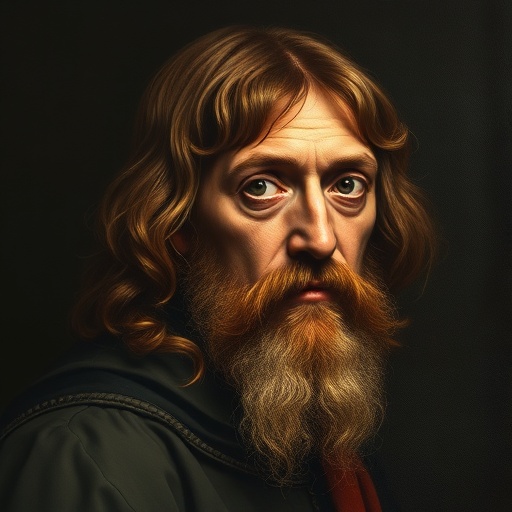
Nicolaus Copernicus — "The Sun, the Moon, and the Earth, are all parts of one great system."
The Sun, the Moon, and the Earth, are all parts of one great system.
The Sun, the Moon, and the Earth, are all parts of one great system.
Click any product to generate a realistic preview. Up to 3 at a time.
* Initial load can take up to 90 seconds — revising the preview in another color is nearly instant.
"The earth has a spherical shape, for it is bounded on all sides by the circumference of a circle."
"For it is not the magnitude of the stars, but the magnitude of their distance from us, that causes them to appear small."
"But if anyone desires to judge these things not ignorantly but with skill and knowledge, he will find that what I have undertaken is in harmony with the best authorities, and that it is in no way oppo…"
"It is not incredible that the earth moves, but that it stands still, that is incredible."
"I am not ignorant that there are some who, having heard that in my treatises on the ordering of the spheres of the universe, I attribute certain motions to the terrestrial globe, will immediately shou…"
Found in 1 providers: grok
1 source checked
The universe isn't a collection of separate, unrelated objects but a unified, interconnected system. The Sun, Moon, and Earth operate together under shared laws, not as independent entities. This expresses a systems-thinking view of the cosmos: everything is bound by gravitational and orbital relationships. Understanding one part requires understanding the whole—a foundational idea in modern astronomy that replaced the fragmented, Earth-centered medieval view of the heavens.
Copernicus spent decades proving that Earth, Sun, and Moon belong to a single ordered system—with the Sun at its center, not Earth. His 1543 work De Revolutionibus Orbium Coelestium reframed the cosmos as a mathematically coherent whole. As a canon and physician who pursued astronomy as a private passion, he understood nature as governed by elegant, unified laws—making this quote a direct expression of his life's central conviction.
In the early 1500s, Europe still accepted Ptolemy's 1,400-year-old geocentric model, which the Catholic Church integrated into theology. The Renaissance was reviving Greek texts and questioning inherited authority. Explorers like Columbus and Magellan were dismantling old geographic certainties. Against this backdrop, Copernicus's vision of a unified solar system was radical—it dethroned Earth from cosmic center and implied that human beings inhabited one small part of an immense, orderly whole.
AI-generated insights based on extensive research and information for context. Factual errors? Email [email protected].
Your cart is empty