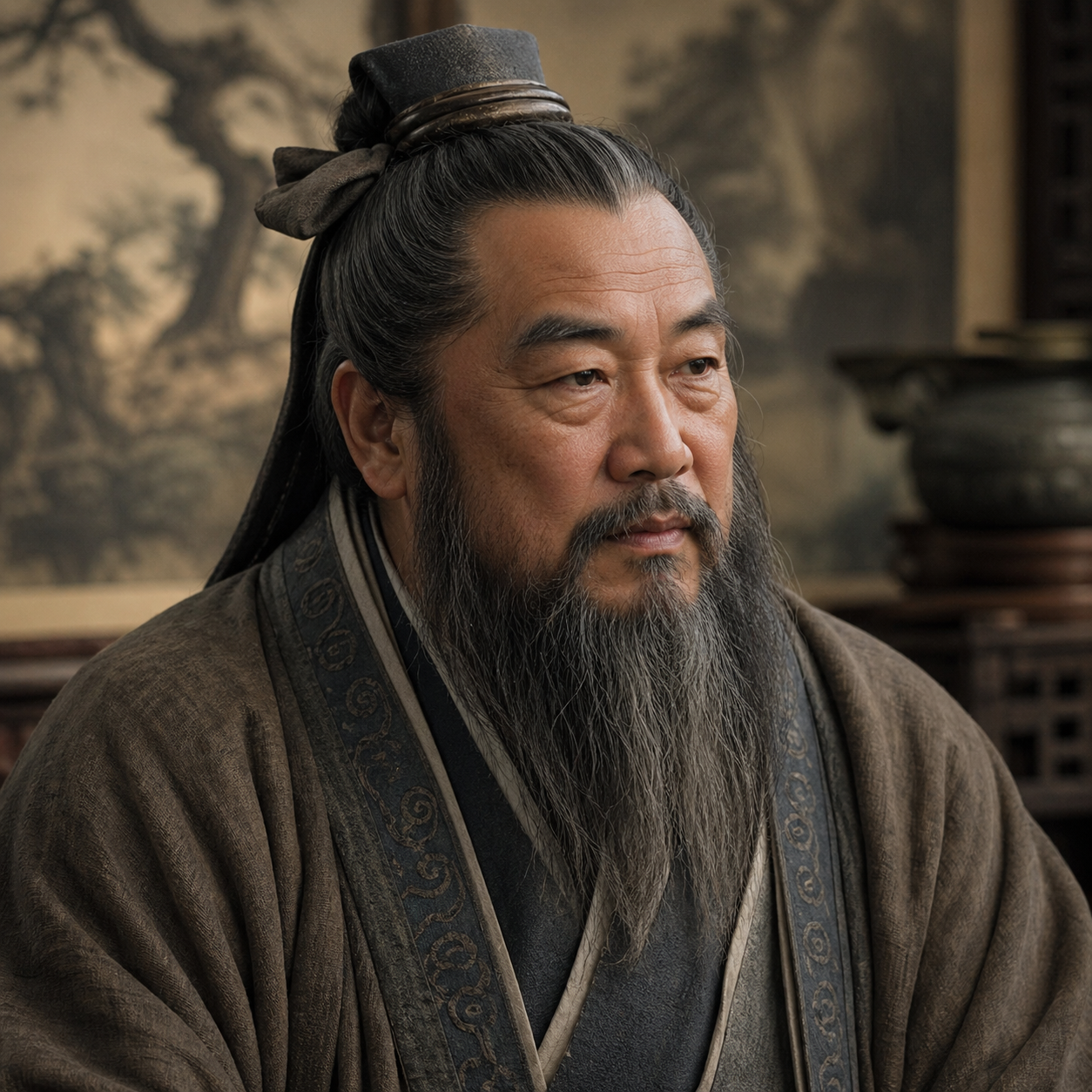
Confucius — "The superior man is dignified but does not wrangle."
The superior man is dignified but does not wrangle.
The superior man is dignified but does not wrangle.
Click any product to generate a realistic preview. Up to 3 at a time.
* Initial load can take up to 90 seconds — revising the preview in another color is nearly instant.
"Riches and honors are the things people desire; but if one obtains them by not following the Way, then one will not be able to hold them. Poverty and low position in society are the things that people…"
"The Master said, 'He who is not concerned about the distant future will find trouble right at hand.'"
"The gentleman concerns himself with the Way; he does not worry about his salary."
"Hold faithfulness and sincerity as first principles. Then no friends will be unlike yourself."
"The gentleman is at ease without being proud; the small man is proud without being at ease."
Chinese philosopher and teacher whose teachings (compiled by his students in the Analects) became the foundational ethical framework of East Asian civilization for 2,500 years. Closely associated with Mencius (his most-influential follower a century later). For an intellectual contrast, see Laozi, near-contemporary Chinese sage and Tao Te Ching author — Confucius systematized social order through ritual and family hierarchy; Laozi's Taoist effortless-action philosophy argued such systems were the disease, not the cure. The two founding poles of Chinese moral philosophy — every East Asian moral tradition since has positioned itself between them.
The standard scholarly entry points to Confucius's work: Philip J. Ivanhoe (Georgetown, Chinese philosophy) — Confucian Moral Self Cultivation (2000); Edward Slingerland (UBC, Asian Studies) — Effortless Action: Wu-wei as Conceptual Metaphor (2003); Tu Weiming (Harvard, Confucian scholar) — Confucian Thought: Selfhood as Creative Transformation (1985). These are the works graduate seminars cite when teaching Confucius.
Found in 1 providers: deepseek
1 source checked
A person of true character carries themselves with quiet self-respect and composure, but refuses to descend into petty arguments, quarrels, or status battles. Dignity means standing firm in your values without needing to bicker, score points, or prove yourself right in heated disputes. You can disagree, hold convictions, and command respect, all while staying calm and refusing to engage in the noisy contests that smaller minds find irresistible.
Confucius spent his life teaching the ideal of the junzi, the 'superior man' or moral exemplar, contrasting him with the petty xiaoren who quarreled for personal gain. As an itinerant teacher rejected by many courts, Confucius modeled patient composure rather than arguing with rulers who dismissed him. He valued ritual propriety, self-cultivation, and harmonious conduct over verbal combat, believing that genuine virtue radiated naturally without needing aggressive defense.
Confucius lived during the late Spring and Autumn period of ancient China, an era of crumbling Zhou authority where rival states warred and court intrigues flourished. Feudal lords schemed, ministers plotted, and scholars competed bitterly for patronage by out-arguing rivals. Against this backdrop of factional wrangling and collapsing social order, Confucius sought to restore stability through cultivated character and ritual decorum, offering the dignified junzi as an antidote to an age consumed by ambition and conflict.
AI-generated insights based on extensive research and information for context. Factual errors? Email [email protected].
Your cart is empty