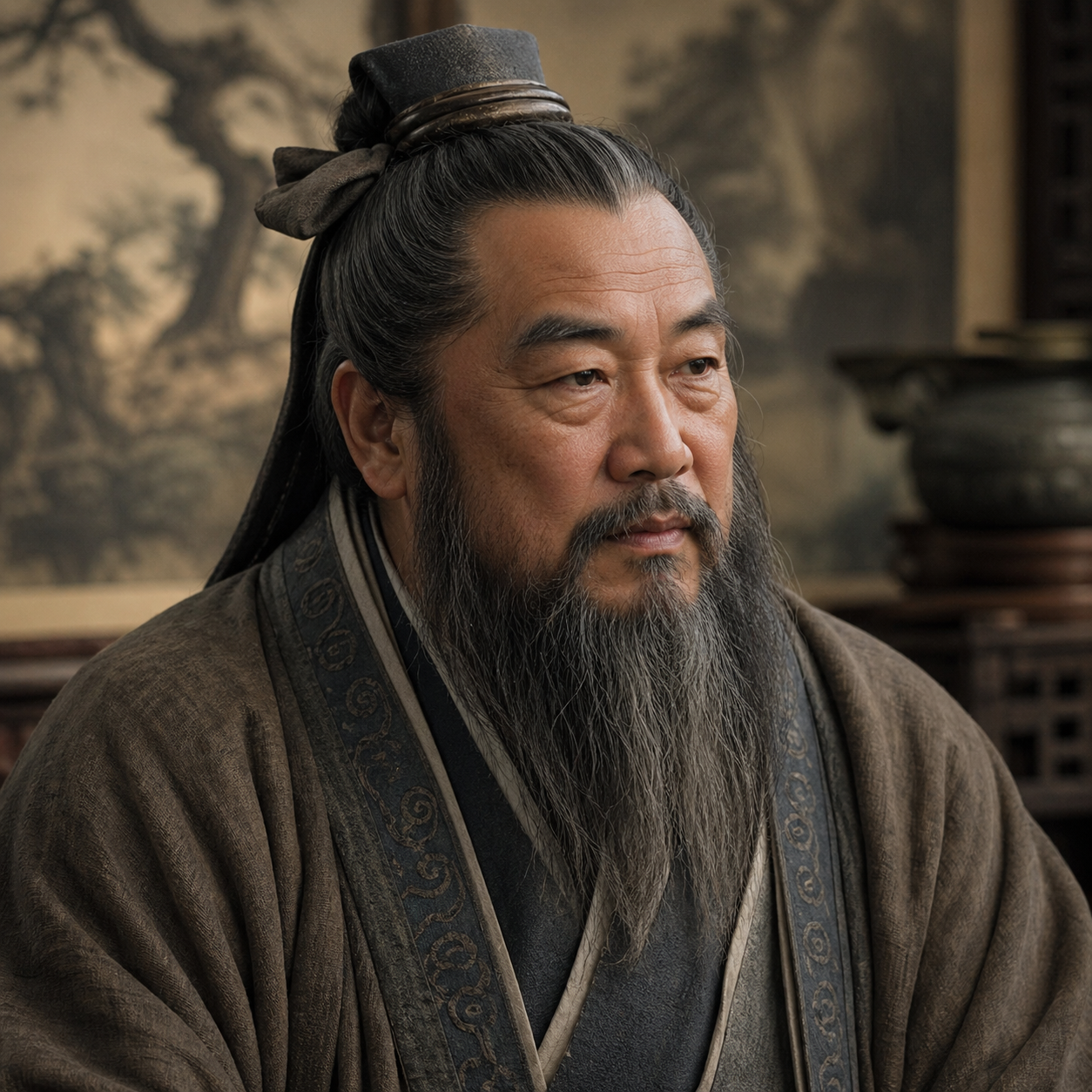
Confucius — "The superior man is universally benevolent, but not clannish."
The superior man is universally benevolent, but not clannish.
The superior man is universally benevolent, but not clannish.
Click any product to generate a realistic preview. Up to 3 at a time.
* Initial load can take up to 90 seconds — revising the preview in another color is nearly instant.
"The Master said, 'If the will be set on virtue, there will be no practice of wickedness.'"
"He who is not concerned about the distant future will find sorrow near at hand."
"He who exercises government by means of his virtue may be compared to the North Star, which keeps its place and all the stars turn towards it."
"The Master said, 'To see what is right, and not to do it, is want of courage.'"
"Is humanity far away? Whenever I want the virtue of humanity, it comes at once."
Chinese philosopher and teacher whose teachings (compiled by his students in the Analects) became the foundational ethical framework of East Asian civilization for 2,500 years. Closely associated with Mencius (his most-influential follower a century later). For an intellectual contrast, see Laozi, near-contemporary Chinese sage and Tao Te Ching author — Confucius systematized social order through ritual and family hierarchy; Laozi's Taoist effortless-action philosophy argued such systems were the disease, not the cure. The two founding poles of Chinese moral philosophy — every East Asian moral tradition since has positioned itself between them.
The standard scholarly entry points to Confucius's work: Philip J. Ivanhoe (Georgetown, Chinese philosophy) — Confucian Moral Self Cultivation (2000); Edward Slingerland (UBC, Asian Studies) — Effortless Action: Wu-wei as Conceptual Metaphor (2003); Tu Weiming (Harvard, Confucian scholar) — Confucian Thought: Selfhood as Creative Transformation (1985). These are the works graduate seminars cite when teaching Confucius.
Analects 15.21 (similar to an earlier quote, but distinct nuance)
Date: c. 5th century BCE
WisdomFound in 1 providers: grok
1 source checked
A truly virtuous person cares about everyone fairly and extends goodwill broadly across society. They do not play favorites, form exclusive cliques, or reserve kindness only for their own family, friends, or tribe. Genuine moral character shows up as impartial concern for all people, while partisanship and in-group loyalty at the expense of outsiders reveal a smaller, less developed character.
Confucius built his entire ethical system around the junzi, the 'superior man' or exemplary person, whose defining trait was ren, humaneness extended to all. As a teacher who accepted students regardless of social rank, charging only dried meat as tuition, he lived this inclusive ideal. He repeatedly contrasted the junzi with the petty person who cliques and schemes, making impartial benevolence a cornerstone of moral cultivation.
Confucius lived during the late Spring and Autumn period (551-479 BCE), when the Zhou dynasty was fracturing into warring states and aristocratic clans fought viciously for power. Loyalty flowed narrowly to family, lineage, and feudal lord, while commoners were expendable. By teaching universal benevolence over clannishness, Confucius challenged the entrenched kinship politics of his age, proposing instead a meritocratic moral order that would later shape Chinese governance for millennia.
AI-generated insights based on extensive research and information for context. Factual errors? Email [email protected].
Your cart is empty