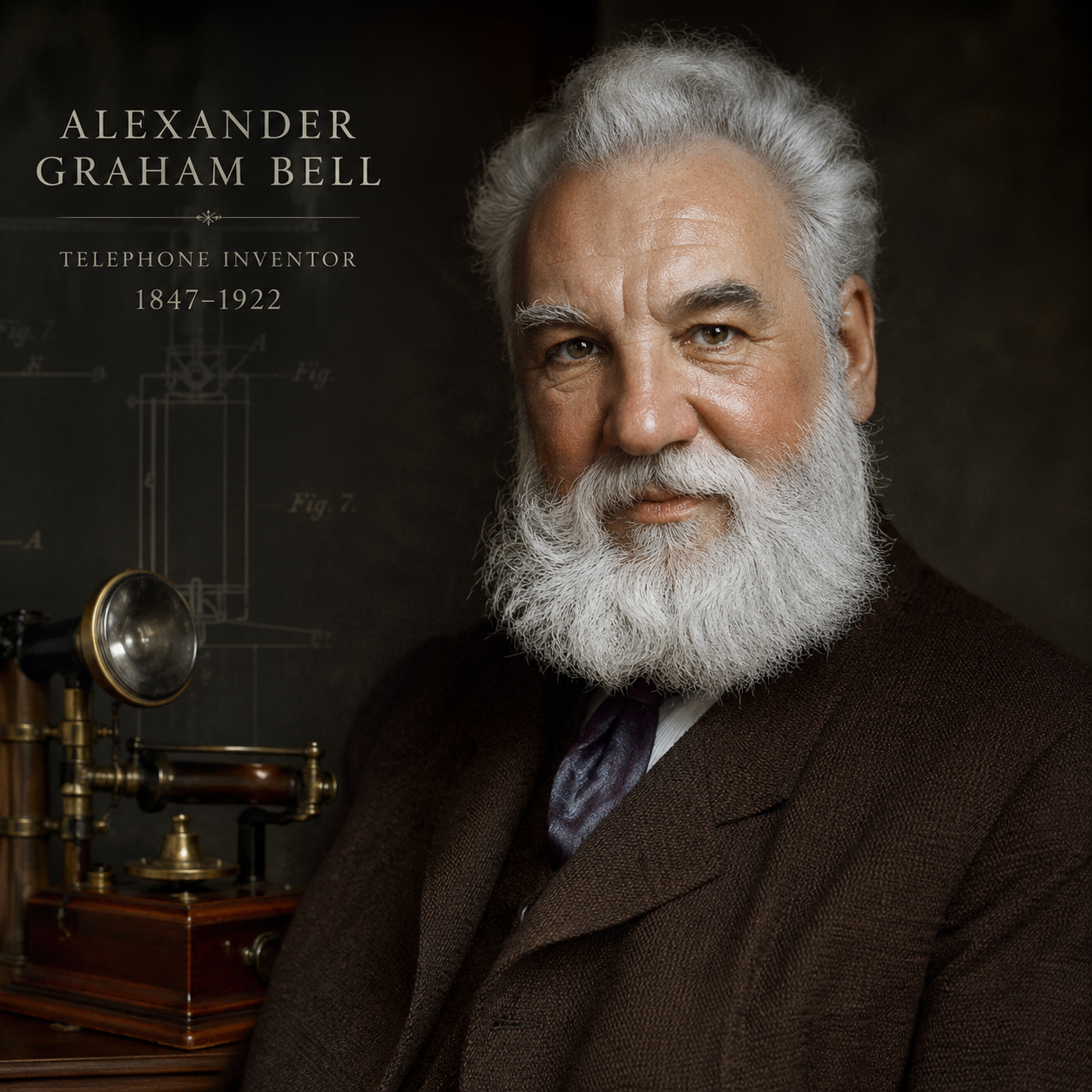
Alexander Graham Bell — "The telephone may be used to talk to the dead, and the dead may be used to talk …"
The telephone may be used to talk to the dead, and the dead may be used to talk to the living.
The telephone may be used to talk to the dead, and the dead may be used to talk to the living.
Click any product to generate a realistic preview. Up to 3 at a time.
* Initial load can take up to 90 seconds — revising the preview in another color is nearly instant.
"The telephone is a wonderful instrument, but it is not a perfect one."
"There are no secrets to success. It is the result of preparation, hard work, and learning from failure."
"Don't keep forever on the public road, going only where others have gone. Leave the beaten track occasionally and dive into the woods. Every time you do so you will be certain to find something that y…"
"The telephone may be used for the transmission of speech, music, and other sounds, but its principal use will be for communication between individuals."
"If it is not necessary, it is obviously not advisable, that deaf children should acquire, and use, as their ordinary and habitual means of communication — their vernacular in fact — a language that is…"
Reported statement, but highly disputed if he actually meant it literally.
Date: c. 1910s
Life & DeathFound in 1 providers: grok
1 source checked
Technology can preserve the voices of people after they die, letting future generations literally hear them speak. Bell is saying that recordings and transmission allow the deceased to continue communicating with the living — that voice, once captured, outlives its speaker. This reflects a profound insight: technology doesn't just connect people across space, it can bridge the gap between life and death, making the past permanently audible.
Bell's life was defined by voice — his mother and wife were both deaf, driving his obsession with sound and communication. Beyond the telephone, he worked at the Volta Laboratory on the graphophone, an early voice recorder. He understood that capturing voice meant preserving identity. The loss of two infant sons deepened his awareness of mortality. For Bell, technology that could preserve a person's voice after death was not fantasy but a logical extension of his life's work.
Bell lived during the height of Victorian spiritualism — séances, spirit photography, and attempts to contact the dead were mainstream pursuits embraced even by intellectuals. Edison simultaneously speculated about building a spirit phone to communicate with the dead. The phonograph's invention in 1877, a year after Bell's telephone, made voice preservation suddenly real. In this atmosphere of overlapping technological wonder and spiritual yearning, the idea that machines might bridge mortality felt both scientifically plausible and culturally urgent.
AI-generated insights based on extensive research and information for context. Factual errors? Email [email protected].
Your cart is empty