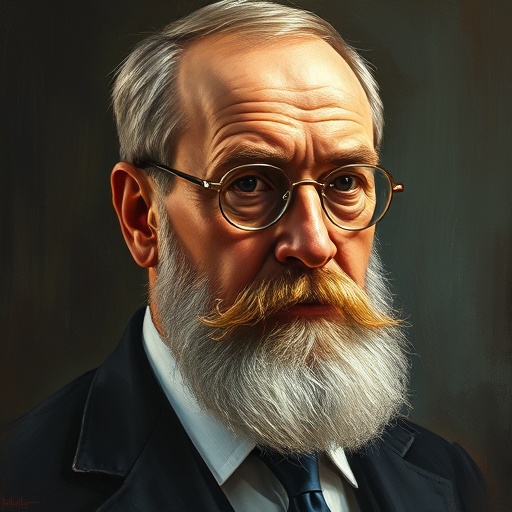
Robert Koch — "The time has come when we can look forward to the eradication of tuberculosis."
The time has come when we can look forward to the eradication of tuberculosis.
The time has come when we can look forward to the eradication of tuberculosis.
Click any product to generate a realistic preview. Up to 3 at a time.
* Initial load can take up to 90 seconds — revising the preview in another color is nearly instant.
"The importance of pure cultures cannot be overstated in bacteriological research."
"The scientific method is the only way to uncover the secrets of nature."
"The future of humanity depends on our ability to control infectious diseases."
"As long as we do not know the cause of a disease, we can do nothing for its prevention."
"The prevention of disease is far more important than its cure."
Found in 1 providers: grok
1 source checked
Tuberculosis, one of humanity's deadliest diseases, can be completely wiped out — that is the bold claim here. Koch is not expressing cautious hope but confident expectation: medical science has advanced far enough to pursue total eradication as a genuine, achievable goal. It reflects the radical shift in thinking when a disease moves from mysterious curse to understood enemy, suggesting that identifying a disease's cause is the essential first step toward defeating it forever.
Koch isolated Mycobacterium tuberculosis in 1882, the landmark discovery that earned him the 1905 Nobel Prize in Medicine. His entire scientific identity rested on proving that specific microbes cause specific diseases — his famous Koch's Postulates codified this methodology. Having handed medicine proof that TB was bacterial, he believed humanity now possessed what was needed to eradicate it. This statement reflects his characteristic conviction that rigorous science, not luck, would ultimately conquer infectious disease.
Tuberculosis killed roughly one in seven people in industrialized nations during Koch's lifetime, bearing names like 'the white plague' and 'consumption.' Koch's 1882 isolation of the TB bacillus came amid a broader germ theory revolution dismantling miasma theory. Public sanatoriums, improved sanitation, and early public health campaigns were beginning to reduce death rates, making eradication feel — for the first time — like a scientifically achievable goal rather than an impossible wish.
AI-generated insights based on extensive research and information for context. Factual errors? Email [email protected].
Your cart is empty