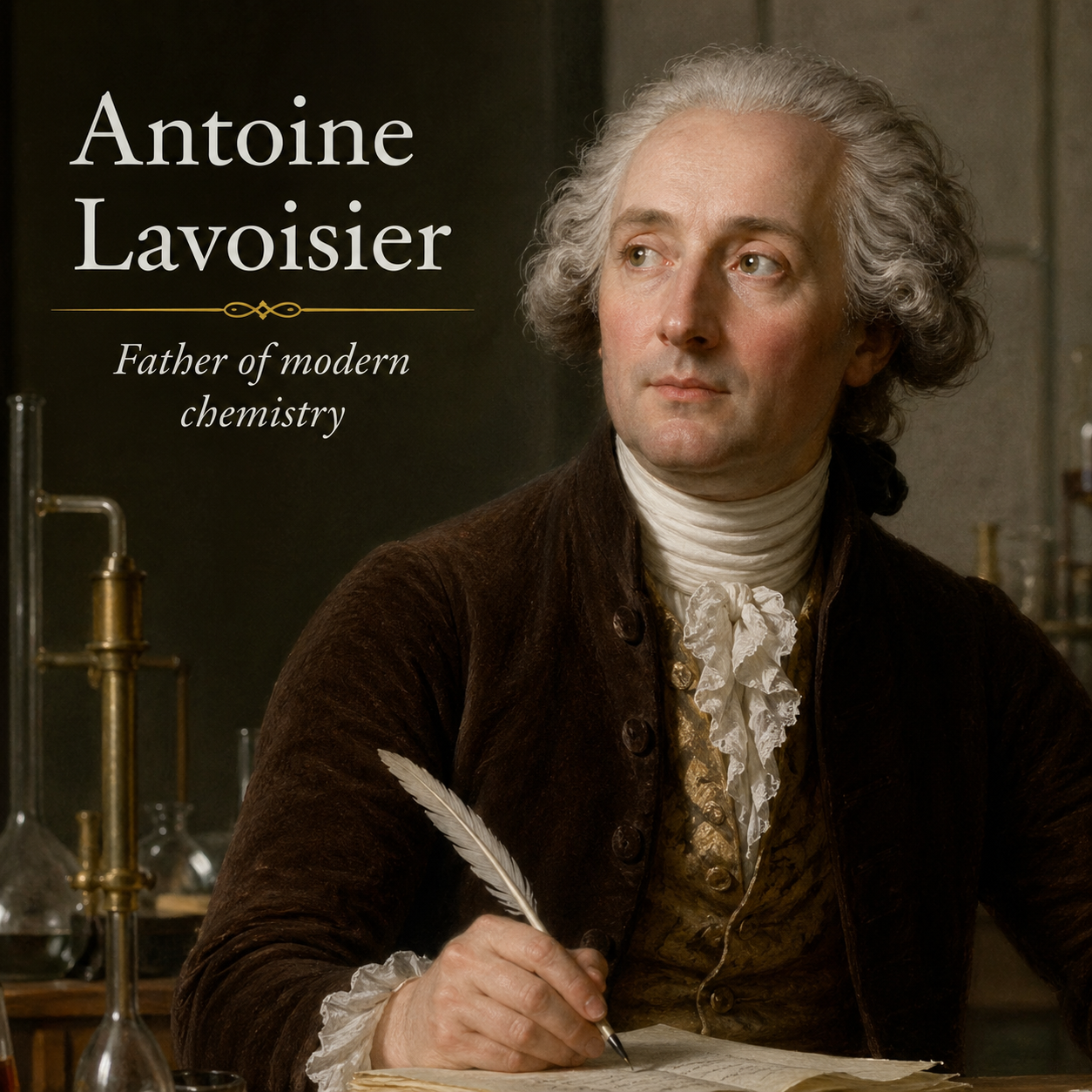
Antoine Lavoisier — "The true philosopher is he who knows how to doubt."
The true philosopher is he who knows how to doubt.
The true philosopher is he who knows how to doubt.
Click any product to generate a realistic preview. Up to 3 at a time.
* Initial load can take up to 90 seconds — revising the preview in another color is nearly instant.
"Imagination, on the contrary, which is ever wandering beyond the bounds of truth, joined to self-love and that self-confidence we are so apt to indulge, prompt us to draw conclusions which are not imm…"
"The desire to do good is the most powerful motive of all."
"It is not given to every man to be a Newton, but every man can be useful to society."
"The greatest pleasure of the human mind is to discover the truth."
"The human mind, like the human body, requires nourishment."
Found in 1 providers: grok
1 source checked
Real intelligence lives in questioning, not certainty. The mark of a genuine thinker is willingness to doubt—to refuse accepting inherited ideas as automatically true. Rather than treating established explanations as settled, the authentic philosopher tests, probes, and remains open to being wrong. Skepticism isn't weakness; it's the essential starting point for real understanding. Comfortable certainty closes the mind, while productive doubt drives every meaningful discovery forward.
Lavoisier embodied productive doubt. He inherited phlogiston theory—the dominant explanation for combustion—and refused to accept it simply because it was established. Through careful quantitative experiments he proved it wrong, replacing it with oxygen-based chemistry. His skepticism also drove him to overhaul the chaotic alchemical naming system into modern chemical nomenclature. Lavoisier's entire legacy rests on his willingness to doubt what virtually everyone around him believed.
Lavoisier worked during the Enlightenment, an era defined by deliberate rejection of inherited authority—religious, political, and intellectual. French philosophes like Voltaire and Diderot championed reason over tradition, and the Encyclopédie systematically questioned received knowledge. In science, the alchemical worldview was crumbling under empirical challenge. Publicly doubting accepted theory was culturally resonant—the same spirit that, taken into politics, would soon ignite the French Revolution that ultimately claimed Lavoisier's own life.
AI-generated insights based on extensive research and information for context. Factual errors? Email [email protected].
Your cart is empty