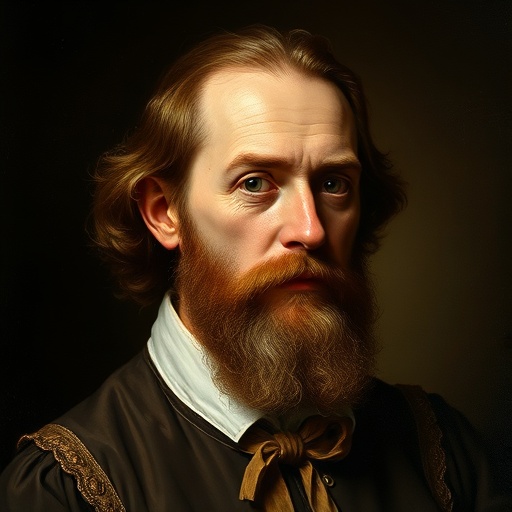
William Harvey — "The true physician is one who loves humanity."
The true physician is one who loves humanity.
The true physician is one who loves humanity.
Click any product to generate a realistic preview. Up to 3 at a time.
* Initial load can take up to 90 seconds — revising the preview in another color is nearly instant.
"I have always preferred to learn and teach anatomy from actual dissection and not from books."
"I hold that the motion of the blood is in a circle, and is constantly impelled and distributed by the pulsific action of the heart."
"I have not only affirmed, but also demonstrated, the circulation of the blood."
"Very many maintain that all we know is still infinitely less than all that still remains unknown; nor do philosophers pin their faith to others' precepts in such wise that they lose their liberty, and…"
"The blood flows from the right ventricle through the lungs to the left auricle."
English physician whose On the Motion of the Heart and Blood in Animals (1628) demonstrated blood circulation, overturning 1,400 years of Galenic medicine. Closely associated with Francis Bacon (his contemporary in the new English empiricism). For an intellectual contrast, see Galenic medicine, the 2nd-century Greek medical tradition (humors, blood-as-consumed-fuel) — Harvey calculated that the heart pumps more blood per hour than the body could possibly produce as fuel — a single quantitative observation that demolished the entire Galenic-Aristotelian medical worldview. The cleanest example in medical history of arithmetic disproving 14 centuries of authority.
An ethical statement on the motivation of a good doctor.
Date: Uncertain (attributed)
WisdomFound in 1 providers: gemini
1 source checked
A genuine doctor is driven by compassion for people, not merely technical skill or profit. Medicine practiced without care for patients as human beings misses its fundamental purpose. The best healers combine knowledge with genuine concern for suffering, treating the whole person rather than just the disease or symptom.
Harvey revolutionized medicine through meticulous observation and experiment, yet his discoveries were motivated by understanding life itself, not fame. His dedication to truth-seeking through dissection and careful study reflected deep respect for human existence. His patience in building evidence over decades showed a temperament more aligned with service than self-promotion.
In early modern Europe, medicine was transforming from ancient Greek authority toward empirical science, yet physicians often served wealthy patrons primarily. Quackery was rampant, and poor patients received little care. Harvey's era saw early hospitals emerging, but medicine remained socially stratified, making the ideal of universal humanitarian duty a genuinely radical and reforming aspiration.
AI-generated insights based on extensive research and information for context. Factual errors? Email [email protected].
Your cart is empty