Robert Oppenheimer — "The true scientist never loses the faculty of amusement. It is the essence of hi…"
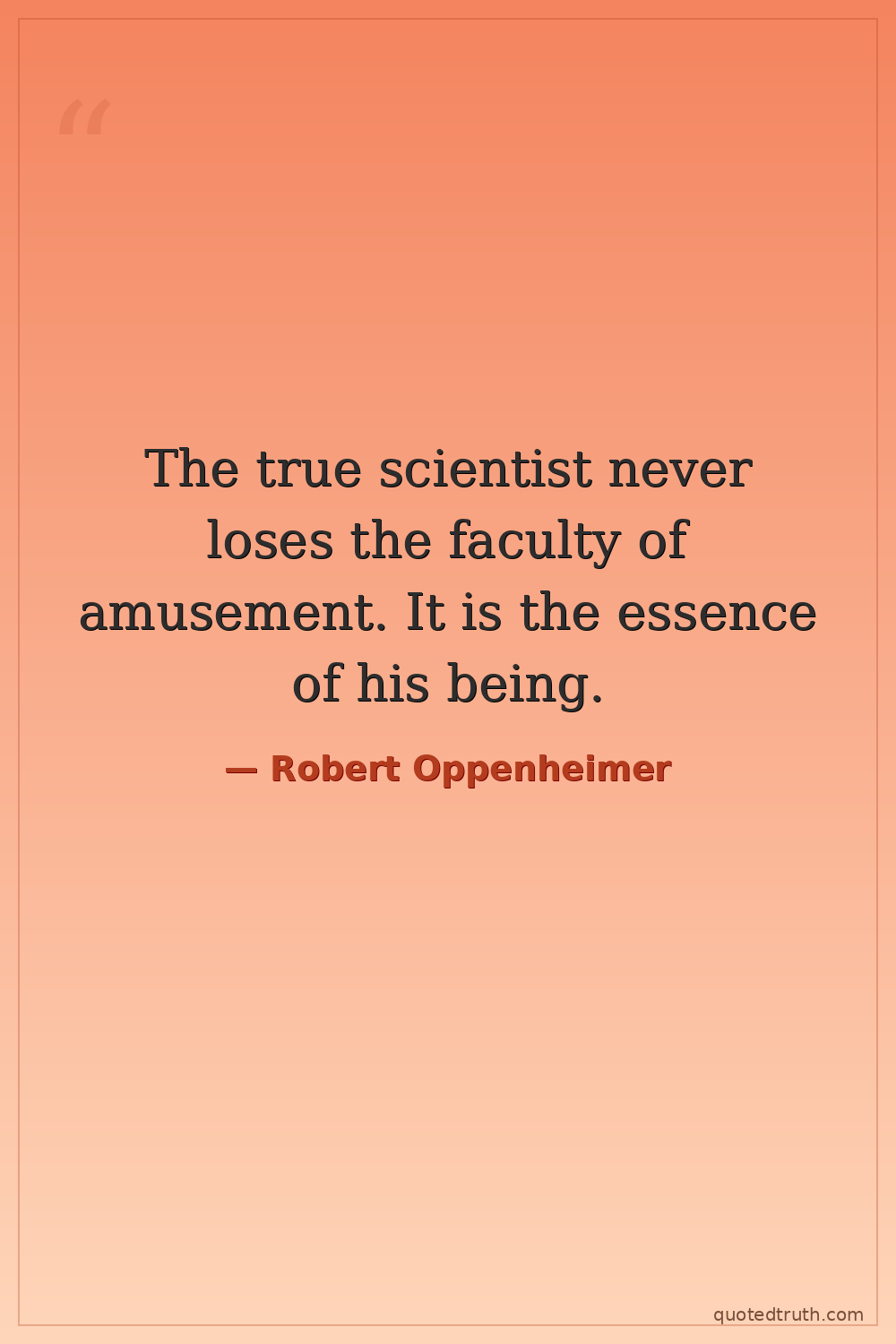
The true scientist never loses the faculty of amusement. It is the essence of his being.
The true scientist never loses the faculty of amusement. It is the essence of his being.
Click any product to generate a realistic preview. Up to 3 at a time.
* Initial load can take up to 90 seconds — revising the preview in another color is nearly instant.
"I had had a continuing smoldering fury about the treatment of Jews in Germany."
"The atomic bomb is a terrible weapon. But it is also a symbol of hope."
"The experience of one's own country and of other countries, the experience of men and women, of cities and of the earth, is an experience which can only be had in freedom."
"The atomic bomb is a symbol of man's mastery over nature, but also of his potential for self-destruction."
"The atomic bomb made the prospect of future war unendurable. It has led us up to the top of the mountain. We can see the promised land, but how to get there we do not know."
American theoretical physicist who directed the Manhattan Project's Los Alamos Laboratory and oversaw the atomic bombs; lost his security clearance in 1954. Closely associated with Niels Bohr (Manhattan Project consultant and atomic-policy advisor) and Hans Bethe (Los Alamos theoretical-division chief). For an intellectual contrast, see Edward Teller, Hungarian-American physicist and 'father of the H-bomb' — Teller pushed the H-bomb against Oppenheimer's objections and testified against him at his 1954 security hearing — the precise moment that ended Oppenheimer's career. The canonical 'physicist-of-conscience vs physicist-of-state' pairing in nuclear-age ethics; Christopher Nolan's Oppenheimer (2023) dramatized this rivalry for a mass audience.
Found in 1 providers: gemini
1 source checked
Genuine scientists never lose their childlike sense of wonder — the ability to be surprised, delighted, and fascinated by how the world works. This isn't about humor but intellectual playfulness: staying curious, finding joy in unexpected discoveries, and approaching problems with openness rather than rigid certainty. That capacity for amusement — being genuinely tickled by nature's mysteries — isn't a luxury for scientists; it's the core drive that keeps inquiry alive.
Oppenheimer embodied intellectual amusement across remarkable breadth — he learned Sanskrit to read the Bhagavad Gita in its original language, studied philosophy, and quoted 'Now I am become Death' at Trinity's first atomic detonation. At Los Alamos, he fostered a culture where curious minds thrived. His early physics career was driven by genuine wonder at quantum mechanics. Yet the bomb's destruction ultimately extinguished that amusement, leaving him wrestling with moral responsibility for the rest of his life.
Oppenheimer came of age during physics' most thrilling era — the 1920s quantum revolution, when Bohr, Heisenberg, and Dirac were overturning classical certainty with discoveries that seemed almost miraculous. Scientists genuinely felt the wonder of a world revealed anew. But by the 1940s, the Manhattan Project weaponized that wonder at catastrophic scale. The postwar Cold War transformed science into a national-security instrument, reducing amusement to utility and eventually stripping Oppenheimer himself of his security clearance in 1954.
AI-generated insights based on extensive research and information for context. Factual errors? Email [email protected].
Your cart is empty