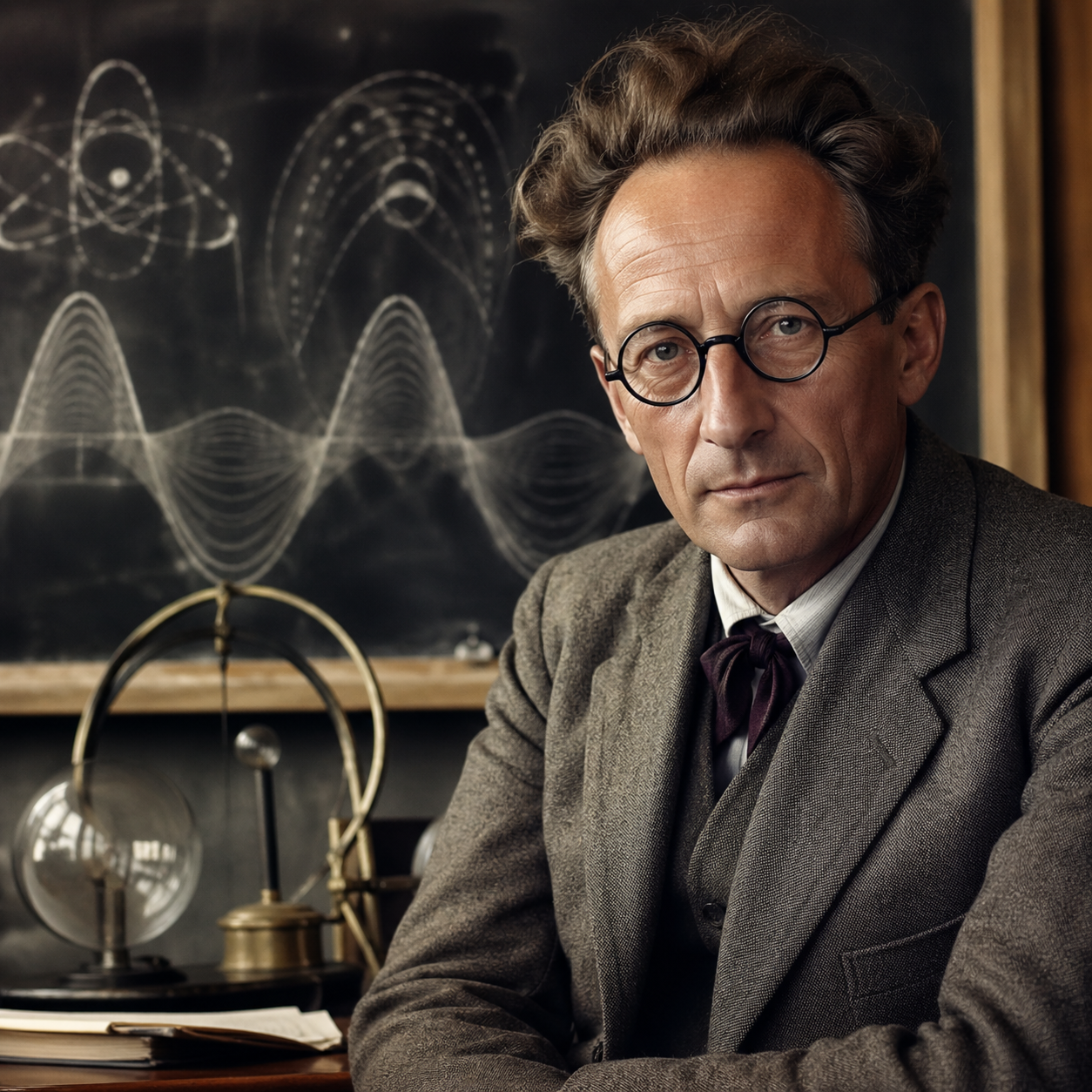
Erwin Schrodinger — "The true sign of intelligence is not knowledge but imagination."
The true sign of intelligence is not knowledge but imagination.
The true sign of intelligence is not knowledge but imagination.
Click any product to generate a realistic preview. Up to 3 at a time.
* Initial load can take up to 90 seconds — revising the preview in another color is nearly instant.
"What we observe as material bodies and forces are nothing but shapes and variations in the structure of space. Particles are just schaumkommen (appearances)!"
"The most amazing thing about the world is that it is comprehensible."
"The greatest discovery of all time is the discovery that we can discover."
"Needless to say, taken literally, this is just as absurd. For an adult organism the energy content is as stationary as the material content. Since, surely, any calorie is worth as much as any other ca…"
"The world is given to me only once, not one existing and one perceived. Subject and object are only one. The barrier between them cannot be said to have broken down as a result of recent experience in…"
Austrian physicist who shared the 1933 Nobel for the wave equation that bears his name and the famous cat thought-experiment. Closely associated with Werner Heisenberg (matrix-mechanics rival who reached the same physics by different math) and Albert Einstein (his pen-pal on quantum interpretation). For an intellectual contrast, see Niels Bohr, Danish physicist and architect of the Copenhagen interpretation — Schrödinger's cat thought-experiment was specifically designed to ridicule Bohr's 'observer-dependent reality' reading of quantum mechanics — Schrödinger thought the Copenhagen interpretation was absurd; the cat was meant as reductio ad absurdum.
Found in 1 providers: grok
1 source checked
True intelligence isn't about storing facts or mastering existing knowledge — it's about conceiving what doesn't yet exist. Imagination allows minds to form hypotheses, spot unexpected connections, and build new frameworks from scratch. A person stuffed with information but unable to think beyond it remains intellectually limited. Real insight requires the capacity to envision possibilities that lie beyond what can be directly observed, measured, or handed down.
Schrödinger's wave mechanics equation (1926) required radical imagination — picturing electrons not as particles but as probability waves smeared across space. His Cat thought experiment imagined quantum superposition at macroscopic scale, a deeply creative leap. His 1944 book What Is Life? imaginatively imported physics into biology, directly inspiring Watson and Crick's DNA discovery. His career demonstrates that breakthrough science demands the ability to picture what no instrument can yet show.
Schrödinger worked through the 1920s–1940s, when classical physics was being dismantled by quantum theory and relativity. The interwar period demanded extraordinary imaginative leaps — nature at atomic scales defied all intuition. Simultaneously, Europe's intellectual culture was fracturing under fascism; Schrödinger fled Nazi Germany in 1933. In an era where established knowledge systems were collapsing politically and scientifically, the premium on imagination over inherited knowledge felt urgent and personally lived.
AI-generated insights based on extensive research and information for context. Factual errors? Email [email protected].
Your cart is empty