Martin Luther — "The true treasure of the church is the most holy gospel of the glory and grace o…"
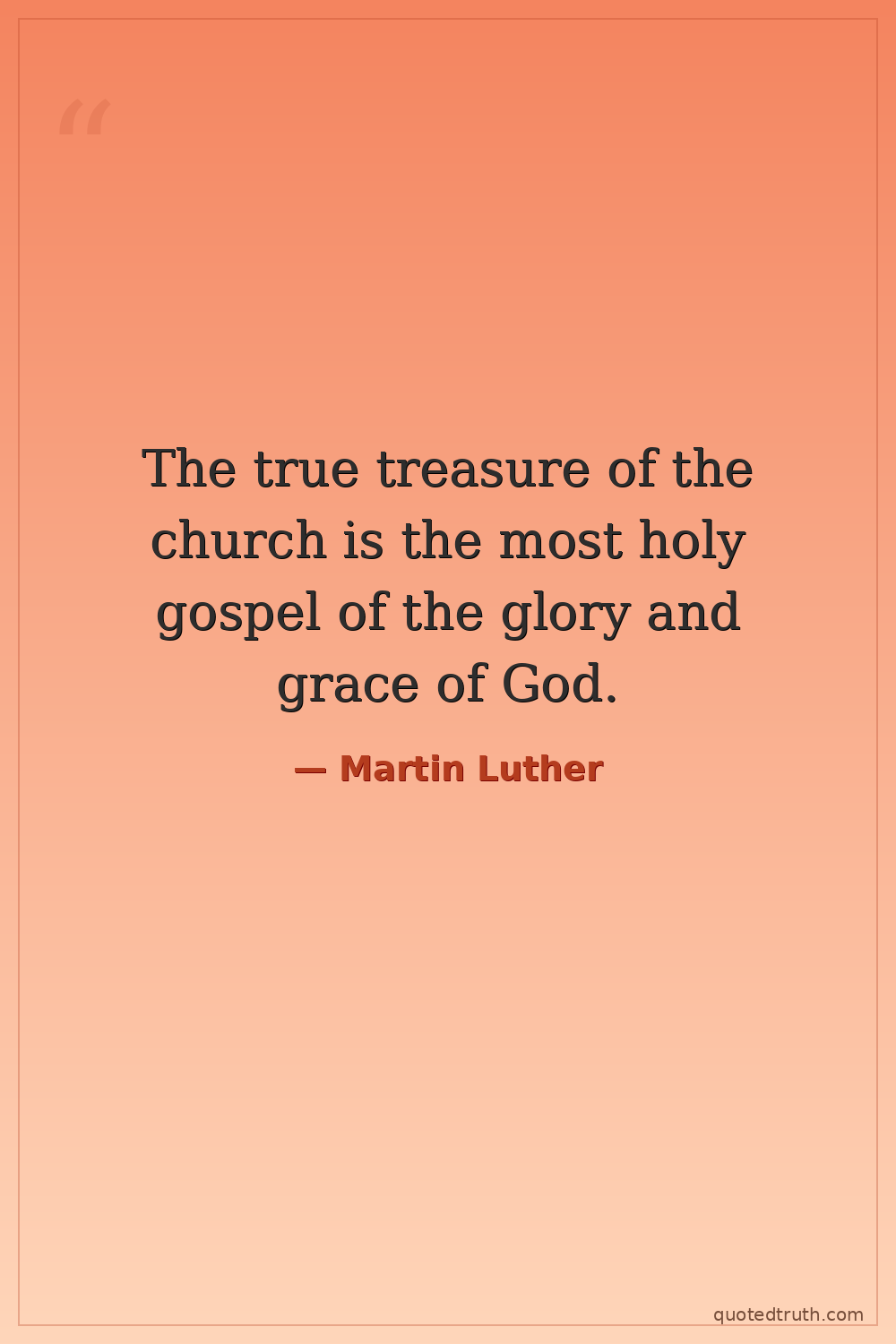
The true treasure of the church is the most holy gospel of the glory and grace of God.
The true treasure of the church is the most holy gospel of the glory and grace of God.
Click any product to generate a realistic preview. Up to 3 at a time.
* Initial load can take up to 90 seconds — revising the preview in another color is nearly instant.
"The dog is the most faithful of animals and would be much esteemed were it not so common. Our Lord God has made His greatest gifts the commonest."
"Reason is the Devil's greatest whore; by nature and manner of being she is a noxious whore; she is a prostitute, the Devil's appointed whore; whore eaten by scab and leprosy who should be trodden unde…"
"Nor let ministers cease studying until they have discovered and are sure that they have taught the devil to death and have become more learned than God himself and all His saints."
"If you are a preacher of grace, then preach a true and not a fictitious grace; if grace is true, you must bear a true and not a fictitious sin."
"If we do [tolerate their conduct], we become sharers in their lies, cursing and blasphemy. Thus we cannot extinguish the unquenchable fire of divine wrath, of which the prophets speak, nor can we conv…"
German theologian whose 95 Theses (1517) launched the Protestant Reformation and broke the Catholic Church's monopoly on Western Christianity. Closely associated with Philipp Melanchthon (Lutheran systematizer) and John Calvin (later Reformer who built on Luther's break). For an intellectual contrast, see Pope Leo X, Renaissance pope (1513-1521) — Leo X's indulgence sales triggered Luther's break and Leo excommunicated him in 1521 — Luther's entire Reformation is structured as a direct answer to the indulgence-funded Vatican Leo represented.
Found in 1 providers: grok
1 source checked
The greatest wealth the church possesses is not gold, relics, or institutional power, but the good news about God's mercy and unearned favor toward humanity. Everything else the church might claim as valuable pales beside the message itself. What actually matters, and what the church should be guarding and sharing, is this announcement of divine grace, not the material holdings or spiritual transactions it accumulates over centuries.
Luther wrote this as Thesis 62 of his Ninety-Five Theses, directly attacking the indulgence trade that treated forgiveness as a purchasable commodity funding St. Peter's Basilica. A German monk and theology professor at Wittenberg, he staked his career and eventually his safety on the conviction that Scripture and grace, not papal treasury or saintly merit, defined Christian faith. This single sentence encapsulates his entire reform program.
In 1517, the Catholic Church dominated Western Europe spiritually and financially, selling indulgences to fund Rome's building projects while peasants paid for supposed relief from purgatory. The printing press had just made mass distribution of texts possible. Luther's theses spread across Germany within weeks, igniting the Protestant Reformation, splitting Christendom, fueling peasant revolts, and reshaping European politics, literacy, and vernacular religion for centuries afterward.
AI-generated insights based on extensive research and information for context. Factual errors? Email [email protected].
Your cart is empty