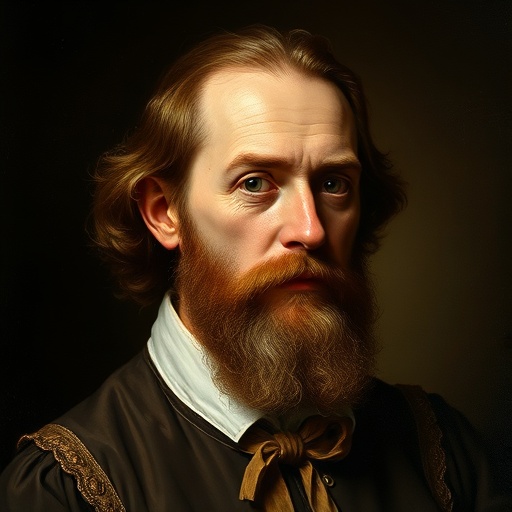
William Harvey — "The truth is always simple, but the way to it is complex."
The truth is always simple, but the way to it is complex.
The truth is always simple, but the way to it is complex.
Click any product to generate a realistic preview. Up to 3 at a time.
* Initial load can take up to 90 seconds — revising the preview in another color is nearly instant.
"I have often wondered and even laughed at those who fancied that everything had been so consummately and absolutely investigated by an Aristotle or a Galen or some other mighty name, that nothing coul…"
"The body is a machine, but it is a divine machine."
"The study of nature is the study of God."
"The study of anatomy is the study of God's handiwork."
"The semen is the efficient cause and the egg the material cause of generation."
English physician whose On the Motion of the Heart and Blood in Animals (1628) demonstrated blood circulation, overturning 1,400 years of Galenic medicine. Closely associated with Francis Bacon (his contemporary in the new English empiricism). For an intellectual contrast, see Galenic medicine, the 2nd-century Greek medical tradition (humors, blood-as-consumed-fuel) — Harvey calculated that the heart pumps more blood per hour than the body could possibly produce as fuel — a single quantitative observation that demolished the entire Galenic-Aristotelian medical worldview. The cleanest example in medical history of arithmetic disproving 14 centuries of authority.
A philosophical observation on the nature of truth and scientific inquiry.
Date: Uncertain (attributed)
WisdomFound in 1 providers: gemini
1 source checked
Truth itself, once found, appears obvious and elegant — but discovering it demands years of painstaking work, failed attempts, and methodical inquiry. The path to understanding is rarely straightforward. Simple conclusions emerge only after navigating layers of complexity, contradiction, and careful observation. What seems self-evident in hindsight required extraordinary effort to uncover in the first place.
Harvey spent decades dissecting animals and observing cardiac function before announcing in 1628 that blood circulates continuously through the body. His conclusion — that the heart pumps blood in a closed loop — was strikingly simple, yet required overturning 1,400 years of Galenic doctrine. He endured ridicule from contemporaries who clung to the old humoral model, embodying this exact tension between simple truth and complex discovery.
The early modern period was defined by the Scientific Revolution's collision with entrenched scholastic authority. Figures like Vesalius, Copernicus, and Galileo were demonstrating that ancient Greek frameworks were wrong, but institutional resistance was fierce. Harvey worked when empirical observation was just beginning to supplant dogma. Stating a simple truth contradicting Galen meant risking professional ruin, making the 'complex way' both intellectual and social.
AI-generated insights based on extensive research and information for context. Factual errors? Email [email protected].
Your cart is empty