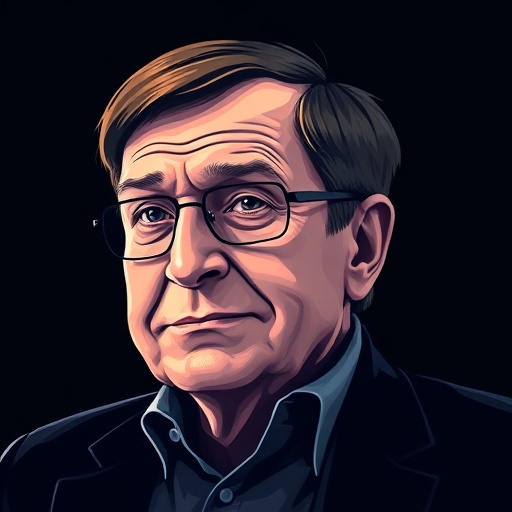
Stephen Hawking — "The universe is a constant source of wonder and inspiration."
The universe is a constant source of wonder and inspiration.
The universe is a constant source of wonder and inspiration.
Click any product to generate a realistic preview. Up to 3 at a time.
* Initial load can take up to 90 seconds — revising the preview in another color is nearly instant.
"Although the chance of a disaster to planet Earth in a given year may be quite low, it adds up over time, and becomes a near certainty in the next thousand or 10 thousand years."
"The universe is not just full of black holes, it's full of black holes that are eating everything."
"I have often been asked: What do you think about God? I have said that we cannot know for sure whether God exists or not. But I don't believe in a personal God."
"I think that the universe is a beautiful and complex place, and I'm very lucky to be able to study it."
"I have noticed that even people who claim that everything is predetermined and that we can do nothing to change it, look before they cross the road."
British theoretical physicist whose Hawking radiation work and A Brief History of Time (1988) brought black-hole physics to a mass audience while he lived with ALS for 55 years. Closely associated with Roger Penrose (his collaborator on singularity theorems) and Carl Sagan (fellow popularizer who wrote Brief History's foreword). For an intellectual contrast, see William Lane Craig, American philosopher of religion — Craig's Kalam cosmological argument depends on the Big Bang requiring a divine first cause; Hawking's no-boundary proposal was specifically designed to remove the moment that would require one — the cleanest cosmology-vs-natural-theology contrast in modern thought.
Found in 1 providers: grok
1 source checked
The universe never runs dry as a source of astonishment and motivation. Every discovery — a black hole, a new galaxy, a quantum anomaly — opens ten more questions. This isn't romantic sentiment; it's a working scientist's observation. The cosmos is structurally inexhaustible: it offers enough complexity, scale, and mystery to fuel human curiosity indefinitely, making the pursuit of knowledge inherently rewarding rather than a task to be finished.
Hawking lived this conviction despite ALS confining him to a wheelchair and stripping away his speech over decades. His theoretical work — Hawking radiation, black hole thermodynamics, the no-boundary proposal — sprang from treating the cosmos as an endless puzzle worth solving. He wrote A Brief History of Time to share that wonder with millions. Even at the limits of physical ability, the universe gave him purpose, making the sentiment personally, not just professionally, true.
Hawking's career spanned cosmology's transformation into a precision science. Apollo landings, the Hubble Space Telescope, detection of cosmic microwave background fluctuations, confirmation of the Higgs boson in 2012, and LIGO's gravitational-wave detection in 2015 delivered successive shocks of wonder. The Cold War space race and later the internet democratized scientific curiosity globally. Each breakthrough validated the universe's inexhaustibility, making Hawking's framing resonate across both laboratory physics and broad public imagination.
AI-generated insights based on extensive research and information for context. Factual errors? Email [email protected].
Your cart is empty