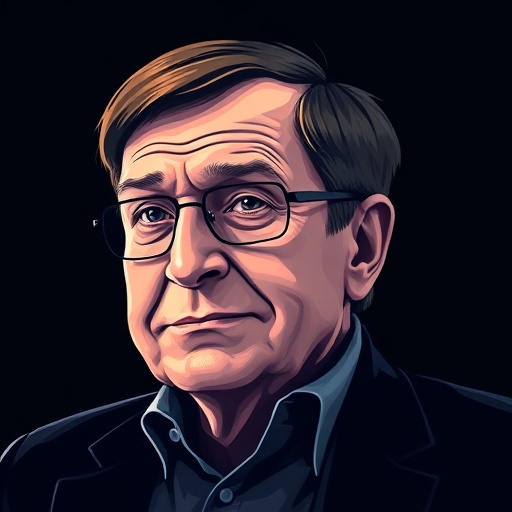
Stephen Hawking — "The universe is a giant computer, and we are all just programs running on it."
The universe is a giant computer, and we are all just programs running on it.
The universe is a giant computer, and we are all just programs running on it.
Click any product to generate a realistic preview. Up to 3 at a time.
* Initial load can take up to 90 seconds — revising the preview in another color is nearly instant.
"There are no boundaries to human endeavor. We are all different. However bad life may seem, there is always something you can do and succeed at. While there's life, there is hope."
"The universe is a pretty big place. If it's just us, seems like an awful waste of space."
"The universe is not only stranger than we imagine, it is stranger than we can imagine."
"There are no black holes in the sense of a region of spacetime from which nothing can escape. Instead, there are apparent horizons which persist for a time and then vanish."
"The whole history of science has been the gradual realization that events do not happen in an arbitrary manner, but that they reflect an underlying order, which may or may not be divinely inspired."
British theoretical physicist whose Hawking radiation work and A Brief History of Time (1988) brought black-hole physics to a mass audience while he lived with ALS for 55 years. Closely associated with Roger Penrose (his collaborator on singularity theorems) and Carl Sagan (fellow popularizer who wrote Brief History's foreword). For an intellectual contrast, see William Lane Craig, American philosopher of religion — Craig's Kalam cosmological argument depends on the Big Bang requiring a divine first cause; Hawking's no-boundary proposal was specifically designed to remove the moment that would require one — the cleanest cosmology-vs-natural-theology contrast in modern thought.
Likely from a public lecture or interview, expressing a computational view of the universe.
Date: Approx. 2000s
GeneralFound in 1 providers: grok
1 source checked
The universe operates like an enormous information-processing machine governed by mathematical rules analogous to code. Humans and all life are patterns of data executing within this system — complex, emergent algorithms rather than independent souls. Physical reality reduces to computation; matter, energy, and space are expressions of underlying logical operations. The idea collapses the boundary between physics and computer science, suggesting consciousness itself is a kind of software running on cosmic hardware.
Hawking's career translated cosmic phenomena into pure mathematics — his black hole radiation equations treated information as physically fundamental, not just metaphorically. Diagnosed with ALS at 21, he existed increasingly as mind over deteriorating body, communicating through synthesized speech machines, making the mind-as-software metaphor personally resonant. His book The Grand Design argued the universe self-creates from physical law alone — a deterministic, godless computation fully consistent with this worldview.
During Hawking's active career spanning the 1960s through 2010s, computing transformed from room-sized machines to pocket supercomputers. John Wheeler coined 'it from bit' in 1989, arguing information underlies physical reality. Edward Fredkin championed digital physics simultaneously. The simulation hypothesis gained mainstream traction through philosophers like Nick Bostrom. Quantum computing emerged, suggesting even quantum mechanics has computational structure. These converging threads made the universe-as-computer metaphor scientifically credible rather than merely poetic.
AI-generated insights based on extensive research and information for context. Factual errors? Email [email protected].
Your cart is empty