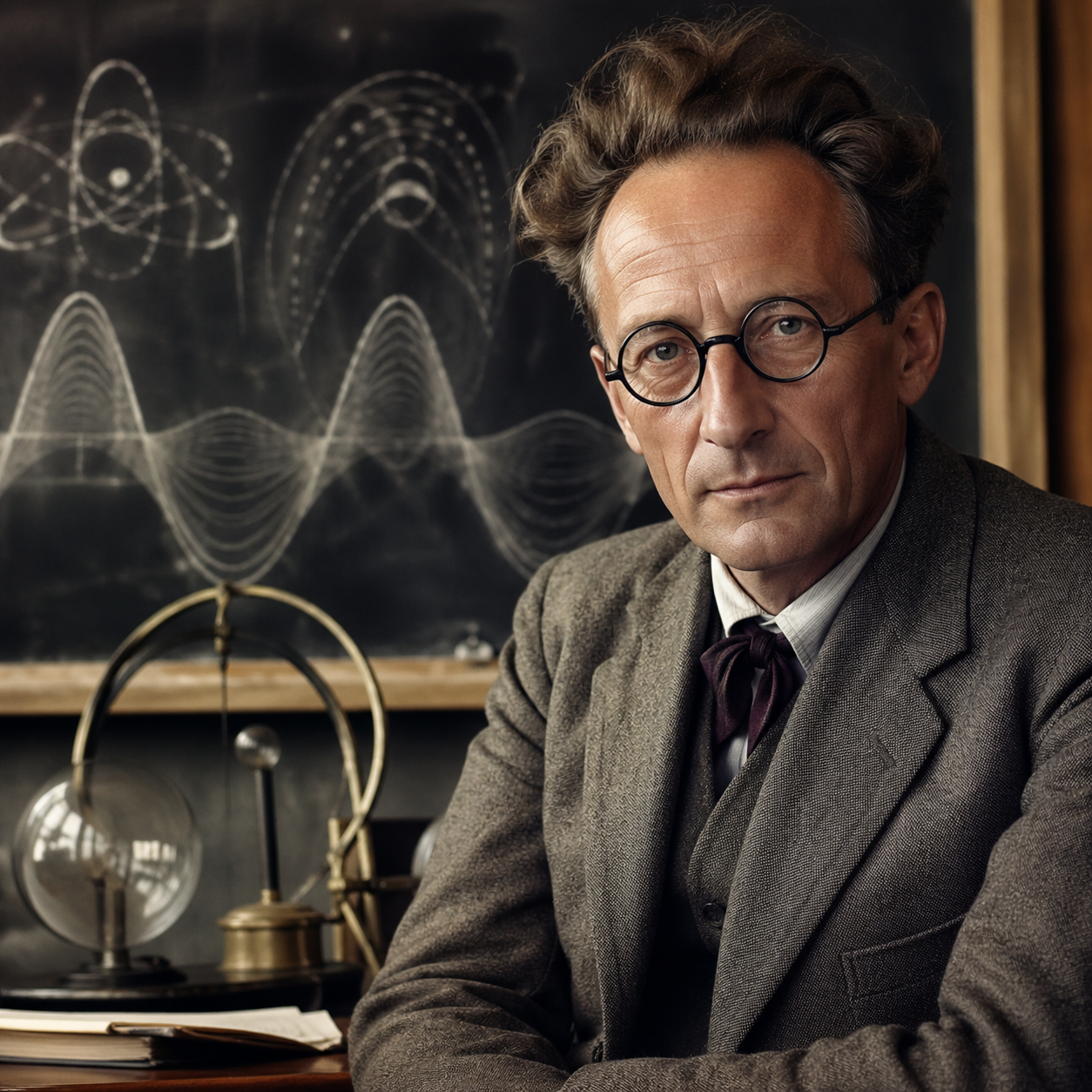
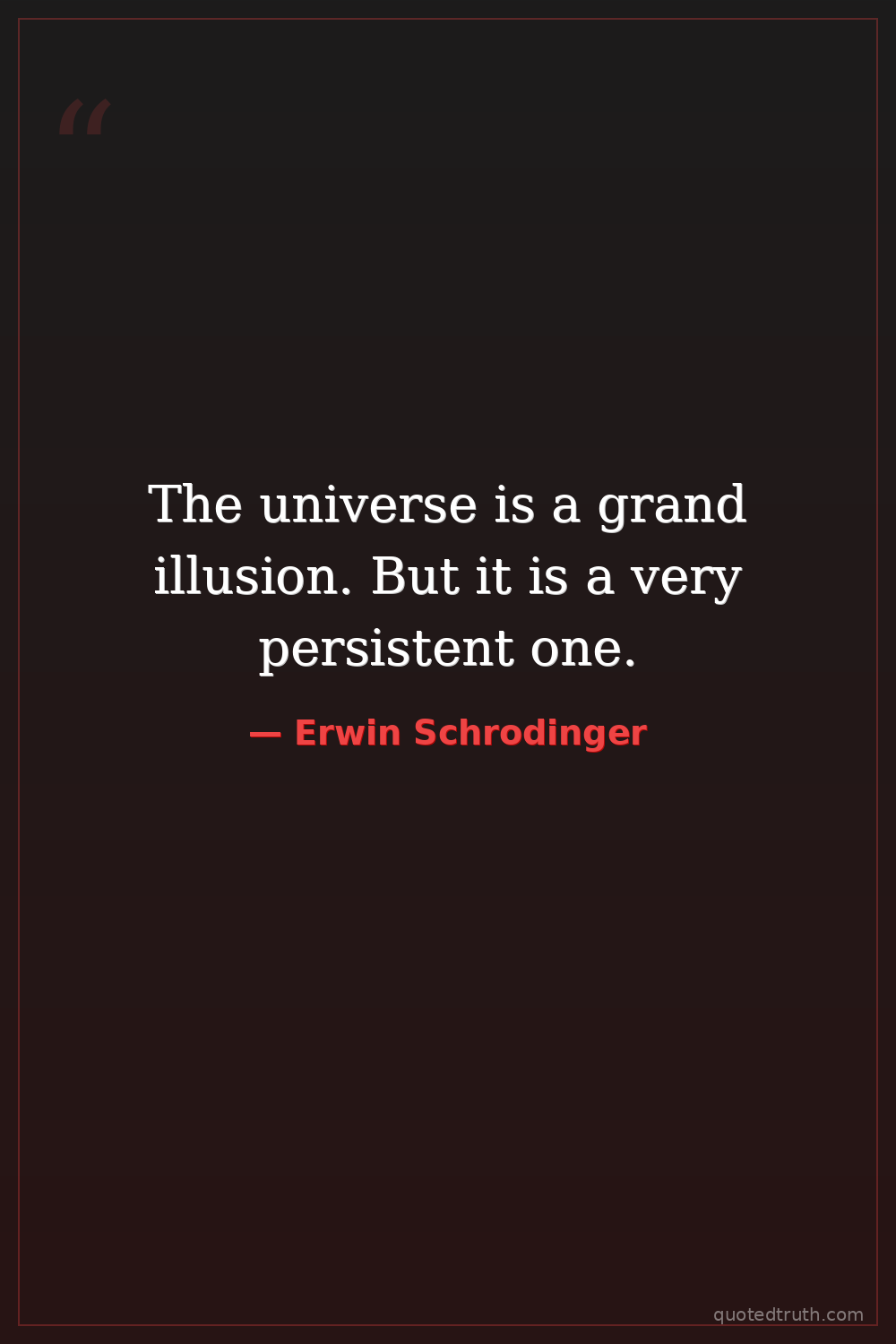
Erwin Schrodinger — "The universe is a grand illusion. But it is a very persistent one."
The universe is a grand illusion. But it is a very persistent one.
The universe is a grand illusion. But it is a very persistent one.
Click any product to generate a realistic preview. Up to 3 at a time.
* Initial load can take up to 90 seconds — revising the preview in another color is nearly instant.
"Logic will get you from A to B. Imagination will take you everywhere."
"The most amazing thing about the world is that it is comprehensible."
"The fundamental laws of physics are statistical. They do not determine precisely what will happen, but only the probability of what will happen."
"Needless to say, taken literally, this is just as absurd. For an adult organism the energy content is as stationary as the material content. Since, surely, any calorie is worth as much as any other ca…"
"The human mind is not capable of grasping the universe. We are like a little child entering a huge library. The walls are covered to the ceilings with books in many different tongues. The child knows …"
Austrian physicist who shared the 1933 Nobel for the wave equation that bears his name and the famous cat thought-experiment. Closely associated with Werner Heisenberg (matrix-mechanics rival who reached the same physics by different math) and Albert Einstein (his pen-pal on quantum interpretation). For an intellectual contrast, see Niels Bohr, Danish physicist and architect of the Copenhagen interpretation — Schrödinger's cat thought-experiment was specifically designed to ridicule Bohr's 'observer-dependent reality' reading of quantum mechanics — Schrödinger thought the Copenhagen interpretation was absurd; the cat was meant as reductio ad absurdum.
Found in 1 providers: grok
1 source checked
What we call 'the universe' — solid, tangible, ruled by cause and effect — is actually a constructed experience, not ultimate truth. Yet this illusion doesn't flicker or fade; it operates with machine-like reliability. The point isn't nihilism but humility: reality as humans perceive it may be a convincing story the cosmos tells itself, coherent enough to build cities on, yet fundamentally not the deepest layer of what exists.
Schrödinger's 1926 wave equation revealed that particles don't have fixed positions — they exist as probability waves, becoming 'real' only upon measurement. His cat thought experiment exposed the absurdity of quantum superposition colliding with classical perception. Beyond physics, he studied Vedantic philosophy deeply, which teaches that perceived reality (maya) is illusion. The quote directly echoes both his scientific findings and his lifelong conviction that consciousness, not matter, underlies existence.
The 1920s quantum revolution dismantled Newtonian certainty. Heisenberg proved position and momentum can't both be known simultaneously; Bohr's Copenhagen interpretation said particles have no definite state before observation; Einstein's relativity had already bent space and time. Western science was colliding with Eastern ideas about maya and consciousness. The era forced physicists to ask whether reality was observer-dependent — a question Schrödinger took seriously in both equations and philosophy.
AI-generated insights based on extensive research and information for context. Factual errors? Email [email protected].
Your cart is empty