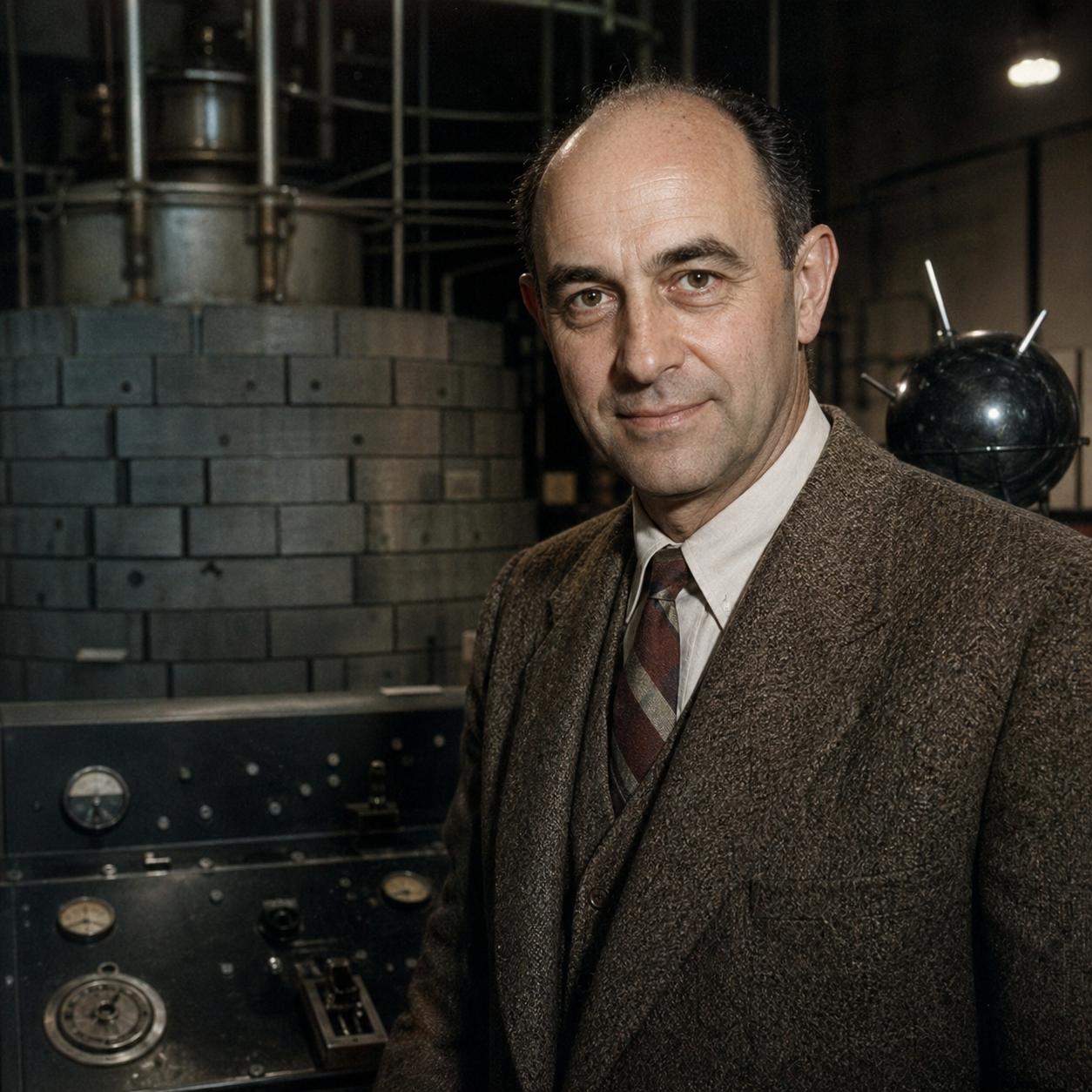
Enrico Fermi — "The universe is a strange and wonderful place, and we are only beginning to unde…"
The universe is a strange and wonderful place, and we are only beginning to understand it.
The universe is a strange and wonderful place, and we are only beginning to understand it.
Click any product to generate a realistic preview. Up to 3 at a time.
* Initial load can take up to 90 seconds — revising the preview in another color is nearly instant.
"The atomic bomb is a testament to the power of human intellect, but it is also a warning about the dangers of human folly."
"The pursuit of knowledge is an endless journey."
"One might be led to question whether the scientists acted wisely in presenting the statesmen of the world with this appalling problem. Actually there was no choice. Once basic knowledge is acquired, a…"
"The atomic age has brought with it great challenges, but also great opportunities."
"I am not an optimist. I am a realist. I believe that we must be prepared for the worst, and hope for the best."
Found in 1 providers: grok
1 source checked
Reality consistently outruns human understanding. Every major scientific breakthrough reveals deeper layers of complexity, opening more questions than it closes. The universe operates by rules that are counterintuitive—quantum particles behave differently when observed, space curves, time dilates. Scientific progress is not a march toward complete knowledge but an ongoing confrontation with how much remains unknown. Genuine discovery requires accepting that current models are always provisional, always incomplete.
Fermi embodied productive wonder. He built Chicago Pile-1 in 1942—the first self-sustaining nuclear chain reaction—and worked on the Manhattan Project, directly confronting how strange matter behaves at atomic scales. His famous Fermi Paradox asked why, given a universe full of stars, we detect no other civilizations—pure intellectual honesty about a universe that doesn't match expectations. His Fermi estimation method taught physicists to reason under deep uncertainty rather than pretend certainty exists.
Fermi worked during physics' most disorienting century. Quantum mechanics overturned classical intuitions in the 1920s and 1930s—matter was wave and particle simultaneously, observation changed outcomes. Nuclear fission's discovery in 1938 showed atoms could unleash civilization-scale energy. The Manhattan Project and Hiroshima demonstrated this, making the universe's strangeness politically urgent. By the early Cold War, when nuclear weapons proliferated, ordinary people grasped that nature operated on principles that were both incomprehensible and apocalyptically consequential.
AI-generated insights based on extensive research and information for context. Factual errors? Email [email protected].
Your cart is empty