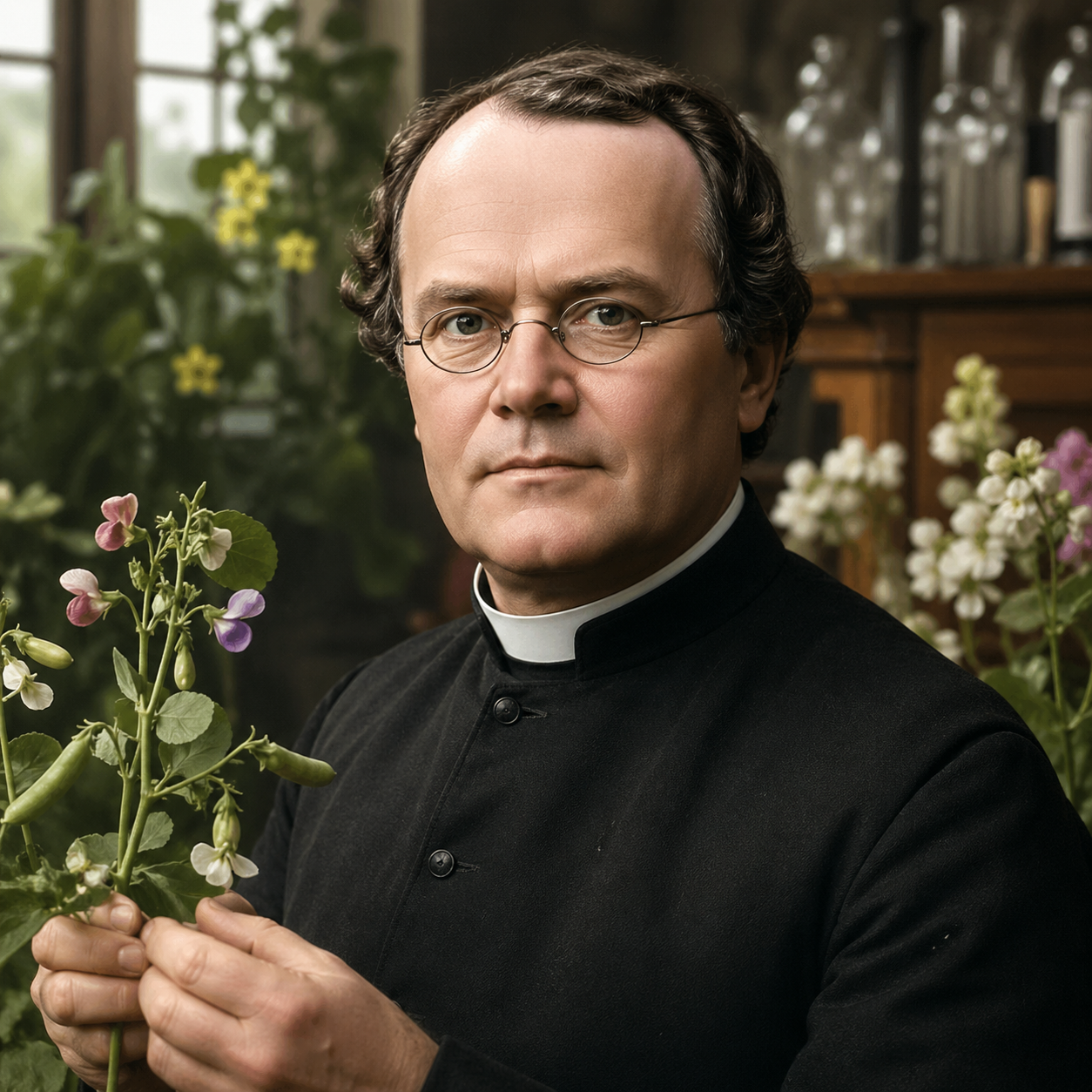
Gregor Mendel — "The value and utility of any experiment are determined by the fitness of the mat…"
The value and utility of any experiment are determined by the fitness of the material to the purpose for which it is used.
The value and utility of any experiment are determined by the fitness of the material to the purpose for which it is used.
Click any product to generate a realistic preview. Up to 3 at a time.
* Initial load can take up to 90 seconds — revising the preview in another color is nearly instant.
"You should regard the numerical expressions as being only empirical, because they can not be proved rational."
"The garden is my kingdom, and the pea plants are my subjects."
"Whether they will retain the characteristics of the hybrid, or whether they will show variations, will be determined by next year's observations."
"The laws of heredity are as fixed as the stars in the heavens."
"It requires indeed some courage to undertake a labor of such far-reaching extent."
Found in 1 providers: deepseek
1 source checked
How valuable an experiment turns out to be depends entirely on whether you chose the right materials for the job. If your test subjects or substances aren't well-suited to the question you're investigating, no amount of careful methodology rescues the results. Picking the right organism, tool, or substance for a study isn't preliminary work—it's the foundation that determines whether your findings are meaningful or worthless.
Mendel's genius lay partly in his deliberate selection of pea plants for heredity experiments. Pisum sativum offered seven clearly distinguishable traits, rapid generations, and controlled cross-pollination—ideal experimental material. He tested multiple species before committing to peas. This quote encapsulates his scientific philosophy: his monk's patience and meticulous nature meant he understood that choosing the right organism wasn't preparation for the experiment—it was the experiment's most critical decision.
Mendel published his breakthrough in 1866, just seven years after Darwin's Origin of Species upended biology. Science was transitioning from descriptive natural philosophy to systematic experimentation, but rigorous experimental design remained uncommon. Most naturalists collected specimens and observed; few ran controlled, statistically analyzed trials. Mendel's insistence on material fitness reflected Enlightenment empiricism meeting industrial-era precision—an approach so ahead of its time that peers couldn't grasp its significance until 1900.
AI-generated insights based on extensive research and information for context. Factual errors? Email [email protected].
Your cart is empty