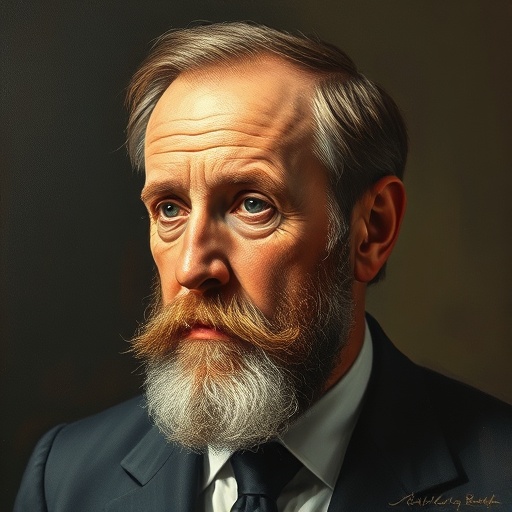
Niels Bohr — "The very act of observing changes the observed."
The very act of observing changes the observed.
The very act of observing changes the observed.
Click any product to generate a realistic preview. Up to 3 at a time.
* Initial load can take up to 90 seconds — revising the preview in another color is nearly instant.
"Accuracy and clarity of expression are a matter of degree."
"The world is full of wonders, and science is the key to unlocking them."
"The opposite of a shallow truth is a falsehood. The opposite of a profound truth may well be another profound truth."
"If quantum mechanics hasn't profoundly shocked you, you haven't understood it yet."
"Physics is not about how the world is, it is about what we can say about the world."
Principle of complementarity, a core idea of his interpretation of quantum mechanics.
Date: 1927
ShockingFound in 1 providers: grok
1 source checked
When you measure or watch something, your observation itself disturbs it. You cannot be a neutral bystander because the tools and processes used to detect reality inevitably interact with what you are trying to see. Perfect objectivity is impossible at a fundamental level. What you learn about a system is shaped by how you chose to look at it, meaning the observer and the observed are linked.
Bohr built the quantum framework where this idea is literal physics, not metaphor. His complementarity principle argued that electrons behave as waves or particles depending on the experiment chosen. He famously debated Einstein, defending the view that measurement collapses possibilities into outcomes. As architect of the atomic model and the Copenhagen interpretation, Bohr spent his career insisting that subatomic reality cannot be separated from the act of probing it.
In the early 20th century, classical Newtonian certainty was collapsing. Heisenberg published the uncertainty principle in 1927, the same year Bohr formalized complementarity at the Como conference. Two world wars framed the era, and Bohr fled Nazi-occupied Denmark in 1943, later working briefly on the Manhattan Project. Physics was transforming philosophy itself, forcing scientists and the public to accept that reality at its smallest scales behaves probabilistically rather than deterministically.
AI-generated insights based on extensive research and information for context. Factual errors? Email [email protected].
Your cart is empty