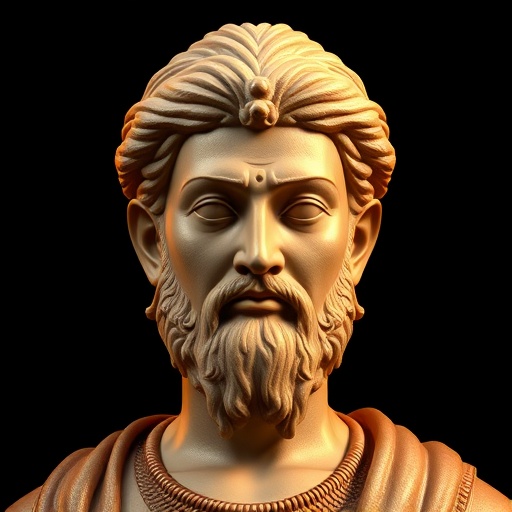
Mahavira — "The virtuous person is never afraid of death."
The virtuous person is never afraid of death.
The virtuous person is never afraid of death.
Click any product to generate a realistic preview. Up to 3 at a time.
* Initial load can take up to 90 seconds — revising the preview in another color is nearly instant.
"One who neglects the supreme art of living, which is self-knowledge, knows nothing of life."
"Happiness and sorrow are the results of one's own actions."
"The soul is permanent and eternal, while the body is temporary and perishable."
"The wise man is he who knows the truth."
"Attachment leads to bondage; detachment leads to liberation."
24th and last Tirthankara of Jainism, whose teachings of strict ahimsa (non-violence), aparigraha (non-attachment), and karma reshaped ancient Indian religion. Closely associated with The Buddha (near-contemporary moral revolutionary, also reacting against Vedic ritualism). For an intellectual contrast, see Vedic Brahmanical ritual sacrifice, the animal-sacrifice-centered Vedic religion of his era — Mahavira's ahimsa demanded total non-violence, including not eating root vegetables that kill the plant — a maximum-distance ethical move from the Vedic priestly tradition that ritually sacrificed cattle and horses. The two cleanest poles of ancient Indian religious ethics.
Found in 1 providers: grok
1 source checked
If you live ethically and cause no harm, death loses its power to frighten you. Someone who has acted with integrity, never violated their conscience, and fulfilled their moral duties has nothing left to regret. This is not bravado—it is the peace that comes from a life well-lived. Virtue creates an inner wholeness that renders fear of death irrelevant; you have already done what matters.
Mahavira renounced his royal upbringing at thirty to pursue twelve years of extreme asceticism, achieving enlightenment and founding Jainism's ethical framework around ahimsa (non-violence), truth, and non-attachment. He ultimately chose sallekhana—voluntary fasting unto death—as his final act, embodying fearless acceptance of mortality. His teaching posits that a soul stripped of karma through virtuous action attains liberation; fear of death signals attachment, the very thing Jain practice eliminates.
Mahavira lived in sixth-century BCE northeastern India during what scholars call the Axial Age, when rigid Vedic ritual orthodoxy was being challenged across the subcontinent. Brahmanical religion managed death anxiety through elaborate sacrifice and priestly mediation. Mahavira and his contemporary the Buddha both rejected this system, teaching that personal ethical conduct—not ritual—determined one's fate after death. Declaring virtue alone sufficient to defeat mortality's fear was genuinely revolutionary.
AI-generated insights based on extensive research and information for context. Factual errors? Email [email protected].
Your cart is empty