Benjamin Franklin — "The way to see faith is to shut our eyes to that which is called reason."
The way to see faith is to shut our eyes to that which is called reason.
The way to see faith is to shut our eyes to that which is called reason.
Click any product to generate a realistic preview. Up to 3 at a time.
* Initial load can take up to 90 seconds — revising the preview in another color is nearly instant.
"Some are weatherwise, some are otherwise."
"In this world nothing is certain but death and taxes."
"Who has deceived thee as often as thyself?"
"It is universally well known, That in digesting our common Food, there is created or produced in the Bowels of human Creatures, a great Quantity of Wind. That the permitting this Air to escape and mix…"
"The greatest pleasure of a dog is that you make a fool of yourself with him and not only will he not scold you, but he will make a fool of himself too."
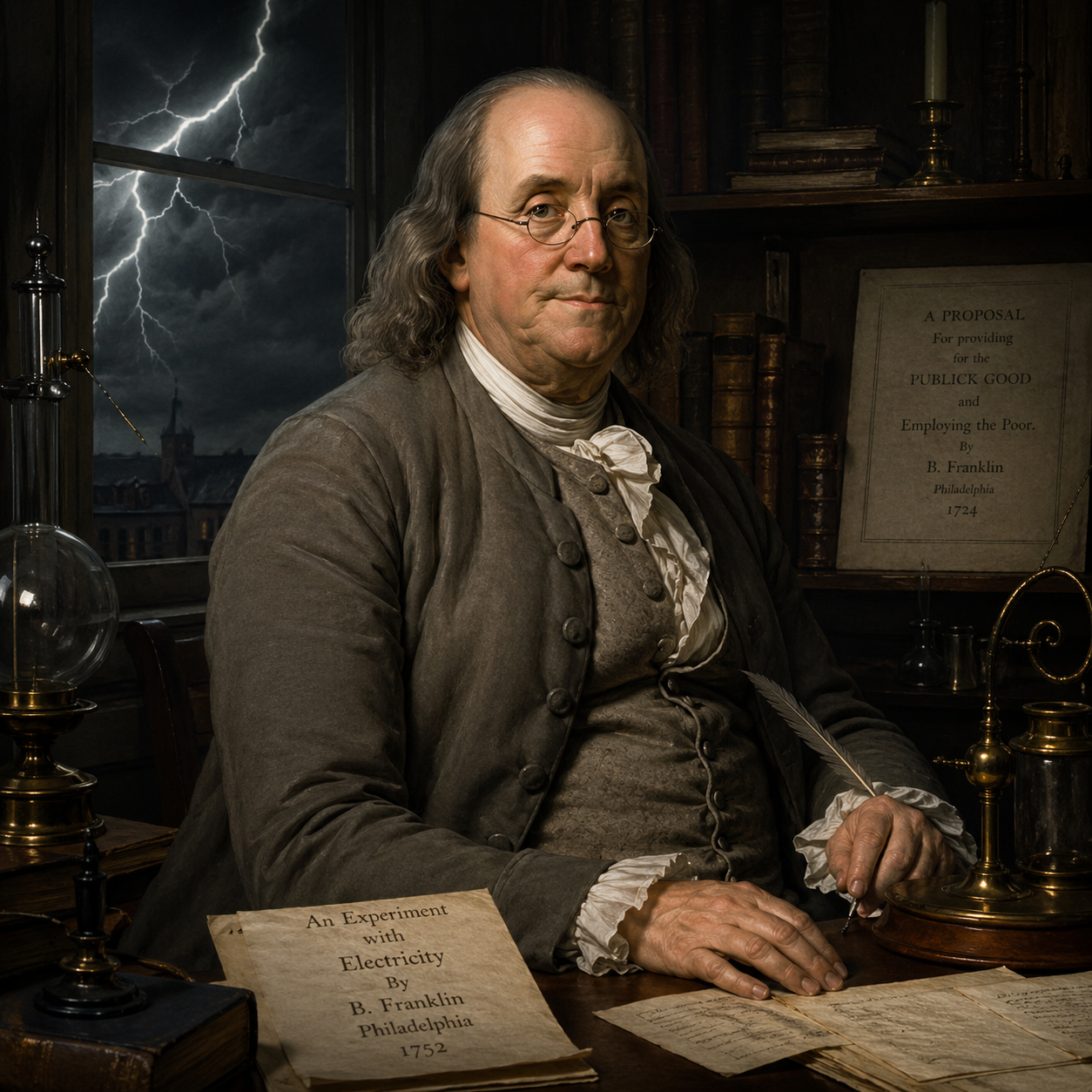
Polymath Founding Father, diplomat, and Poor Richard's Almanack author who helped draft the Declaration of Independence and the Constitution. Closely associated with John Adams (fellow Founder, Massachusetts statesman) and Thomas Jefferson (fellow Declaration drafter). For an intellectual contrast, see Thomas Hutchinson, last royal governor of colonial Massachusetts — Franklin leaked Hutchinson's loyalist correspondence to Boston in 1772 to inflame revolutionary sentiment — Hutchinson represented the colonial-aristocrat crown-loyalty that Franklin's revolution was organized to dismantle.
Found in 1 providers: grok
1 source checked
Faith and reason are fundamentally incompatible — to genuinely believe through faith, one must deliberately set aside logical analysis and the demand for evidence. Spiritual conviction operates on a different plane than empirical observation or rational deduction. True faith requires surrendering the need for proof and embracing trust in something that reason alone cannot verify or confirm.
This quote sits uneasily with Franklin, a man defined by empiricism, scientific experiment, and Enlightenment rationalism. As a Deist, he believed God created the universe but distrusted scripture and religious dogma, preferring observable evidence. The quote likely reflects his philosophical acknowledgment that faith, by its very nature, transcends proof — a detached observation about how belief works, not a personal endorsement of abandoning reason.
Franklin lived during the Enlightenment, when thinkers like Voltaire and Locke elevated reason and science over church authority, and Newtonian physics reframed the universe mechanistically. Yet colonial American society remained deeply religious, and the Great Awakening revivals of the 1730s–40s swept thousands into fervent devotion. This friction between rational inquiry and passionate religious belief was the defining cultural fault line shaping Franklin's world.
AI-generated insights based on extensive research and information for context. Factual errors? Email [email protected].
Your cart is empty