Tim Berners-Lee — "The web is too important to be left in the hands of a few powerful companies. We…"
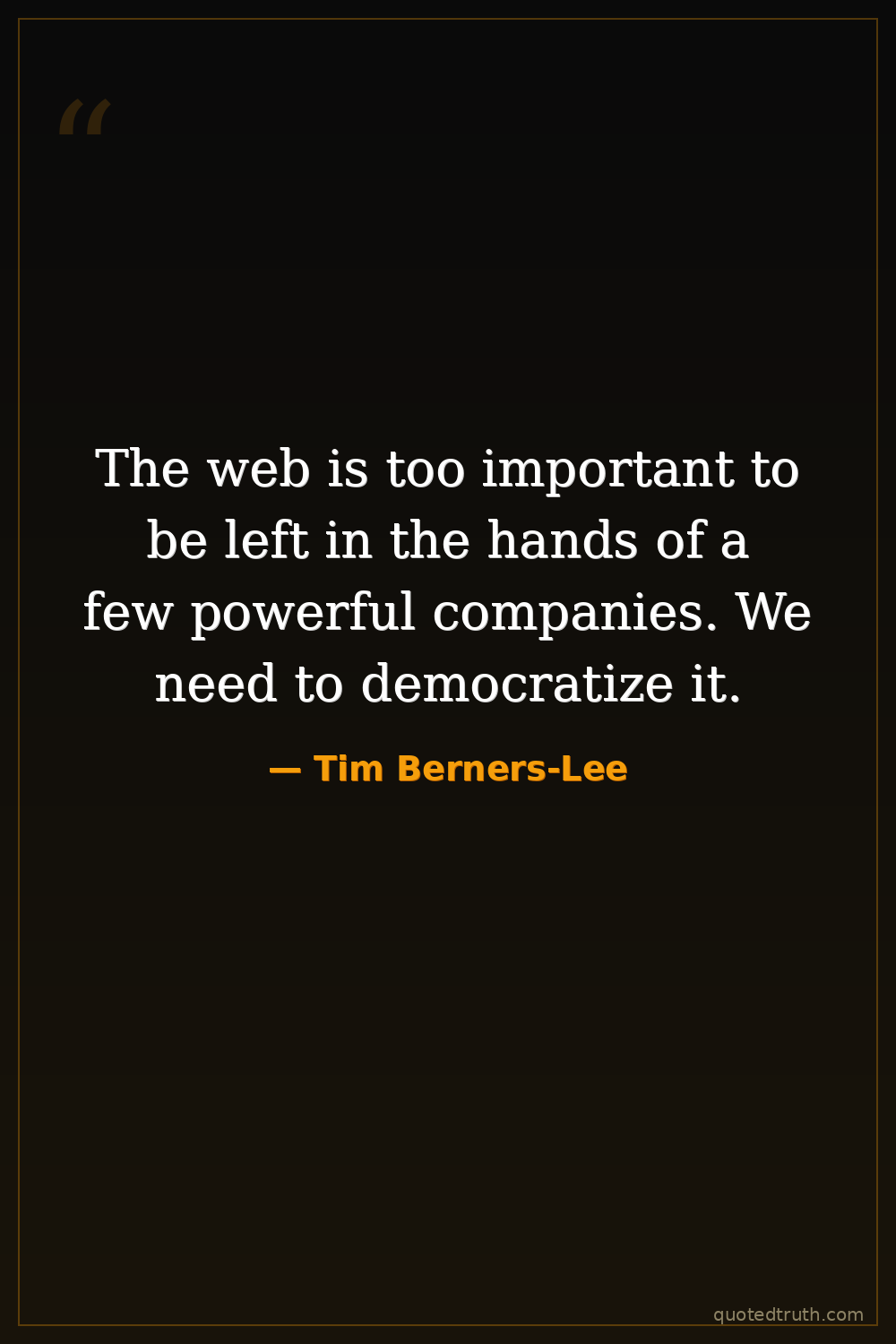
The web is too important to be left in the hands of a few powerful companies. We need to democratize it.
The web is too important to be left in the hands of a few powerful companies. We need to democratize it.
Click any product to generate a realistic preview. Up to 3 at a time.
* Initial load can take up to 90 seconds — revising the preview in another color is nearly instant.
"I never intended for the web to be a surveillance tool. That's a perversion of its original purpose."
"Governments are using the web to spy on their citizens. This is a betrayal of trust."
"We need to fight for the right to privacy online. It's a fundamental human right."
"We need to make sure the web is a force for good, not evil."
"The web was supposed to be decentralized, but it’s not anymore."
British computer scientist who invented the World Wide Web at CERN in 1989 and founded the W3C, championing open web standards. Closely associated with Vint Cerf (TCP/IP co-creator and 'father of the internet') and Marc Andreessen (Mosaic browser creator and Netscape co-founder). For an intellectual contrast, see Mark Zuckerberg, Facebook (Meta) founder — Zuckerberg's walled-garden Facebook is the canonical contemporary opposite of Berners-Lee's open-web vision; Berners-Lee's Solid project and 'recapture the web' essays are explicitly written as a rebuttal to the platform-monopoly model Facebook pioneered.
Found in 1 providers: grok
1 source checked
The internet should not be controlled or dominated by a small group of corporations. Power over the web's direction, standards, and access must be distributed broadly among individuals, governments, civil society, and communities worldwide — otherwise the open, free exchange of information that makes the web valuable gets replaced by gatekeeping, profit motives, and censorship.
Berners-Lee invented the World Wide Web in 1989 and deliberately gave it away royalty-free, refusing to patent or monetize it. He founded the W3C to keep standards open and later launched the Contract for the Web and Solid protocol specifically to reclaim user data sovereignty from platform giants — this quote is the defining mission of his post-invention career.
By the 2010s, Google, Facebook, Amazon, and Apple had consolidated enormous control over web infrastructure, advertising, identity, and content distribution. Surveillance capitalism, algorithmic manipulation, and data monopolies emerged as existential threats to the open web Berners-Lee envisioned. Regulatory battles like GDPR, antitrust cases against Big Tech, and net neutrality debates defined this era.
AI-generated insights based on extensive research and information for context. Factual errors? Email [email protected].
Your cart is empty