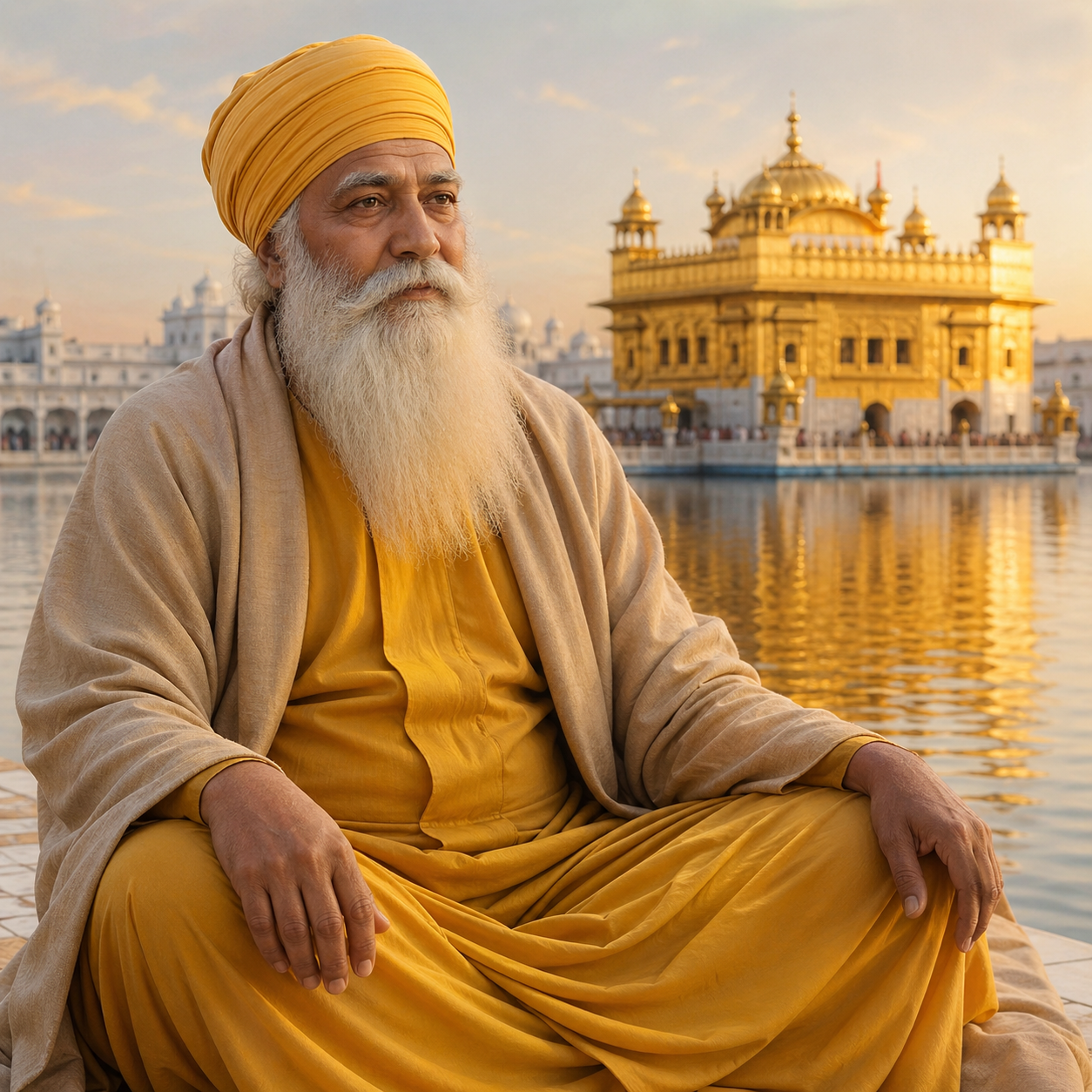
Guru Nanak — "The whole creation is His temple."
The whole creation is His temple.
The whole creation is His temple.
Click any product to generate a realistic preview. Up to 3 at a time.
* Initial load can take up to 90 seconds — revising the preview in another color is nearly instant.
"There is but One God. His Name is Truth; He is the Creator, Sustainer of all, Free from fear and hate, Immortal, Unborn, Self-existent, Realized by the Guru's Grace."
"The world is a drama, staged in a dream. And sometimes, the plot is really confusing."
"One cannot comprehend Him through reason, even if one reasoned for ages."
"By the grace of the Guru, one obtains the treasure of the True Name."
"There is but One God. His Name is Truth. He is the Creator. He fears none. He is without enmity. He is timeless, unborn, self-existent. By the Guru's Grace, He is met."
Founder of Sikhism and the first of the Ten Sikh Gurus, whose teachings of one universal God and rejection of caste shaped Punjab. Closely associated with Kabir (mystical poet whose verses appear in the Sikh Guru Granth Sahib). For an intellectual contrast, see Brahmanical orthodoxy, the Hindu caste-and-ritual establishment of his era — Sikhism was founded as a deliberate alternative to both Hindu ritual hierarchy and Islamic exclusivism — Nanak's universalism was a structural rejection of caste and priestly mediation.
Found in 1 providers: grok
1 source checked
Every part of the natural world — mountains, rivers, people, animals, the sky — is a sacred space where the divine is present. You do not need to enter a specific building to find God, because the entire universe already functions as that holy place. Worship, reverence, and awareness of the divine can happen anywhere, at any moment, because creation itself is continuously displaying its creator.
Guru Nanak rejected ritual-bound worship tied to temples, mosques, and pilgrimage sites, teaching instead that one formless God (Ik Onkar) pervades all existence. He traveled across South Asia and the Middle East on his udasis, preaching to Hindus, Muslims, and ascetics alike. This saying mirrors his lifelong insistence that honest labor, remembrance of the divine name, and service to creation outweigh ceremonial worship inside sanctioned holy buildings.
In late-15th and early-16th century Punjab, Hindu temple rituals, Brahmin gatekeeping, Islamic orthodoxy under the Lodi and early Mughal sultans, and caste exclusion defined religious life. Sacred space was tightly controlled — by priests, by purity rules, by rulers. Declaring the whole creation a temple dissolved those boundaries, challenging both Hindu and Muslim clerical authority and offering ordinary farmers and laborers direct, unmediated access to the divine.
AI-generated insights based on extensive research and information for context. Factual errors? Email [email protected].
Your cart is empty