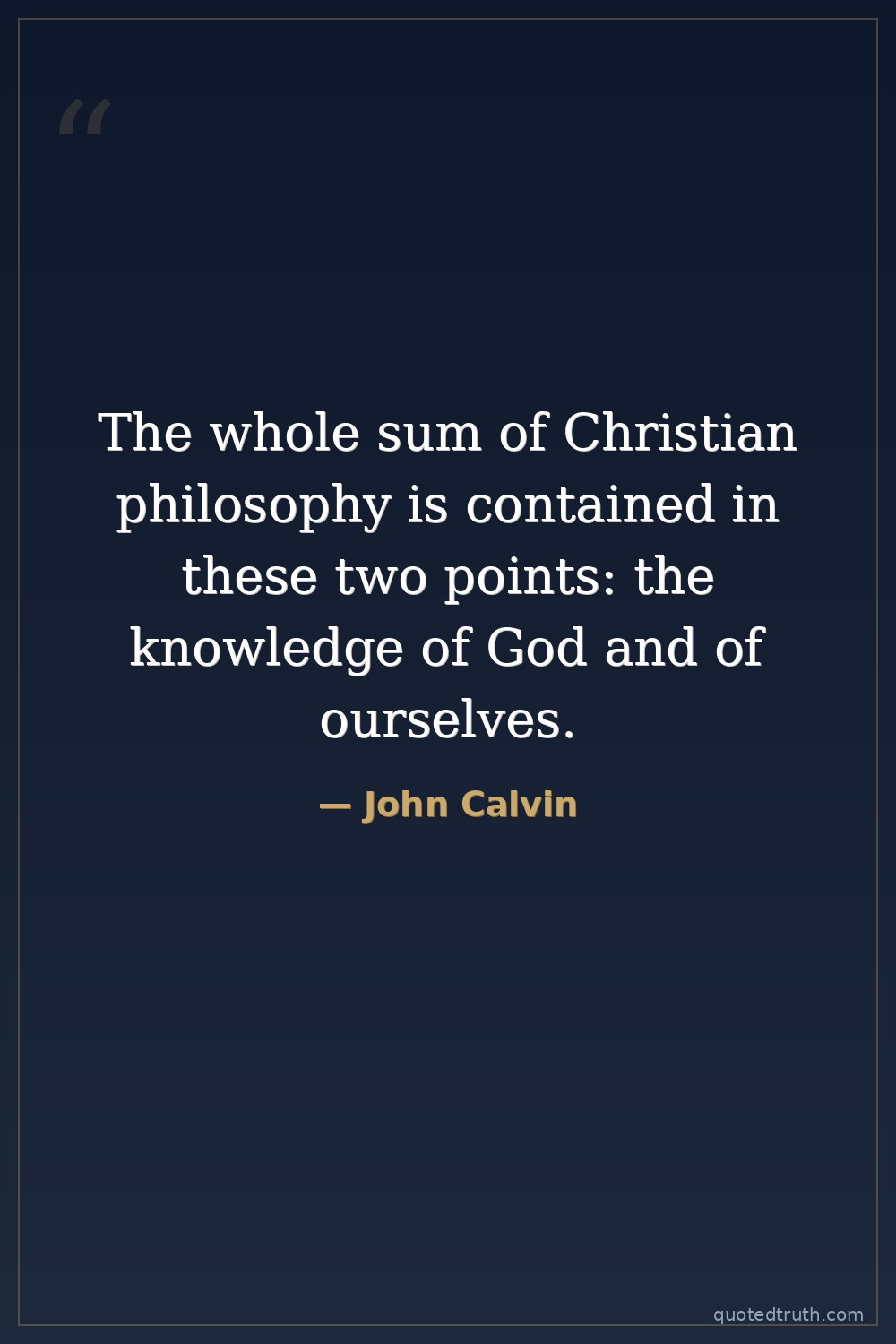
John Calvin — "The whole sum of Christian philosophy is contained in these two points: the know…"
The whole sum of Christian philosophy is contained in these two points: the knowledge of God and of ourselves.
The whole sum of Christian philosophy is contained in these two points: the knowledge of God and of ourselves.
Click any product to generate a realistic preview. Up to 3 at a time.
* Initial load can take up to 90 seconds — revising the preview in another color is nearly instant.
"The elect are called according to God's purpose, not according to their own merits."
"The heart of man is a perpetual idol factory."
"By predestination we mean the eternal decree of God, by which he has determined with himself whatever he wills to happen with regard to every man."
"The church is the mother of all the godly."
"When God wants to punish a nation, he sends them bad preachers."
French theologian whose Institutes of the Christian Religion (1536) systematized Protestant Reformed doctrine, including predestination. Closely associated with Martin Luther (Reformation founder, Calvin's predecessor). For an intellectual contrast, see Jacobus Arminius, Dutch Reformed theologian (1560-1609) — Arminius's rejection of strict double-predestination founded Arminianism — the theological tradition modern Methodism, most evangelicalism, and Pentecostalism descend from. The Calvinist-Arminian debate has divided Protestantism for 400 years.
Found in 1 providers: grok
1 source checked
Christian thought, in its entirety, orbits two interconnected pursuits: understanding God and understanding yourself. These aren't separate tasks—they mirror each other. You cannot truly know God without recognizing your own creatureliness, and you cannot grasp your own nature without measuring yourself against God. All theology, ethics, worship, and spiritual discipline flows from this dual inquiry. Strip away the elaborations, and these two questions are what remains at Christianity's core.
This is the literal opening thesis of Calvin's Institutes of the Christian Religion, his life's defining work. His doctrine of total depravity—that humans are fundamentally corrupted by sin—demanded unflinching self-examination. His belief in God's absolute sovereignty demanded equally rigorous study of divine nature. As Geneva's theological architect, Calvin built an entire civic and ecclesiastical system on these two poles, insisting neither self-knowledge nor God-knowledge could exist without the other.
The Protestant Reformation was dismantling centuries of Catholic scholastic theology—elaborate sacramental systems, papal hierarchy, and Aristotelian metaphysics layered onto Scripture. Calvin wrote amid this upheaval, cutting through complexity. Simultaneously, Renaissance humanism had revived the Delphic imperative to 'know thyself,' shaping educated European culture. Calvin seized that humanist impulse and reframed it theologically: self-knowledge only becomes spiritually meaningful when oriented toward knowing God, not as an end in itself.
AI-generated insights based on extensive research and information for context. Factual errors? Email [email protected].
Your cart is empty