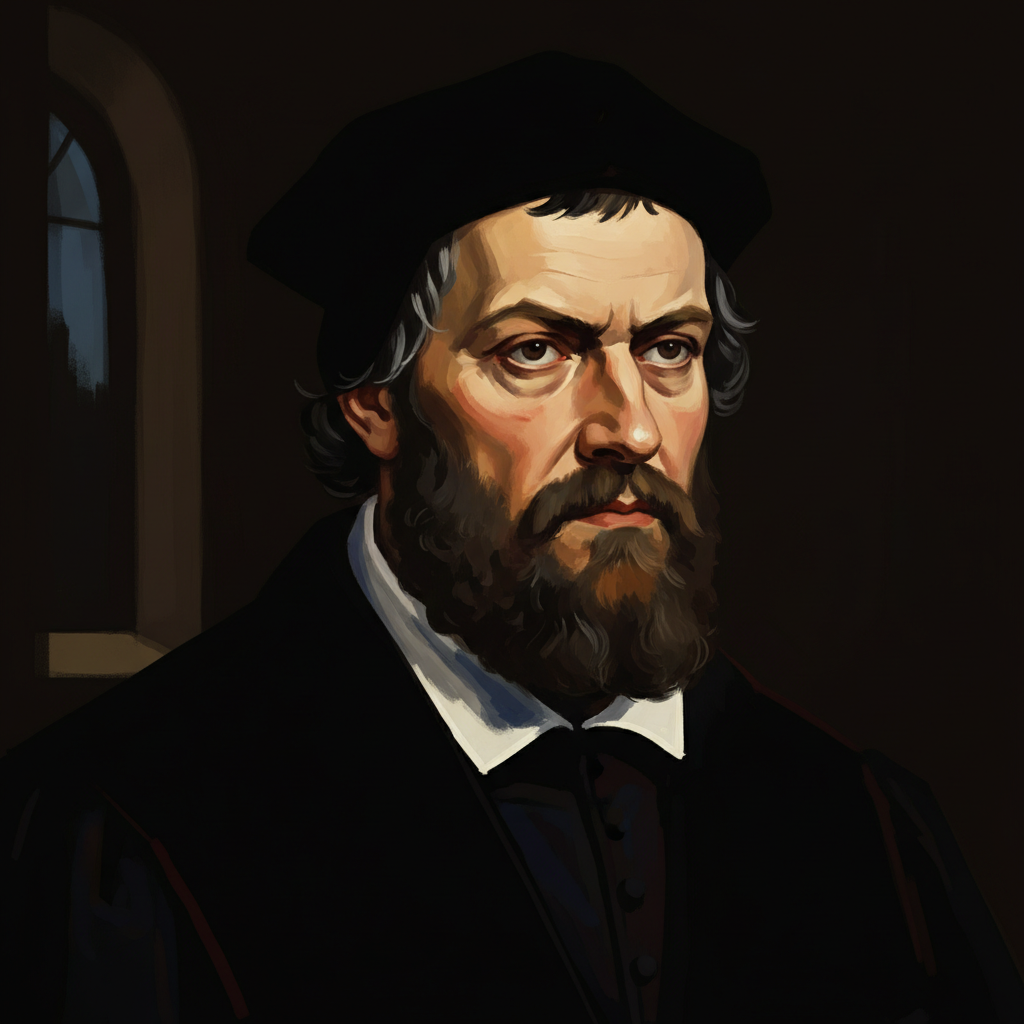
Martin Luther — "The world is a great privy and I am a stool."
The world is a great privy and I am a stool.
The world is a great privy and I am a stool.
Click any product to generate a realistic preview. Up to 3 at a time.
* Initial load can take up to 90 seconds — revising the preview in another color is nearly instant.
"I would rather be a sow than a Christian if I had to believe that God is as cruel as some say."
"Faith is a living, daring confidence in God's grace, so sure and certain that a man could stake his life on it a thousand times."
"Sleep is a most excellent thing, for it makes us forget all the miseries of life."
"I have to confess that I have no desire to be a martyr."
"The will is a beast of burden. If God mounts it, it wishes and goes as God wills; if Satan mounts it, it wishes and goes as Satan wills; Nor can it choose its rider... the riders contend for its posse…"
German theologian whose 95 Theses (1517) launched the Protestant Reformation and broke the Catholic Church's monopoly on Western Christianity. Closely associated with Philipp Melanchthon (Lutheran systematizer) and John Calvin (later Reformer who built on Luther's break). For an intellectual contrast, see Pope Leo X, Renaissance pope (1513-1521) — Leo X's indulgence sales triggered Luther's break and Leo excommunicated him in 1521 — Luther's entire Reformation is structured as a direct answer to the indulgence-funded Vatican Leo represented.
Found in 1 providers: grok
1 source checked
Luther is crudely comparing the world to an outhouse and himself to waste within it. He expresses a stark sense of human lowliness and the filthy, corrupt nature of earthly existence. Rather than a polished philosophical statement, it is blunt self-deprecation paired with contempt for worldly affairs, suggesting that people and the world share the same base, unclean condition before God, who alone stands above it.
Luther was famous for earthy, scatological language, frequently invoking bodily functions to mock the devil, the papacy, and human pride. As an Augustinian monk turned reformer, he stressed total human depravity and the need for divine grace. This saying fits his theology of humanity as helpless and soiled, and his personal style of using vulgar imagery to puncture pretension, both his own and that of his opponents in Rome.
In early sixteenth-century Germany, plague, poor sanitation, and open sewage were daily realities, and coarse bodily humor was common in sermons and pamphlets. Luther's era saw the Reformation's explosion of printed tracts, often rude and polemical, aimed at a broad lay audience. Against a backdrop of indulgence sales, peasant unrest, and apocalyptic expectation, stark images of filth and worthlessness reinforced the reformers' message that salvation could never be earned through worldly effort.
AI-generated insights based on extensive research and information for context. Factual errors? Email [email protected].
Your cart is empty