Carl Linnaeus — "The world is full of wonders, but man is the greatest wonder of all."
The world is full of wonders, but man is the greatest wonder of all.
The world is full of wonders, but man is the greatest wonder of all.
Click any product to generate a realistic preview. Up to 3 at a time.
* Initial load can take up to 90 seconds — revising the preview in another color is nearly instant.
"Nature does not make any leaps. (Natura non facit saltus)"
"In natural science the principles of truth ought to be confirmed by observation."
"I have explored the whole world of nature."
"The true botanist is not one who knows many plants, but one who knows how to find them."
"The study of nature is the study of God."
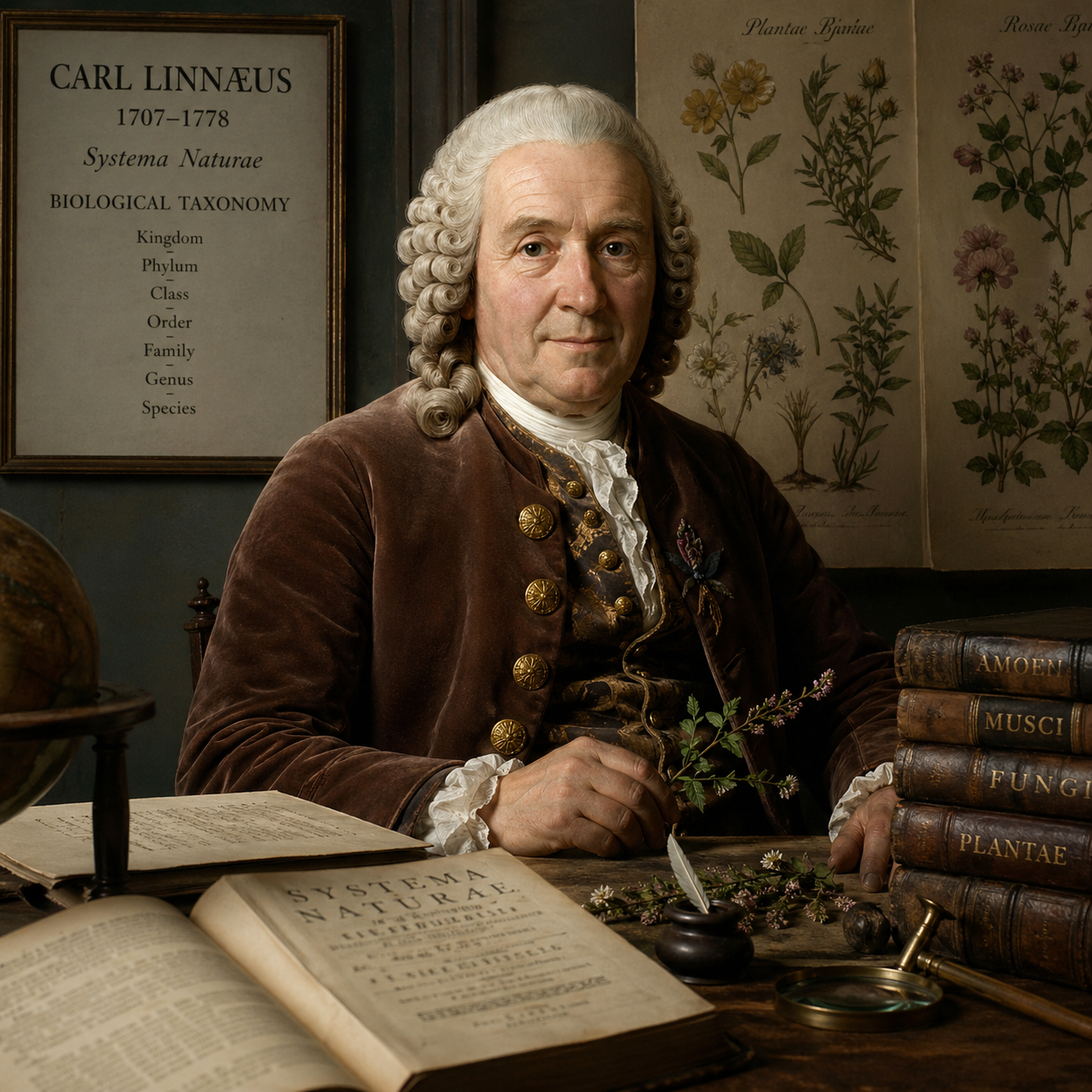
Swedish botanist and the father of modern taxonomy whose Systema Naturae (1735) introduced binomial nomenclature for naming all species. Closely associated with Joseph Banks (British naturalist who carried Linnaean classification on Cook's voyages). For an intellectual contrast, see Comte de Buffon, French naturalist and Histoire Naturelle author (1749-1788) — Buffon explicitly attacked Linnaean fixed-categories taxonomy as artificial and rejected the binomial system; his gradualist, environment-shaped natural history was the explicit alternative. Anticipates the fixed-species-vs-evolution debate Darwin would later resolve.
A philosophical statement on the uniqueness of humanity.
Date: Uncertain (attributed)
WisdomFound in 1 providers: gemini
1 source checked
The quote asserts that while nature teems with astonishing phenomena, humanity surpasses them all. It positions humans not merely as one species among many but as the pinnacle of observable creation — distinguished by reason, consciousness, and the capacity to understand the very wonders surrounding them. It's a declaration that human complexity, both physical and intellectual, outweighs anything else nature has produced.
Linnaeus catalogued over 12,000 species across Systema Naturae, yet reserved special status for humans, naming them Homo sapiens — 'wise man' — the only species defined by self-knowledge rather than physical traits. He was the first naturalist to formally classify humans alongside animals, simultaneously humbling and elevating humanity. His taxonomic life's work made him uniquely positioned to declare what distinguished humans from everything else he meticulously studied.
Linnaeus worked during the Enlightenment, when European thinkers championed reason as humanity's defining attribute. Natural history expeditions were mapping global biodiversity for the first time, generating awe at nature's scale. Yet placing humans taxonomically among animals — as Linnaeus did in 1735 — was theologically provocative. This quote reflects the era's tension: marveling at nature's diversity while insisting human rationality remained categorically supreme, bridging religious humanism and emerging secular science.
AI-generated insights based on extensive research and information for context. Factual errors? Email [email protected].
Your cart is empty