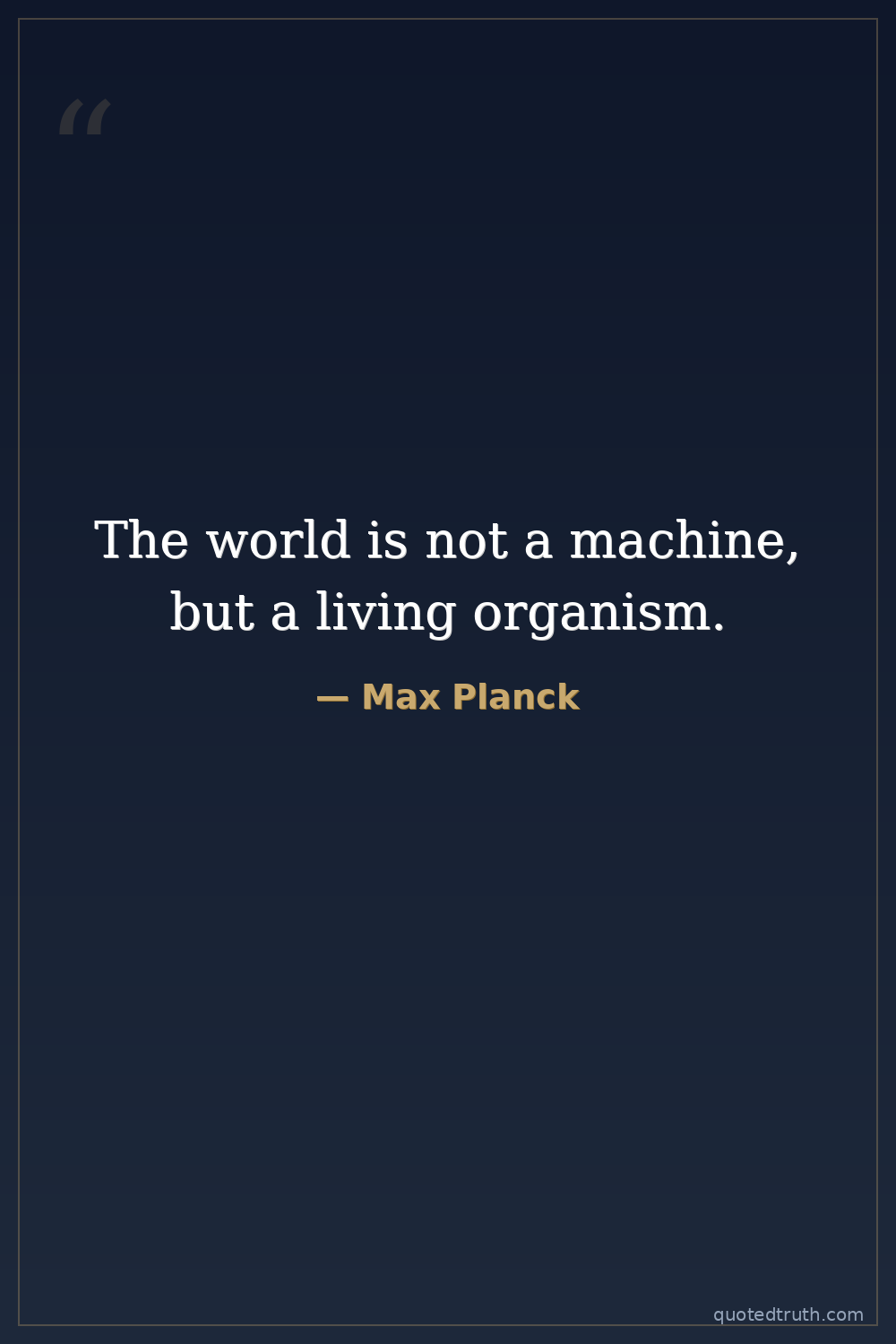
Max Planck — "The world is not a machine, but a living organism."
The world is not a machine, but a living organism.
The world is not a machine, but a living organism.
Click any product to generate a realistic preview. Up to 3 at a time.
* Initial load can take up to 90 seconds — revising the preview in another color is nearly instant.
"Science and religion are not antagonistic; they are complementary."
"There is no matter as such! All matter originates and exists only by virtue of a force which brings the particle of an atom to vibration and holds this most minute solar system of the atom together. W…"
"The quantum of action plays a fundamental role in atomic theory."
"The greatest joy of a scientist is to be able to communicate his ideas to others."
"Mathematics, rightly viewed, possesses not only truth, but supreme beauty — a beauty cold and austere, like that of sculpture, without appeal to any part of our weaker nature, without the gorgeous tra…"
Found in 1 providers: grok
1 source checked
Reality is not a collection of separate parts working mechanically like gears in a clock. Instead, the universe behaves more like a biological system, where everything is interconnected, dynamic, and evolving. Parts cannot be fully understood in isolation because they depend on and influence each other. Processes unfold with growth, adaptation, and wholeness rather than following rigid, predictable mechanical rules that treat matter as inert and disconnected.
Planck shattered the clockwork universe of classical physics when he discovered energy comes in discrete quanta, launching quantum theory in 1900. Though trained in Newtonian mechanics, his findings forced him toward a more holistic worldview. A devout believer in a rational intelligence behind nature, Planck openly rejected pure materialism, arguing consciousness was fundamental. This quote captures his conviction that reductionist, mechanistic science alone could never fully describe the interconnected reality he uncovered.
Planck worked during the late 19th and early 20th centuries, when Newtonian mechanism dominated and scientists believed physics was nearly complete. The Industrial Revolution framed everything as machinery. Then relativity and quantum mechanics shattered certainties, revealing observer-dependent, probabilistic reality. Two world wars, including the loss of his son to the Nazis, deepened his spiritual outlook. Vitalism debated mechanism in biology, and thinkers increasingly questioned whether cold materialism could explain life, mind, or the strange new physics emerging.
AI-generated insights based on extensive research and information for context. Factual errors? Email [email protected].
Your cart is empty