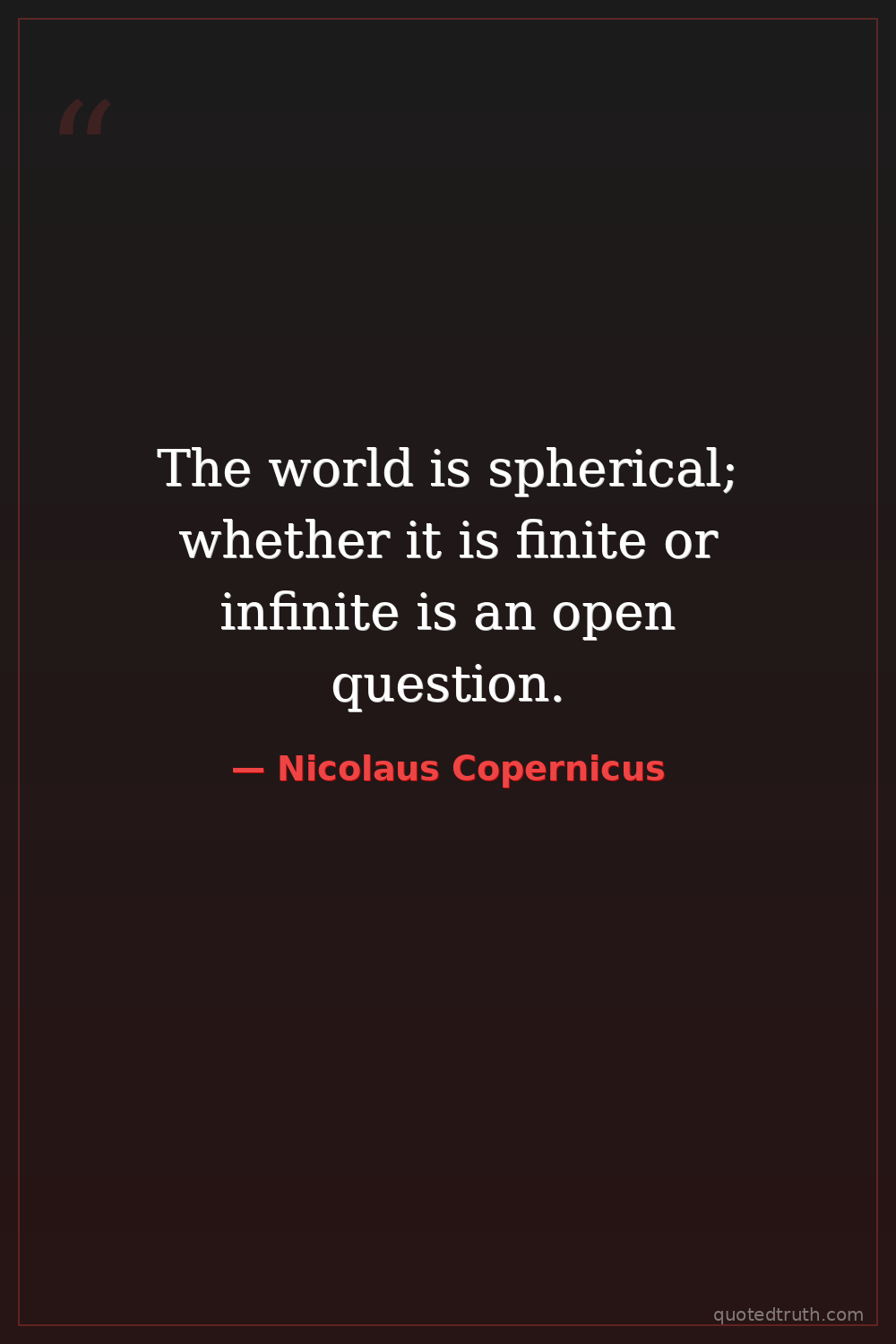
Nicolaus Copernicus — "The world is spherical; whether it is finite or infinite is an open question."
The world is spherical; whether it is finite or infinite is an open question.
The world is spherical; whether it is finite or infinite is an open question.
Click any product to generate a realistic preview. Up to 3 at a time.
* Initial load can take up to 90 seconds — revising the preview in another color is nearly instant.
"The universe is a spherical whole, and of all possible forms, the sphere is the most perfect."
"Therefore, we must find a better way to explain the apparent motion of the heavens, which is so complicated and irregular."
"The Universe has been wrought for us by a supremely good and orderly Creator."
"For it is the work of a good mathematician to compute the motions of the heavenly bodies, and to predict their positions at any given time."
"Those things which I am saying now may be obscure, yet they will be made clearer in their proper place."
From 'De Revolutionibus Orbium Coelestium', Book I, Chapter 1. He states it's spherical, but doesn't definitively answer finite/infinite.
Date: 1543
GeneralFound in 1 providers: grok
1 source checked
The universe has a spherical shape — geometry and observation confirm that. But whether it stretches on forever or has some ultimate boundary remains genuinely unresolved. Copernicus draws a clear line between settled knowledge and open inquiry, asserting only what evidence supports while honestly admitting what it cannot yet answer. Confidence about the provable, candor about the unknowable — that is the intellectual posture here.
Copernicus, the Polish canon and astronomer who overturned Earth-centered cosmology in *De Revolutionibus* (1543), built his heliocentric model through decades of meticulous calculation. He was bold enough to displace Earth from the center yet disciplined enough to separate geometric certainty from metaphysical speculation. His training in mathematics and canon law sharpened this precise habit: prove what the numbers support, leave open what they cannot yet reach.
In the early 16th century, Ptolemaic astronomy inherited from antiquity still dominated, but the Renaissance was reopening ancient debates about cosmic scale. Church doctrine favored a finite, created universe — asserting infinite space risked charges of heresy, a fate Giordano Bruno later suffered in 1600. Copernicus withheld *De Revolutionibus* for decades before publishing it the year he died. Hedging carefully on infinity reflected both genuine uncertainty and prudent survival in an era where cosmological claims carried serious theological consequences.
AI-generated insights based on extensive research and information for context. Factual errors? Email [email protected].
Your cart is empty