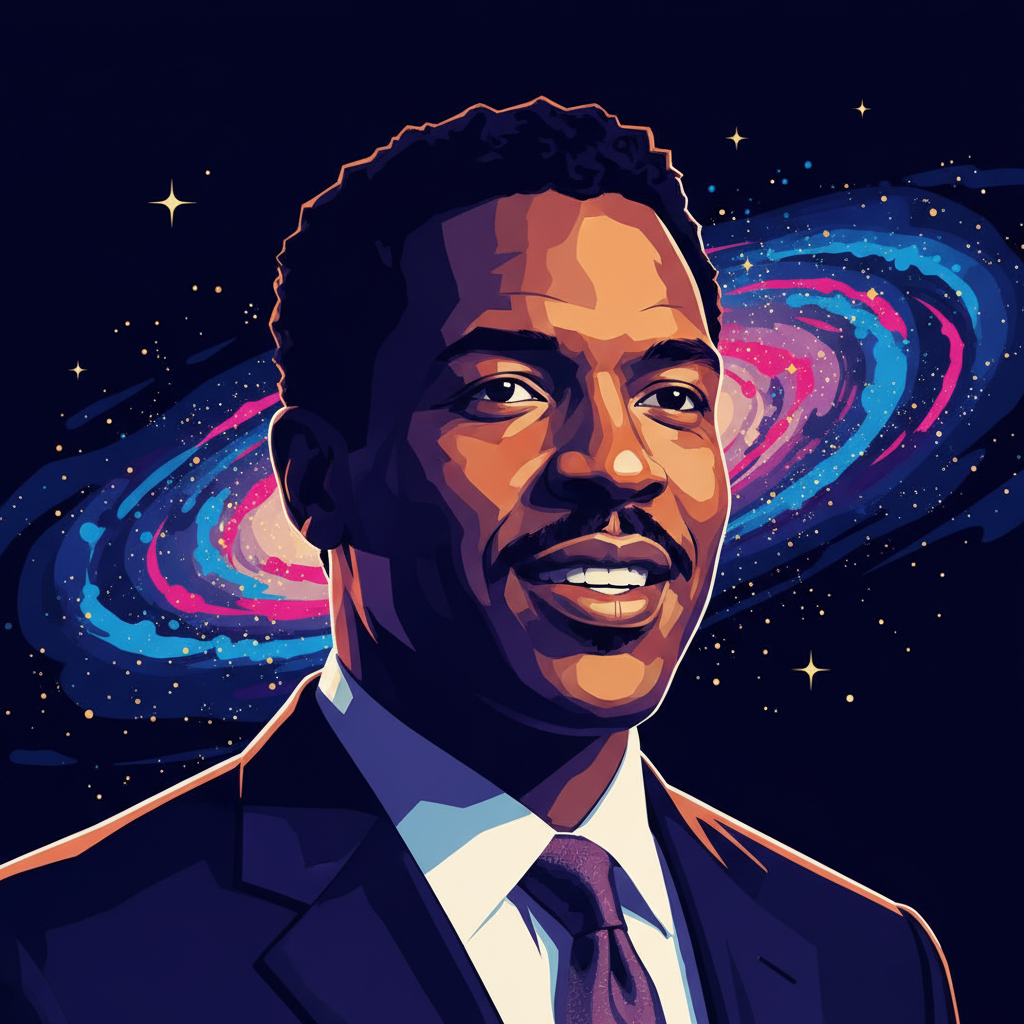
Neil deGrasse Tyson — "There are no bad ideas in science, just bad experiments."
There are no bad ideas in science, just bad experiments.
There are no bad ideas in science, just bad experiments.
Click any product to generate a realistic preview. Up to 3 at a time.
* Initial load can take up to 90 seconds — revising the preview in another color is nearly instant.
"I'm not saying there's no God. I'm saying if there is a God, he's an absentee landlord."
"The universe is expanding. We are all expanding. Everything is expanding. What are you doing?"
"When you look at the universe, you realize how insignificant we are. But then you realize how significant we are, because we are the universe looking at itself."
"I'm not a guru. I'm just a guy who loves the universe."
"Earth is a small planet, and we are not alone. We are not alone in the universe, and we are not alone on this planet."
American astrophysicist, Hayden Planetarium director, and Cosmos: A Spacetime Odyssey host who carries the Carl Sagan public-science mantle. Closely associated with Bill Nye (fellow science communicator) and Brian Greene (theoretical physicist and string-theory popularizer). For an intellectual contrast, see Ken Ham, founder of Answers in Genesis and the Creation Museum — Ham's career has been organized around defending biblical 6-day creationism — exactly the science-education position Tyson's mainstream-science communication is structured to refute.
Found in 1 providers: grok
1 source checked
Every scientific hypothesis deserves testing, regardless of how unlikely it seems. Ideas themselves cannot be wrong until experimentation proves otherwise. History repeatedly shows that outlandish proposals became foundational truths. The value lies not in the initial concept but in rigorous experimental design and honest interpretation of results. Premature dismissal of ideas stifles discovery; methodology and evidence determine validity, not intuition.
Tyson built his career democratizing science, consistently arguing that curiosity should never be gatekept. As director of the Hayden Planetarium and host of Cosmos, he championed scientific openness over orthodoxy. His public advocacy against pseudoscience paradoxically stems from respecting all hypotheses equally while demanding experimental rigor—precisely the philosophy this quote embodies. He regularly defends unconventional thinkers who later proved correct.
In Tyson's contemporary era, science faces unprecedented public skepticism—climate denial, vaccine hesitancy, flat-earth movements—while simultaneously experiencing explosive discovery through CRISPR, gravitational waves, and exoplanet detection. This tension makes the quote urgent: encouraging experimental boldness counters both anti-science populism and institutional conservatism that slows funding of unconventional research. Open inquiry has never been more culturally contested or scientifically necessary.
AI-generated insights based on extensive research and information for context. Factual errors? Email [email protected].
Your cart is empty