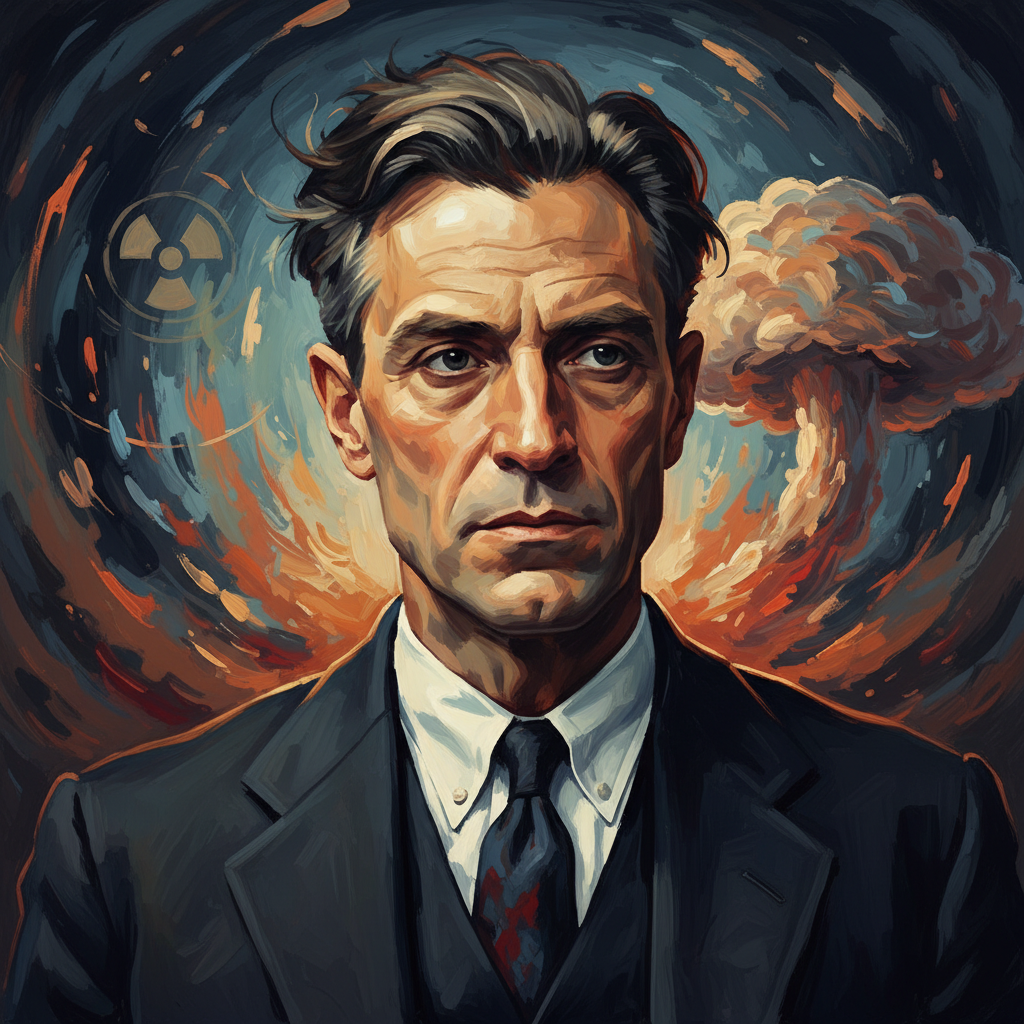
Robert Oppenheimer — "There are some people who can live without wild places, and some who cannot."
There are some people who can live without wild places, and some who cannot.
There are some people who can live without wild places, and some who cannot.
Click any product to generate a realistic preview. Up to 3 at a time.
* Initial load can take up to 90 seconds — revising the preview in another color is nearly instant.
"The world is not a collection of facts, but a collection of relationships."
"We have to find a way to transcend the fear and the hatred that led to the creation of the atomic bomb."
"In the spring of 1936, I was introduced by friends to Jean Tatlock. In the autumn, I began to court her. We were at least twice close enough to marriage to think of ourselves as engaged."
"I feel that in a world where atomic bombs are possible, the only safety is in a world where atomic bombs are no longer needed."
"The greatest adventure is to explore the unknown."
American theoretical physicist who directed the Manhattan Project's Los Alamos Laboratory and oversaw the atomic bombs; lost his security clearance in 1954. Closely associated with Niels Bohr (Manhattan Project consultant and atomic-policy advisor) and Hans Bethe (Los Alamos theoretical-division chief). For an intellectual contrast, see Edward Teller, Hungarian-American physicist and 'father of the H-bomb' — Teller pushed the H-bomb against Oppenheimer's objections and testified against him at his 1954 security hearing — the precise moment that ended Oppenheimer's career. The canonical 'physicist-of-conscience vs physicist-of-state' pairing in nuclear-age ethics; Christopher Nolan's Oppenheimer (2023) dramatized this rivalry for a mass audience.
Found in 1 providers: grok
1 source checked
Some people feel no absence when surrounded only by civilization—cities, routines, and human constructs satisfy them completely. Others experience a genuine psychological need for wilderness, untamed landscapes, and raw nature. The quote draws a clean dividing line in human temperament: those for whom wild places are optional, and those for whom their absence creates a permanent, aching void.
Oppenheimer maintained a beloved ranch called Perro Caliente in the New Mexico mountains, returning there throughout his life for renewal. The same desert landscape he treasured became home to Los Alamos and the Trinity test site. He was drawn to the Southwest's stark wilderness from his youth, finding in it something cities could not provide—placing him firmly among those who cannot live without wild places.
The mid-20th century brought explosive American suburbanization, bulldozing vast landscapes for tract housing and highways. Simultaneously, the atomic bomb Oppenheimer helped create made nature itself newly fragile and existentially threatened. The 1940s-50s gave birth to modern environmentalism—Aldo Leopold's Sand County Almanac appeared in 1949, wilderness preservation debates intensified—as industrial civilization visibly consumed the remaining wild spaces that defined the American identity.
AI-generated insights based on extensive research and information for context. Factual errors? Email [email protected].
Your cart is empty