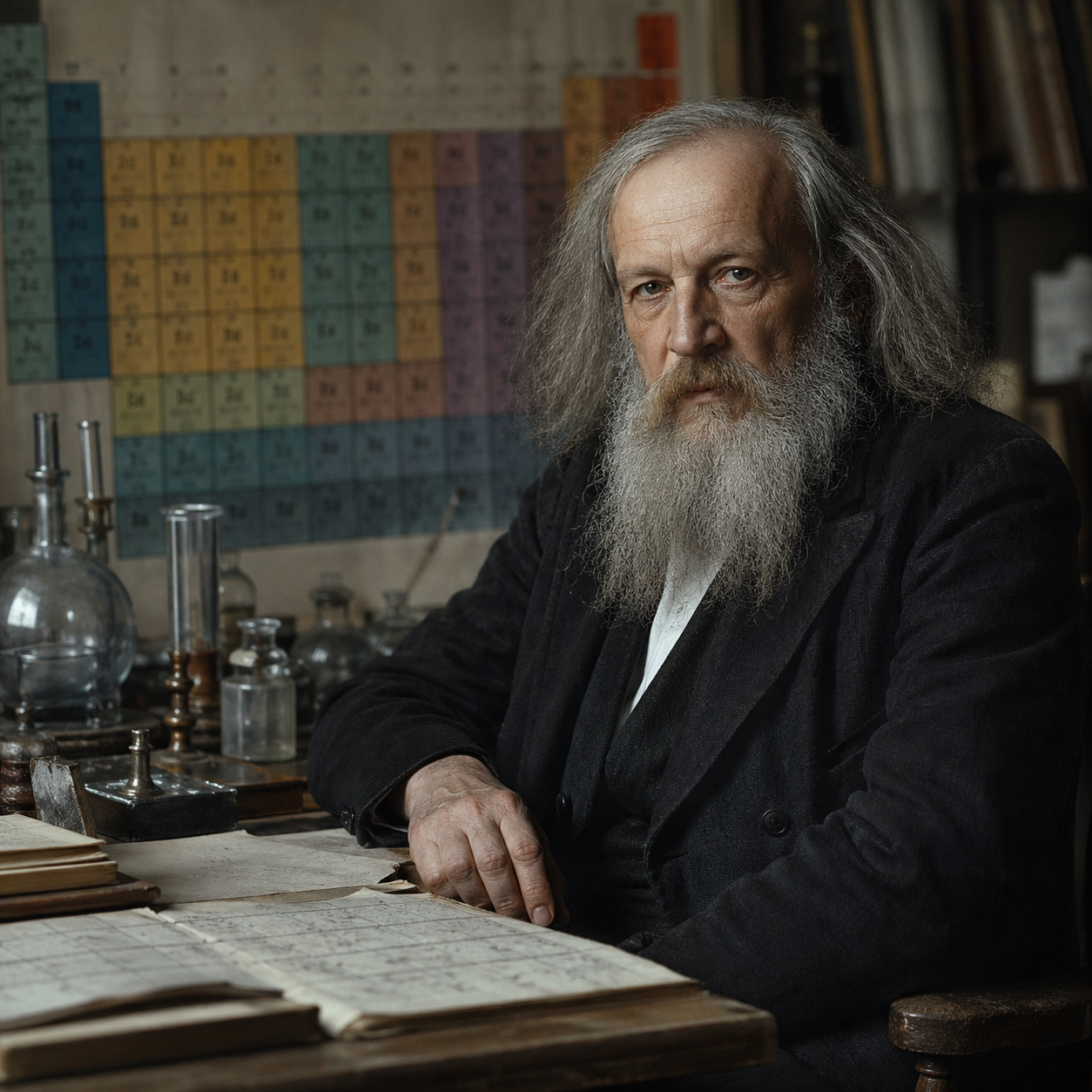
Dmitri Mendeleev — "There is nothing in this world that I fear to say."
There is nothing in this world that I fear to say.
There is nothing in this world that I fear to say.
Click any product to generate a realistic preview. Up to 3 at a time.
* Initial load can take up to 90 seconds — revising the preview in another color is nearly instant.
"A well-made theory is like a good overcoat; Eloquent words are like a beautiful tie."
"The chemical elements are the children of the sun."
"If statements of fact themselves depend upon the person who observes them, how much more distinct is the reflection of the personality of him who gives an account of methods and of philosophical specu…"
"It is the duty of the chemist to teach the world how to use the elements wisely."
"It is easier to make a scientific discovery than to explain it to the common man."
Found in 2 providers: deepseek,gemini
2 sources checked
The speaker declares total fearlessness in expressing thoughts, opinions, or truths. Nothing—no authority, consequence, social pressure, or taboo—can silence them. It is a statement of complete intellectual and moral courage, asserting that honesty matters more than comfort or safety. The speaker claims the freedom to voice any idea, however controversial, unpopular, or dangerous, without hesitation or self-censorship of any kind.
Mendeleev lived this defiance. He publicly criticized the Tsarist government, resigned from St. Petersburg University in 1890 after officials refused to forward student grievances, and was denied the Nobel Prize partly due to political enemies. He championed unpopular scientific predictions—leaving gaps in his periodic table for undiscovered elements like gallium and germanium—trusting his reasoning over consensus. His bluntness extended to economics, industry, and education reform.
Nineteenth-century Imperial Russia operated under strict Tsarist censorship, secret police surveillance, and punishment of dissenters through exile or imprisonment. Intellectuals faced real danger for political speech, and academic freedom was constantly threatened. Simultaneously, this was an era of radical scientific transformation—Darwin, Maxwell, and atomic theory were upending orthodoxy. To speak fearlessly in Mendeleev's Russia required genuine courage, distinguishing free thinkers from those who self-censored to protect careers.
AI-generated insights based on extensive research and information for context. Factual errors? Email [email protected].
Your cart is empty