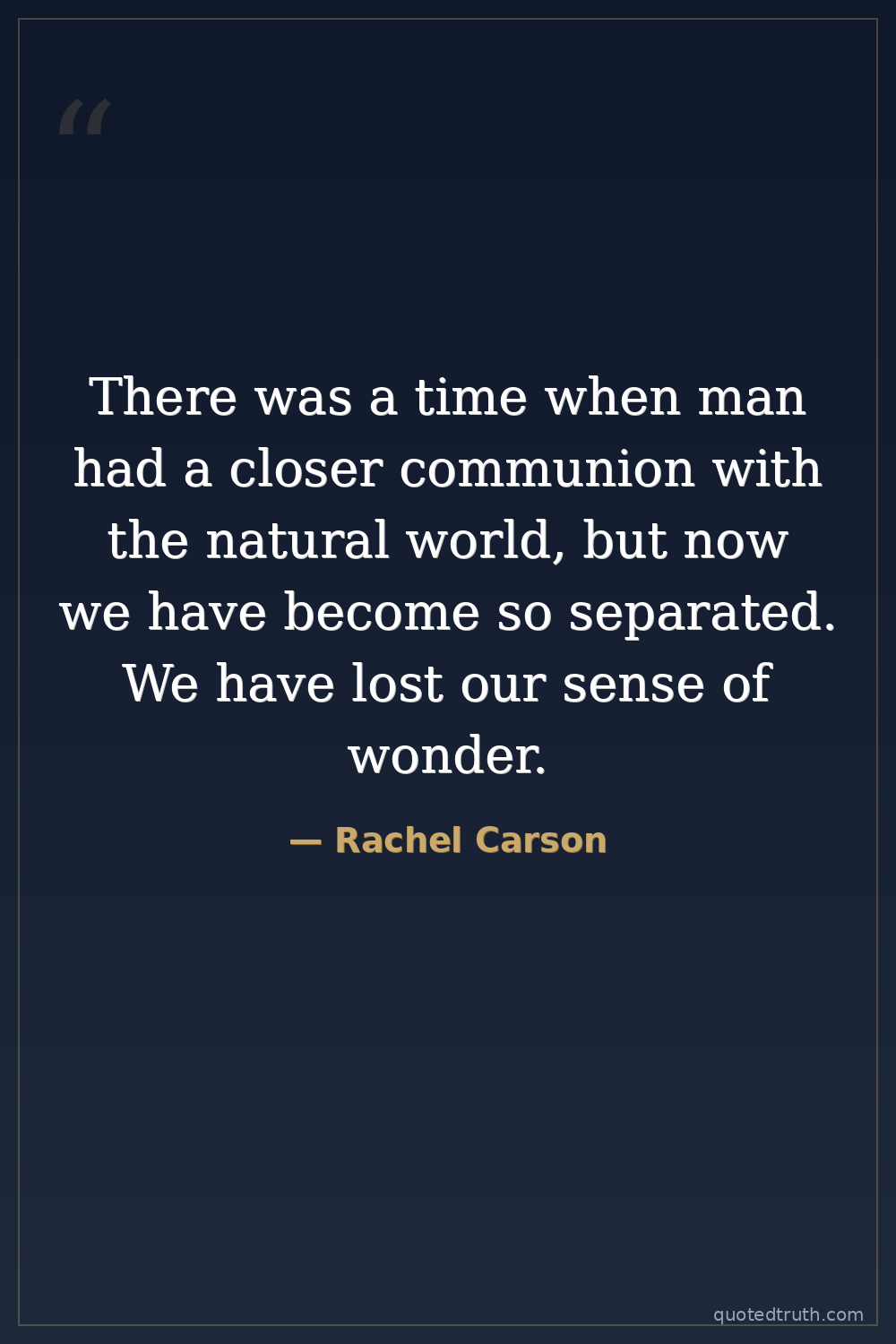
Rachel Carson — "There was a time when man had a closer communion with the natural world, but now…"
There was a time when man had a closer communion with the natural world, but now we have become so separated. We have lost our sense of wonder.
There was a time when man had a closer communion with the natural world, but now we have become so separated. We have lost our sense of wonder.
Click any product to generate a realistic preview. Up to 3 at a time.
* Initial load can take up to 90 seconds — revising the preview in another color is nearly instant.
"The more we understand the intricate web of life, the more we will appreciate its fragility."
"The balance of nature is not a static thing; it is a dynamic, complex, and constantly changing relation among living things and their nonliving environment."
"The most alarming of all man's assaults upon the environment is the contamination of air, earth, rivers, and sea with dangerous and even lethal materials."
"A Who's Who of pesticides is therefore a veritable rogues' gallery of poisons."
"The more clearly we can focus our attention on the wonders and realities of the universe about us, the less taste we shall have for destruction."
Found in 1 providers: grok
1 source checked
This quote mourns humanity's drift away from intimate connection with the natural world. Where earlier generations lived alongside nature — observing seasons, animals, and ecosystems daily — modern people increasingly inhabit artificial environments of cities, machines, and screens. The deeper loss is psychological: we've surrendered our capacity for genuine awe at the living world, replacing wonder with utility and treating nature as backdrop rather than community.
Carson devoted her life to restoring exactly this lost wonder. As a marine biologist and nature writer, she believed emotional connection to nature was the prerequisite for protecting it — a conviction she expressed most directly in her posthumous essay "The Sense of Wonder." Silent Spring documented how pesticides were severing natural relationships on a mass scale. Raised in rural Pennsylvania by a mother who cultivated her curiosity, Carson never lost what she feared others had.
Carson wrote during the postwar industrial boom of the 1950s–60s, when DDT was sprayed across American suburbs, chemical companies promised technological mastery over nature, and television pulled families indoors. Rapid suburbanization separated millions from rural landscapes. Yet this era also sparked modern environmentalism — Silent Spring (1962) catalyzed the movement, leading to the EPA's founding in 1970. Her lament resonated because audiences were just beginning to recognize what they had surrendered.
AI-generated insights based on extensive research and information for context. Factual errors? Email [email protected].
Your cart is empty