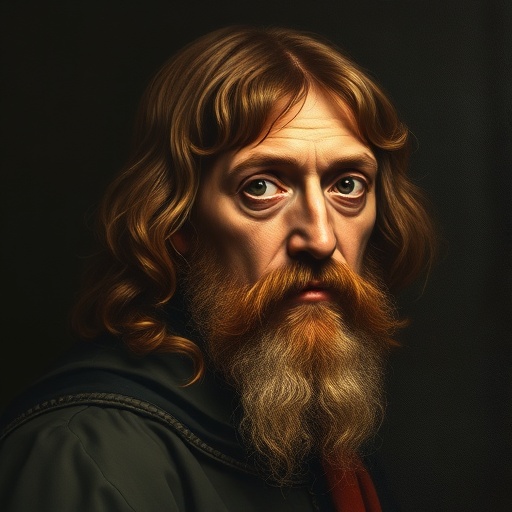
Nicolaus Copernicus — "Therefore, we must find a better way to explain the apparent motion of the heave…"
Therefore, we must find a better way to explain the apparent motion of the heavens, which is so complicated and irregular.
Therefore, we must find a better way to explain the apparent motion of the heavens, which is so complicated and irregular.
Click any product to generate a realistic preview. Up to 3 at a time.
* Initial load can take up to 90 seconds — revising the preview in another color is nearly instant.
"The universe is a harmonious system, and all its parts are in perfect accord."
"The earth, too, has other motions than that of the daily rotation."
"Those things which I am saying now may be obscure, yet they will be made clearer in their proper place."
"Nor do I doubt that learned and skillful mathematicians will agree with me if they are willing to give not superficial but profound attention to the arguments I adduce in this work."
"For I am convinced that the world is a single, unified system, and that all its parts are interrelated."
Found in 1 providers: grok
1 source checked
The quote voices frustration with overly complex and inconsistent existing explanations of how celestial bodies appear to move across the sky. Copernicus is calling for a cleaner, more coherent theoretical framework—one that doesn't require constant mathematical patches to account for observed irregularities. The word 'apparent' signals his suspicion that Earth's own movement, not planetary chaos, is the true source of what observers see from the ground.
Copernicus spent over thirty years working inside the Ptolemaic system before rejecting it. As a trained mathematician and Catholic canon who valued divine order, he found the system's accumulating epicycles—band-aid fixes to force geocentrism to match observations—philosophically offensive. He believed the cosmos should obey simple, elegant laws. That conviction drove him to propose heliocentrism in De Revolutionibus (1543), a manuscript he withheld for nearly a decade fearing backlash.
In early sixteenth-century Europe, the Ptolemaic geocentric model had dominated astronomy for 1,400 years, but navigational demands from the Age of Exploration were exposing its inaccuracies. Astronomers kept adding mathematical epicycles to salvage the Earth-centered system, producing unwieldy calculations. The Renaissance spirit of questioning ancient authorities created intellectual space for radical rethinking, yet church doctrine treated Earth's central position as theological fact, making cosmological dissent genuinely dangerous.
AI-generated insights based on extensive research and information for context. Factual errors? Email [email protected].
Your cart is empty