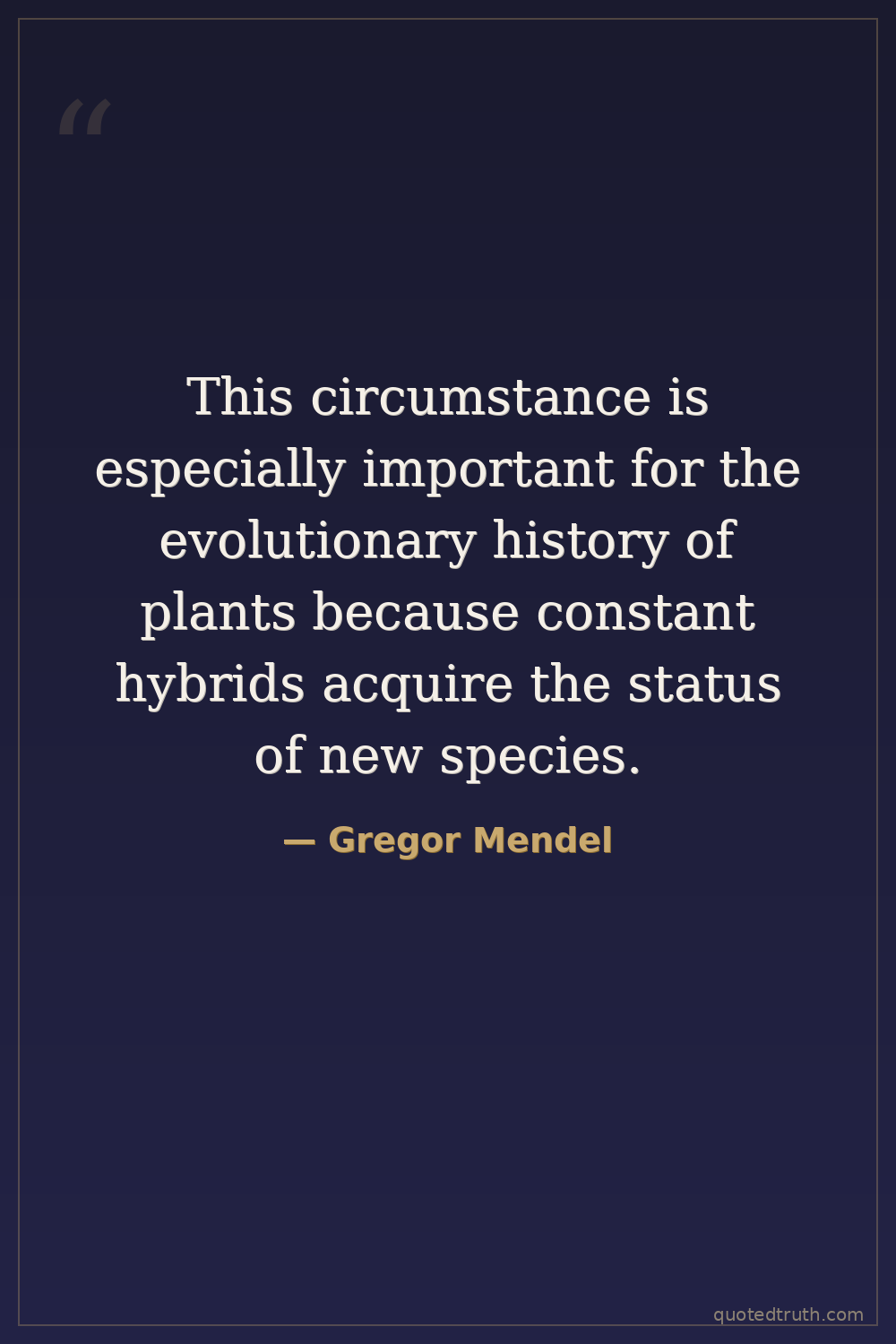
Gregor Mendel — "This circumstance is especially important for the evolutionary history of plants…"
This circumstance is especially important for the evolutionary history of plants because constant hybrids acquire the status of new species.
This circumstance is especially important for the evolutionary history of plants because constant hybrids acquire the status of new species.
Click any product to generate a realistic preview. Up to 3 at a time.
* Initial load can take up to 90 seconds — revising the preview in another color is nearly instant.
"That no generally applicable law of the formulation and development of hybrids has yet been successfully formulated can hardly astonish anyone who is acquainted with the extent of the task and who can…"
"You should regard the numerical expressions as being only empirical, because they can not be proved rational."
"I have been called a fool, but time will prove me right."
"The most important result of hybridization is beyond doubt the production of new constant forms."
"Nature loves simplicity and unity."
From 'Experiments on Plant Hybridization', showing his awareness of the implications of his work for evolution.
Date: 1865
PhilosophicalFound in 1 providers: gemini
1 source checked
When hybrid plants breed true across generations — producing offspring with identical, stable traits every time — they effectively become new species. The quote argues hybridization is a genuine mechanism for species formation, not just variation. If a crossbred plant reliably passes its combined traits unchanged to all descendants, it has functionally diverged from its parent lines and deserves recognition as a distinct species in its own right.
Mendel spent eight years crossing pea plants in his monastery garden at St. Thomas's Abbey in Brno, meticulously tracking which traits persisted across generations. His discovery of dominant and recessive hereditary factors — what we now call genes — explained precisely why some hybrid lines breed true while others segregate. This quote shows Mendel connecting his inheritance laws directly to species formation, believing his garden experiments answered evolution's deepest mechanism.
Darwin published 'On the Origin of Species' in 1859, seven years before Mendel's 1866 paper, igniting fierce debate about how new species actually form. Scientists accepted evolution but lacked any mechanism explaining stable trait inheritance or speciation. In the Austro-Hungarian Empire, empirical natural science was flourishing. Mendel's claim that constant hybrids achieve species status directly addressed the era's central biological puzzle: what produces the heritable divergence that drives evolution forward.
AI-generated insights based on extensive research and information for context. Factual errors? Email [email protected].
Your cart is empty