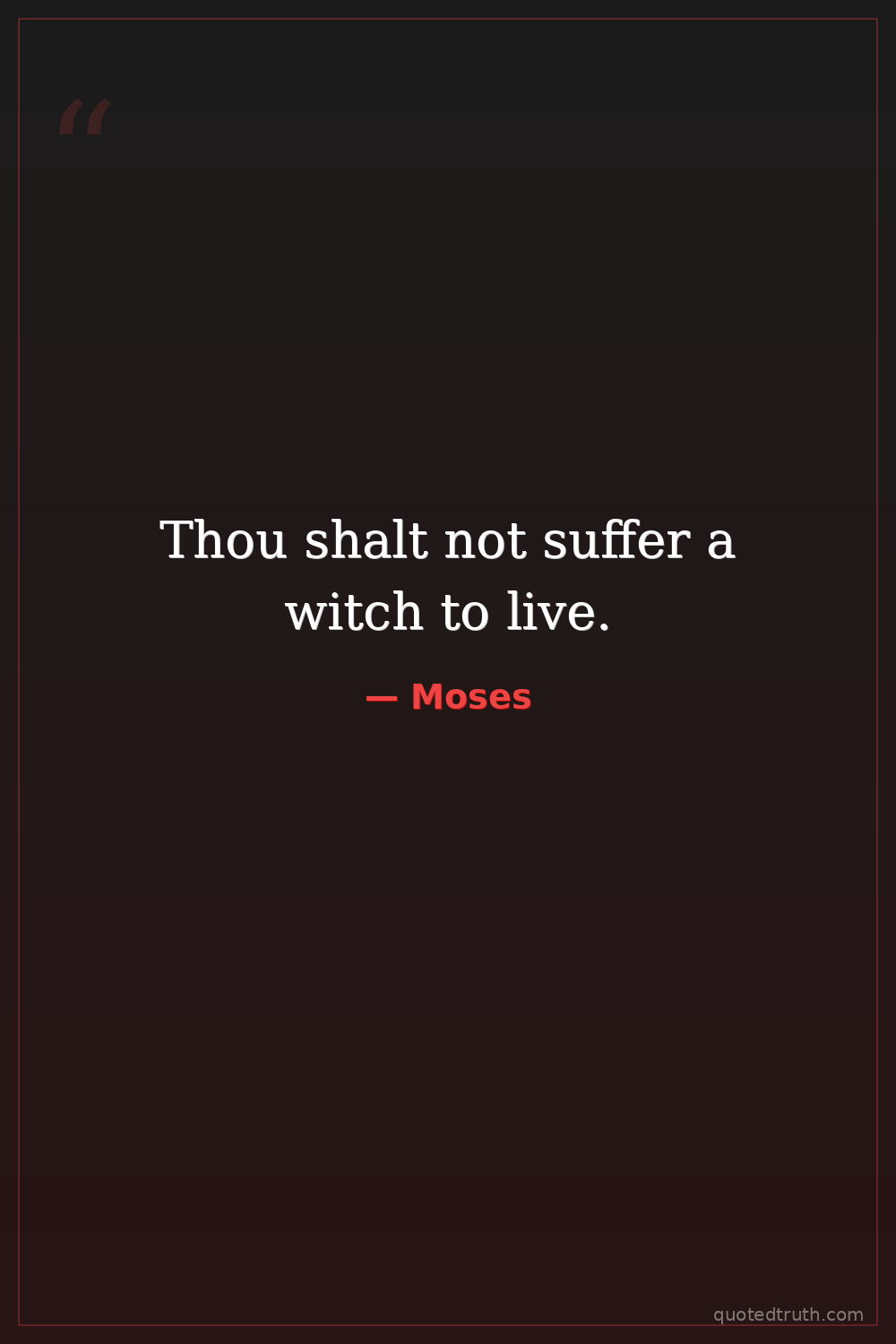
Moses — "Thou shalt not suffer a witch to live."
Thou shalt not suffer a witch to live.
Thou shalt not suffer a witch to live.
Click any product to generate a realistic preview. Up to 3 at a time.
* Initial load can take up to 90 seconds — revising the preview in another color is nearly instant.
"You shall not covet your neighbor’s house. You shall not covet your neighbor’s wife, or his male or female servant, his ox or donkey, or anything that belongs to your neighbor."
"And the Lord said, I have pardoned according to thy word:"
"What is that in thine hand? And he said, A rod."
"As ye have spoken in mine ears, so will I do to you:"
"The nakedness of your father’s wife shall you not uncover: it is your father’s nakedness."
Found in 1 providers: deepseek
1 source checked
This command declares that anyone practicing witchcraft should not be allowed to continue living within the community. In plain terms, it treats sorcery as a capital offense, forbidding society from tolerating those who claim supernatural powers outside sanctioned religion. It draws a hard line: practitioners of magic are not to be ignored, exiled, or rehabilitated, but removed entirely. The statement is absolute, leaving no room for leniency or coexistence with occult practitioners.
Moses delivered this law as part of the legal code given at Sinai, central to his role as Israel's lawgiver and prophet. Having confronted Pharaoh's magicians in Egypt, he understood sorcery as rival spiritual authority threatening monotheistic worship. His mission was forging a covenant nation devoted solely to Yahweh, so occult practices represented direct rebellion. This statute reflects his priorities: purging idolatry, establishing divine law over pagan custom, and protecting a people surrounded by magic-steeped cultures.
During the Late Bronze Age, surrounding cultures—Egyptian, Canaanite, Mesopotamian—were saturated with sorcery, divination, necromancy, and fertility magic woven into daily religion. Witches, sorcerers, and temple magicians held genuine social power. Israel was forming its identity as a distinct monotheistic nation rejecting these practices. Harsh prohibitions against witchcraft were necessary to separate the covenant community from neighboring ritual systems and prevent syncretism, which ancient leaders viewed as the greatest threat to national and spiritual survival.
AI-generated insights based on extensive research and information for context. Factual errors? Email [email protected].
Your cart is empty