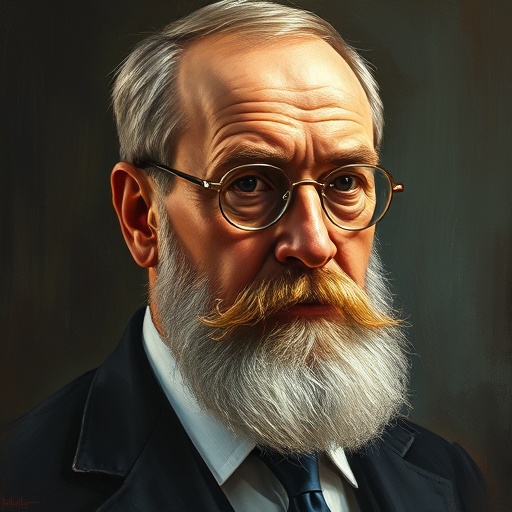
Robert Koch — "To conquer disease, we must first understand its nature."
To conquer disease, we must first understand its nature.
To conquer disease, we must first understand its nature.
Click any product to generate a realistic preview. Up to 3 at a time.
* Initial load can take up to 90 seconds — revising the preview in another color is nearly instant.
"I have always been fascinated by the invisible world of microbes."
"My work on tuberculosis was a labor of love."
"The greatest obstacle to progress is not ignorance, but the illusion of knowledge."
"I have no other aim than to advance science and to contribute to the welfare of mankind."
"My greatest reward is the knowledge that my work has alleviated human suffering."
Found in 1 providers: grok
1 source checked
Winning against disease demands more than treating symptoms — it requires identifying the actual cause, how it spreads, and why it harms the body. Without that knowledge, medicine is guesswork. Understanding a disease's fundamental nature — its origin, mechanism, and behavior — is the necessary prerequisite to developing effective treatments, vaccines, or prevention strategies. Action without comprehension is futile; systematic investigation is the only path to genuine victory over illness.
Koch spent his career proving this exact principle. He developed Koch's Postulates — four criteria requiring scientists to isolate, culture, and confirm a specific microbe before attributing disease causation. In 1882 he identified Mycobacterium tuberculosis, the century's greatest killer; in 1883, Vibrio cholerae. Each discovery followed painstaking investigation before any treatment claims. His Nobel Prize in 1905 recognized that insisting on rigorous pathogen understanding transformed medicine from inherited assumption into empirical science.
When Koch worked, tuberculosis killed roughly one in seven Europeans and cholera swept in deadly pandemic waves. Miasma theory still blamed disease on foul air, and treatments were largely ineffective. Germ theory was emerging but lacked rigorous proof. Rapid industrialization crowded urban populations, turning epidemics catastrophic. Koch's insistence on empirical understanding over tradition arrived precisely when medicine most desperately needed a scientific foundation to prevent mass death.
AI-generated insights based on extensive research and information for context. Factual errors? Email [email protected].
Your cart is empty