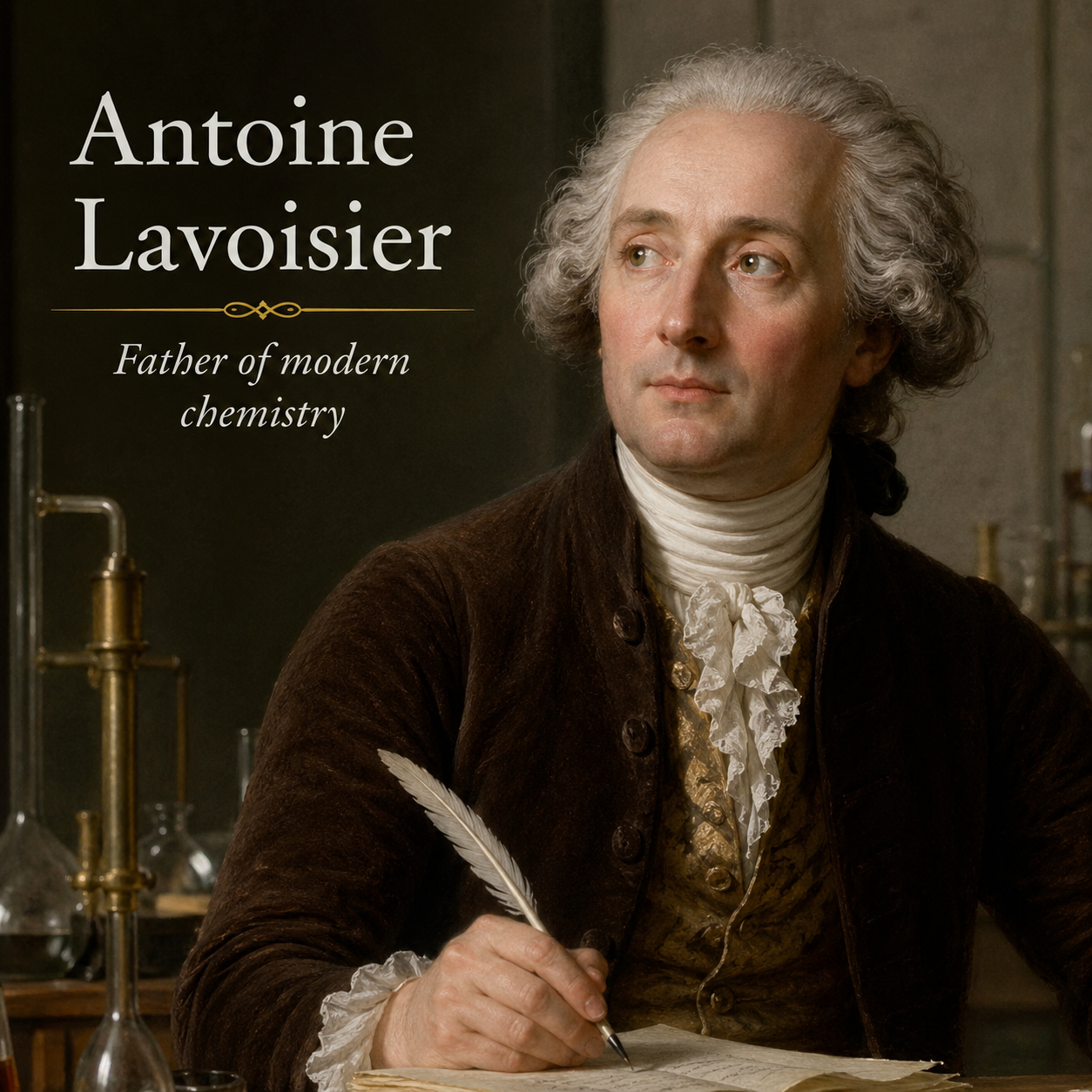
Antoine Lavoisier — "To invent is to choose."
To invent is to choose.
To invent is to choose.
Click any product to generate a realistic preview. Up to 3 at a time.
* Initial load can take up to 90 seconds — revising the preview in another color is nearly instant.
"We must trust to nothing but facts: these are presented to us by nature and cannot deceive."
"I have lived long enough to be certain that the world will not be ready for my discoveries until at least a hundred years after my death."
"The more we know, the more we admire."
"The human mind is capable of understanding all the secrets of nature."
"I have always sought to unite theory with practice."
Found in 1 providers: grok
1 source checked
Invention isn't stumbling onto something new by accident — it's the deliberate act of selecting what to pursue, which variables matter, which explanations to trust, and which paths to abandon. Among endless possibilities, the inventor exercises judgment. Creativity is fundamentally a series of choices: what question to ask, what evidence counts, what framework to adopt. The selecting itself is the inventing.
Lavoisier overhauled chemistry not through lucky discoveries but through deliberate methodological choices: adopting precise mass measurements, choosing to name elements systematically, selecting oxidation over phlogiston as the correct combustion framework. He chose which experiments the scientific community should run and which inherited assumptions to discard. His revolution was built on disciplined selection — of methods, terminology, and explanatory models — rather than accident.
Lavoisier worked during the 18th-century Enlightenment, when European thinkers were actively dismantling centuries of scholastic and alchemical authority by choosing empirical method over inherited doctrine. France's encyclopédistes made explicit choices about which knowledge deserved preservation. Politically and intellectually, old frameworks were collapsing simultaneously. In this era of deliberate reconstruction — scientific, philosophical, soon revolutionary — asserting that invention is choice was a statement about human rational agency over tradition and accident.
AI-generated insights based on extensive research and information for context. Factual errors? Email [email protected].
Your cart is empty