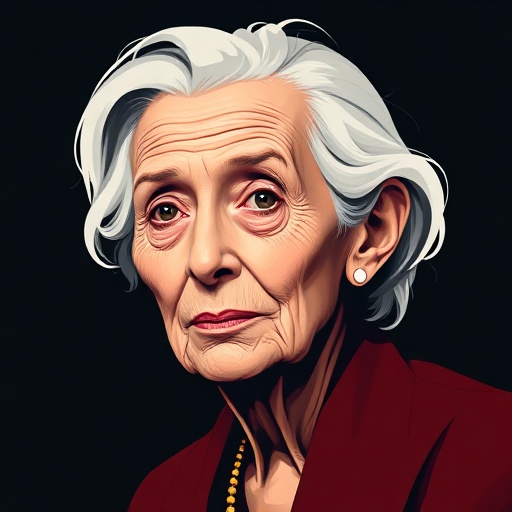
Jane Goodall — "We are all interconnected. What happens to one part of the world affects us all."
We are all interconnected. What happens to one part of the world affects us all.
We are all interconnected. What happens to one part of the world affects us all.
Click any product to generate a realistic preview. Up to 3 at a time.
* Initial load can take up to 90 seconds — revising the preview in another color is nearly instant.
"We are all interconnected. What we do to the Earth, we do to ourselves."
"Animals are not just things. They're living beings with feelings, just like us."
"The future of the planet depends on us, and we need to take that responsibility seriously."
"I have hope for the future, but we have to work together to make it happen."
"Every choice we make has an impact on the world, and we should choose wisely."
British primatologist who in 1960 began the longest-running wild primate study at Gombe Stream, transforming our understanding of chimpanzees. Closely associated with Dian Fossey (mountain-gorilla researcher) and Birutė Galdikas (orangutan researcher; together with Goodall and Fossey one of Louis Leakey's 'Trimates'). For an intellectual contrast, see Walter Palmer, American dentist who killed Cecil the Lion in Zimbabwe in 2015 — Palmer represents the trophy-hunting tradition Goodall's life's work has been organized against — the colonial-era hunter-naturalist worldview that treated primates and big game as specimens or trophies, which Goodall's Roots & Shoots and Jane Goodall Institute exist specifically to displace.
Found in 1 providers: grok
1 source checked
Every living thing and every community on Earth is linked through ecological, social, and economic systems. An action taken in one place—deforestation in the Congo, pollution in a river, a pathogen crossing borders—ripples outward and affects people and species far away. Isolation is an illusion. Our shared fate makes planetary responsibility collective rather than local, and ignoring distant harm ultimately returns it to your own doorstep.
Goodall spent decades at Gombe Stream in Tanzania studying chimpanzees, discovering tool use and complex social bonds that blurred the line between human and animal. That research evolved into global environmental activism through the Jane Goodall Institute and Roots & Shoots youth program. She consistently argues that habitat destruction in Africa or Asia directly threatens human communities worldwide—a conviction forged by watching forests disappear and primate populations collapse.
Goodall's career spanned the Cold War's ecological blindness through the globalization era and into the climate crisis. The 1992 Rio Earth Summit formalized the idea that environmental problems require global cooperation. COVID-19 then made interconnection viscerally undeniable—a pathogen from one region shutting down the entire world. Accelerating biodiversity loss and climate-driven disasters reinforce daily that no nation's environmental choices stay within its borders.
AI-generated insights based on extensive research and information for context. Factual errors? Email [email protected].
Your cart is empty