Erwin Schrodinger — "We are all stardust."
We are all stardust.
We are all stardust.
Click any product to generate a realistic preview. Up to 3 at a time.
* Initial load can take up to 90 seconds — revising the preview in another color is nearly instant.
"The plurality that we perceive is only an appearance; it is not real. Vedantic philosophy... has sought to clarify it by a number of analogies."
"We are all part of the same cosmic dance."
"The greatest discovery of all time is the discovery that we can discover."
"The world is not a static place, but is constantly changing and evolving."
"I consider science to be an integral part of our endeavour to answer the one great philosophical question which embraces all others, the one that has puzzled man from earliest times: Who are we? What …"
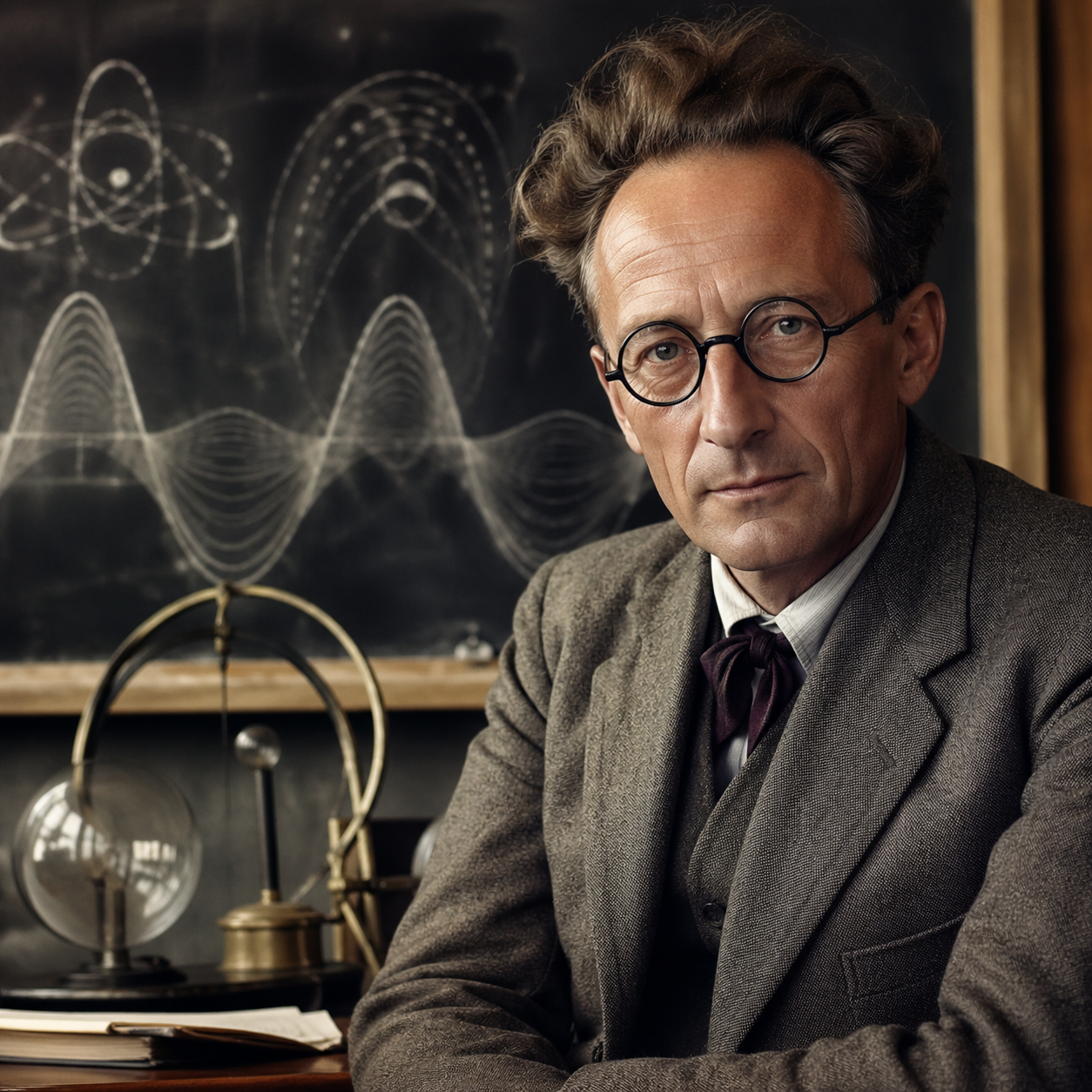
Austrian physicist who shared the 1933 Nobel for the wave equation that bears his name and the famous cat thought-experiment. Closely associated with Werner Heisenberg (matrix-mechanics rival who reached the same physics by different math) and Albert Einstein (his pen-pal on quantum interpretation). For an intellectual contrast, see Niels Bohr, Danish physicist and architect of the Copenhagen interpretation — Schrödinger's cat thought-experiment was specifically designed to ridicule Bohr's 'observer-dependent reality' reading of quantum mechanics — Schrödinger thought the Copenhagen interpretation was absurd; the cat was meant as reductio ad absurdum.
Attributed, a popular scientific and poetic phrase, not uniquely Schrodinger's.
Date: Unknown
GeneralFound in 1 providers: grok
1 source checked
The atoms making up every human body — carbon, oxygen, iron — were forged inside ancient stars through nuclear fusion, then scattered across the cosmos when those stars exploded as supernovae. We are not separate from the universe; we are composed of it. This collapses the divide between humanity and the cosmos, framing existence not as something apart from nature but as a direct continuation of stellar history.
Schrödinger's wave mechanics dissolved the sharp boundary between particle and wave, showing matter exists as probabilistic fields rather than fixed objects — deeply consonant with cosmic interconnection. His 1944 book What Is Life? pushed quantum physics into biology, arguing physical laws govern living organisms. He saw no fundamental barrier between physics and life, making the idea that we share atomic origins with ancient stars a natural extension of his worldview.
The early-to-mid 20th century transformed humanity's understanding of matter and cosmos simultaneously. Quantum mechanics revealed atoms' internal structure while nuclear physics began explaining stellar nucleosynthesis — how stars forge heavy elements and scatter them as supernovae. Einstein's relativity reshaped space and time. This era produced both atomic weapons and deep cosmological insight, making the poetic truth that human bodies contain atoms born in dying stars newly and viscerally real.
AI-generated insights based on extensive research and information for context. Factual errors? Email [email protected].
Your cart is empty