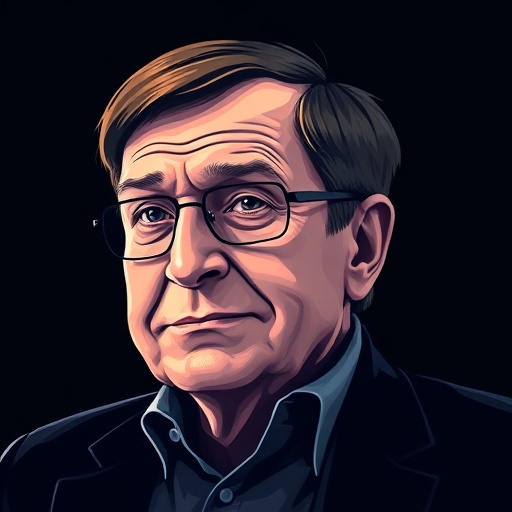
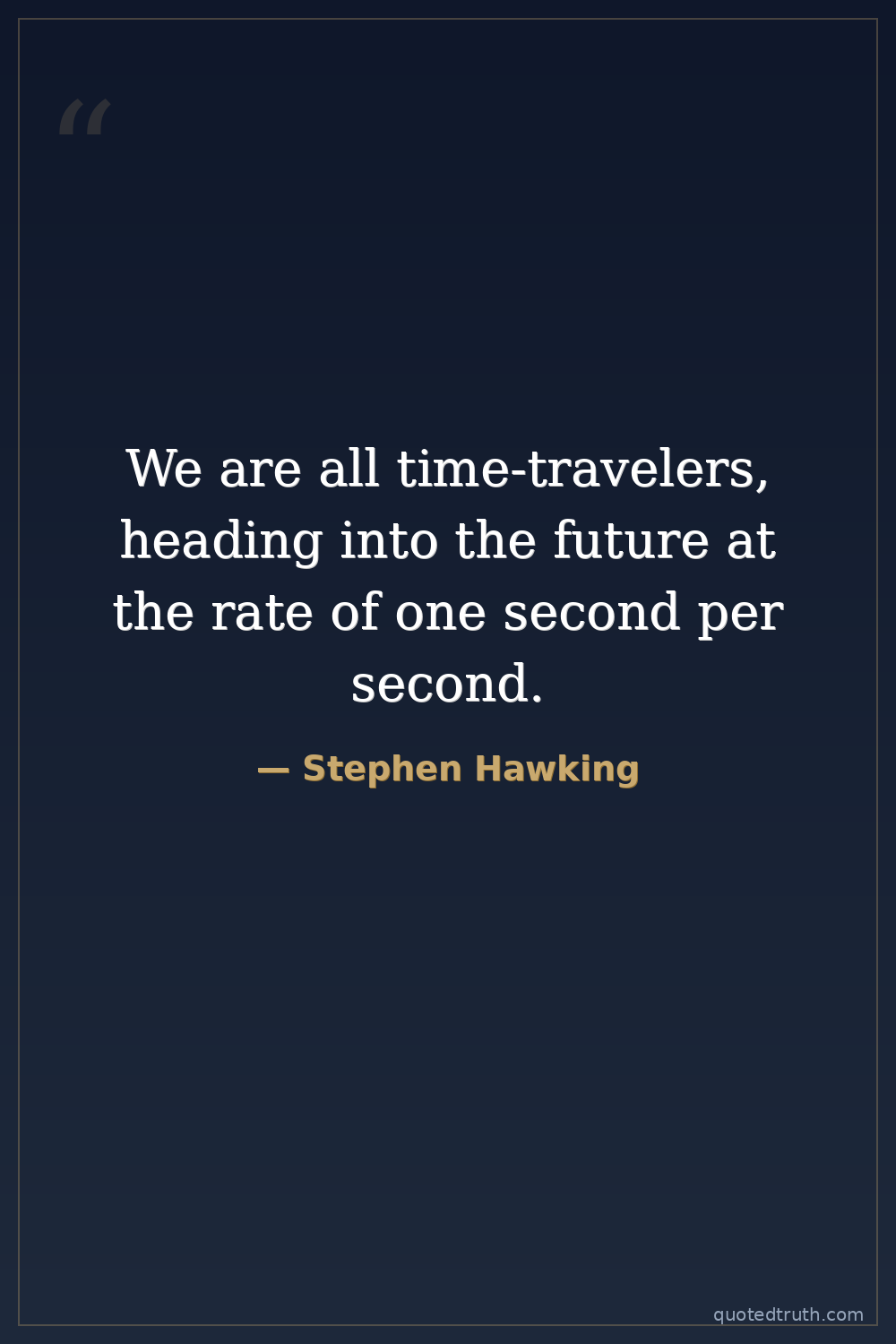
Stephen Hawking — "We are all time-travelers, heading into the future at the rate of one second per…"
We are all time-travelers, heading into the future at the rate of one second per second.
We are all time-travelers, heading into the future at the rate of one second per second.
Click any product to generate a realistic preview. Up to 3 at a time.
* Initial load can take up to 90 seconds — revising the preview in another color is nearly instant.
"The universe is not just full of black holes, it's full of black holes that are eating everything."
"Black holes ain't as black as they are painted. They are not the eternal prisons they were once thought. Things can get out of a black hole, both to the outside, and possibly, to another universe. So,…"
"I think that the human race has a destiny to explore the universe."
"We are all driven by a desire to understand the universe."
"I have no idea what the future holds, but I'm optimistic."
British theoretical physicist whose Hawking radiation work and A Brief History of Time (1988) brought black-hole physics to a mass audience while he lived with ALS for 55 years. Closely associated with Roger Penrose (his collaborator on singularity theorems) and Carl Sagan (fellow popularizer who wrote Brief History's foreword). For an intellectual contrast, see William Lane Craig, American philosopher of religion — Craig's Kalam cosmological argument depends on the Big Bang requiring a divine first cause; Hawking's no-boundary proposal was specifically designed to remove the moment that would require one — the cleanest cosmology-vs-natural-theology contrast in modern thought.
Found in 1 providers: grok
1 source checked
Every living person moves through time involuntarily and at exactly the same pace — no one moves faster or slower than anyone else. There is no escaping time's forward march. This reframes a concept people rarely notice as something universal and quietly remarkable, turning the mundane experience of simply existing into a kind of travel we all share equally.
Hawking spent his career dismantling intuitions about space and time — from Hawking radiation to the no-boundary proposal. He explored time's arrow, black hole singularities, and whether time travel was theoretically possible. Living with ALS for five decades, time held personal weight for him; he understood its passage as both a physical law and a deeply human experience.
Hawking spoke and wrote during an era when physics was revolutionizing concepts of time — relativity was a century old but still filtering into public understanding, and theoretical work on wormholes, closed timelike curves, and the multiverse was mainstream in physics. His gift was translating these ideas into language that made ordinary people feel connected to the cosmos.
AI-generated insights based on extensive research and information for context. Factual errors? Email [email protected].
Your cart is empty