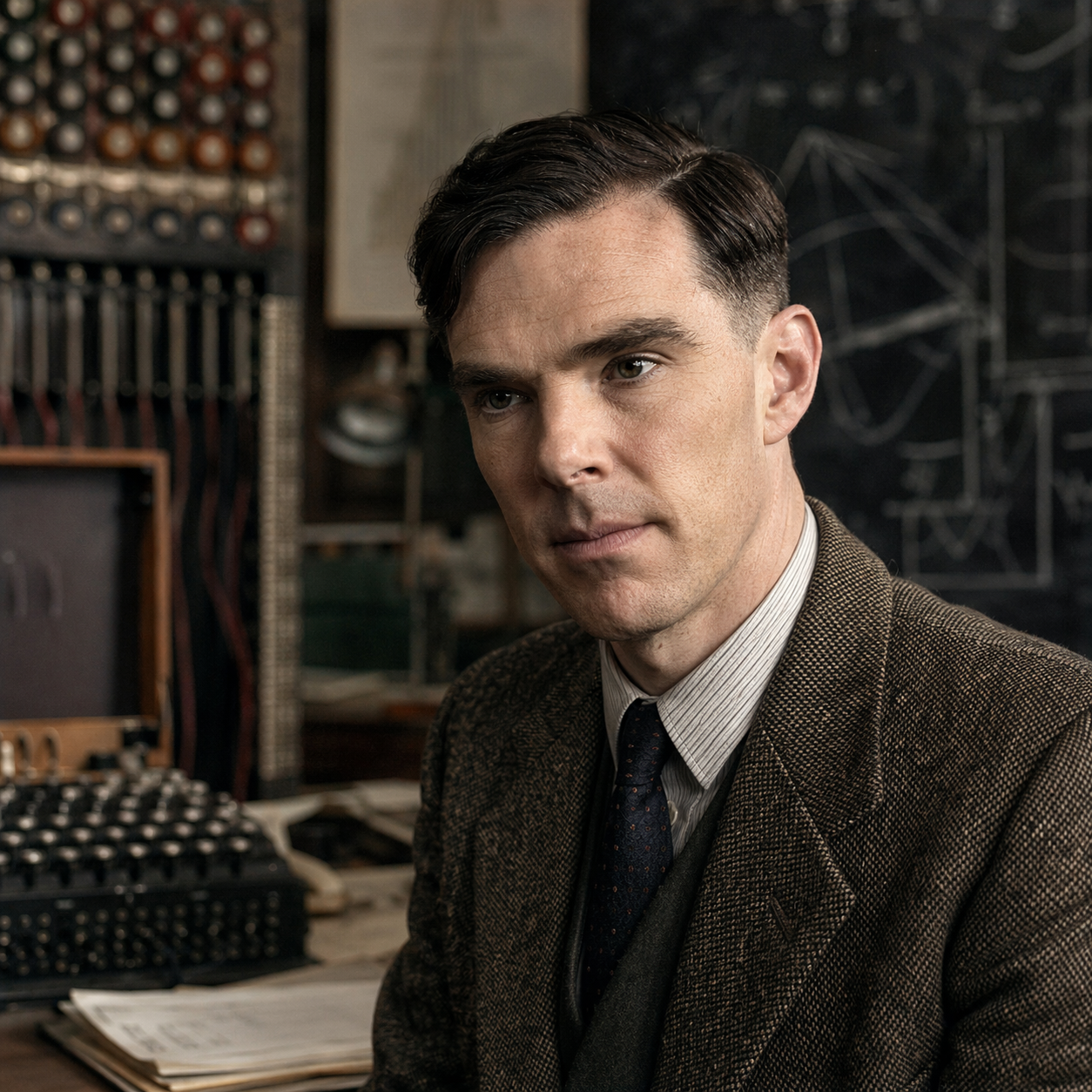
Alan Turing — "We are building a brain."
We are building a brain.
We are building a brain.
Click any product to generate a realistic preview. Up to 3 at a time.
* Initial load can take up to 90 seconds — revising the preview in another color is nearly instant.
"A smallish proportion are supercritical. An idea presented to such a mind may give rise to a whole 'theory' consisting of secondary, tertiary and more remote ideas. Animals' minds seem to be very defi…"
"The machine should be able to carry out logical deductions."
"The human brain is a machine, and it can be simulated by another machine."
"The original question, 'Can machines think?' I believe to be too meaningless to deserve discussion. Nevertheless I believe that at the end of the century the use of words and general educated opinion …"
"The human brain is a biological computer."
Referring to the ACE computer project, as quoted in 'Alan Turing: The Enigma' by Andrew Hodges.
Date: 1946
ShockingFound in 1 providers: grok
1 source checked
The quote captures a radical ambition: that a machine could replicate not just calculation but thought itself. Turing asserts that intelligence is not mystical or uniquely biological — it is a process that can be engineered. The word 'brain' reframes the computer from a calculator into a mind, challenging assumptions about what separates human cognition from mechanical process. The plural 'we' signals a collective scientific enterprise, not a lone inventor's fantasy.
Turing spent his career dissolving the boundary between mind and machine. His 1950 paper 'Computing Machinery and Intelligence' asked 'Can machines think?' and proposed the Turing Test. He designed the ACE computer at the National Physical Laboratory and theorized universal machines capable of simulating any computation. His Bletchley Park codebreaking demonstrated machines amplifying human cognition under pressure. He believed the brain was, at bottom, a computable system — this quote is that belief distilled.
The late 1940s saw the first real electronic computers — ENIAC (1945), Manchester Baby (1948) — emerge from wartime necessity. The Cold War created urgent demand for computation in cryptography and weapons. Society was awed by atomic power and scientific possibility, yet most people still saw computers as glorified calculators. Turing's framing of 'building a brain' was provocative: it suggested machines would eventually rival human minds, a concept the era found both thrilling and deeply unsettling.
AI-generated insights based on extensive research and information for context. Factual errors? Email [email protected].
Your cart is empty