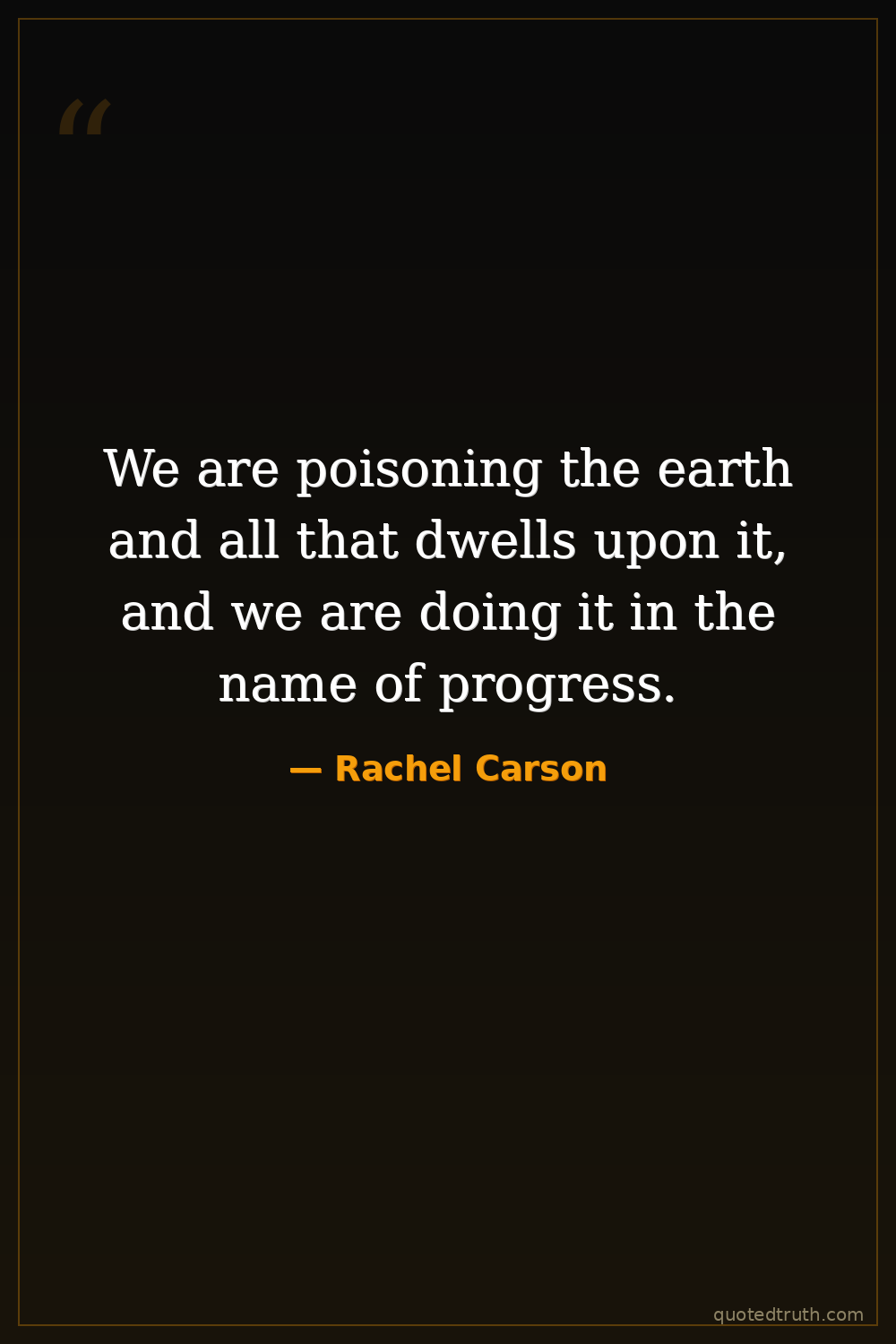
Rachel Carson — "We are poisoning the earth and all that dwells upon it, and we are doing it in t…"
We are poisoning the earth and all that dwells upon it, and we are doing it in the name of progress.
We are poisoning the earth and all that dwells upon it, and we are doing it in the name of progress.
Click any product to generate a realistic preview. Up to 3 at a time.
* Initial load can take up to 90 seconds — revising the preview in another color is nearly instant.
"The public is being misled, and it is a scandal of the highest order."
"The human race is challenged more than ever before to demonstrate our mastery, not over nature but of ourselves."
"I hope that my book will awaken a sense of responsibility in all who read it."
"It is not my intention to create hysteria, but to awaken people to the dangers that exist."
"The true meaning of conservation is to protect the earth's resources for future generations."
Found in 1 providers: grok
1 source checked
Humanity is systematically contaminating the planet and everything living on it — soil, water, wildlife, and people — while calling this destruction progress. The word 'progress' is used ironically: what society frames as technological and agricultural advancement is actually slow, deliberate poisoning. It challenges the assumption that industrial growth automatically means improvement and demands accountability for the environmental cost of so-called development.
Carson was a marine biologist whose 1962 book Silent Spring meticulously documented how synthetic pesticides like DDT moved through food chains, silencing songbirds and contaminating water supplies. Despite fierce industry opposition and attempts to discredit her as hysterical, she presented rigorous scientific evidence. This quote distills her core argument: that chemical companies were marketing mass ecological contamination as agricultural innovation, a deception she spent her final years fighting to expose.
Carson wrote during the post-WWII chemical boom, when DDT and other synthetic pesticides were being sprayed indiscriminately across American farms, suburbs, and even schools. The 1950s and early 1960s were defined by Cold War faith in science and industry as pillars of American strength, making criticism of agribusiness nearly heretical. Her work helped shatter that consensus, directly contributing to the U.S. DDT ban in 1972 and the founding of the EPA in 1970.
AI-generated insights based on extensive research and information for context. Factual errors? Email [email protected].
Your cart is empty