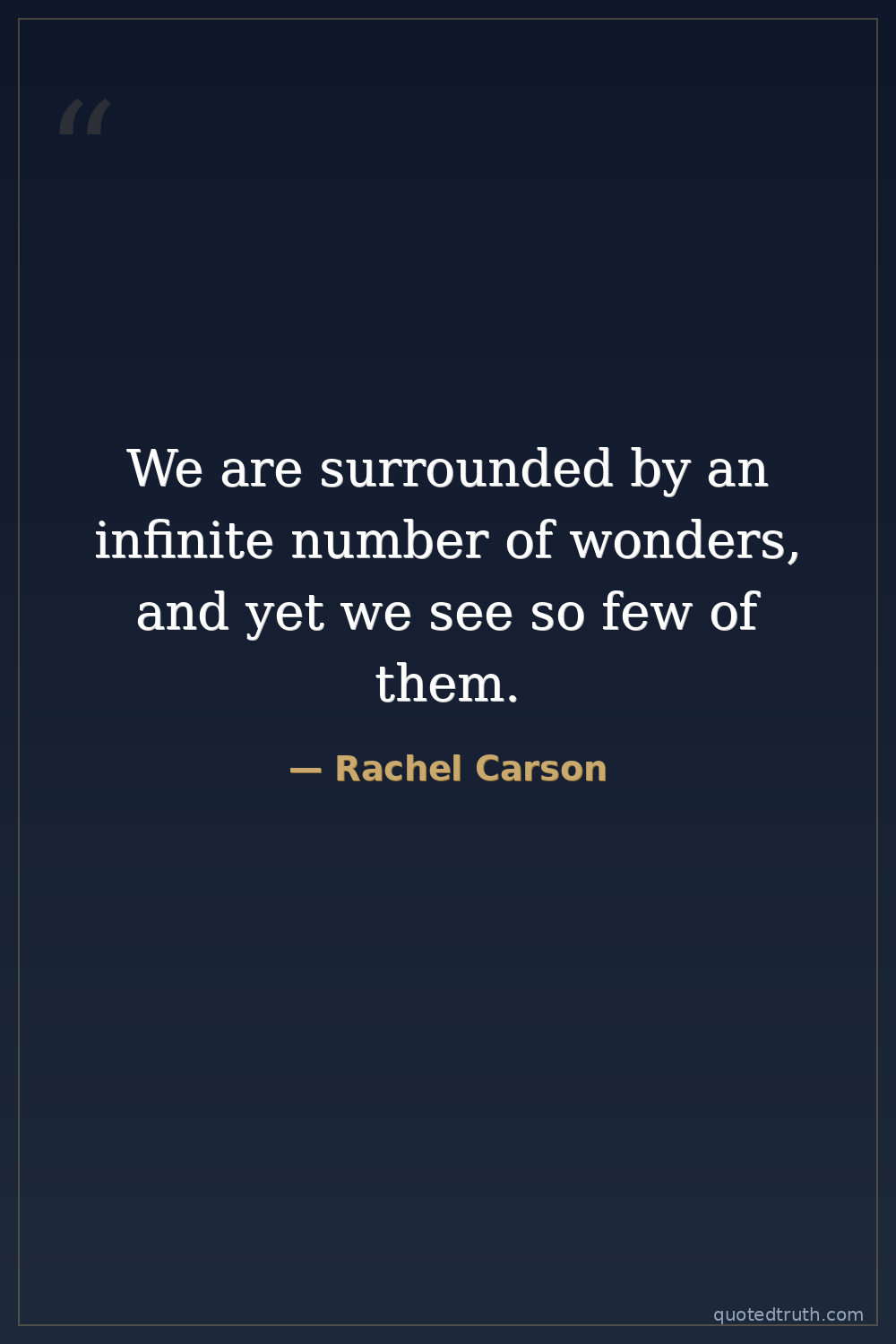
Rachel Carson — "We are surrounded by an infinite number of wonders, and yet we see so few of the…"
We are surrounded by an infinite number of wonders, and yet we see so few of them.
We are surrounded by an infinite number of wonders, and yet we see so few of them.
Click any product to generate a realistic preview. Up to 3 at a time.
* Initial load can take up to 90 seconds — revising the preview in another color is nearly instant.
"The winds, the sea, and the moving tides are what they are. If there is wonder and beauty and majesty in them, science will discover these qualities."
"Perhaps the most serious of all the omissions of the mass extermination programs is the failure to take into account the fact that environmental pollution is a two-way street."
"Are we to stand by while the people of the world are fed into a biological meat grinder? When we poison the air, the water, and the soil, we are poisoning ourselves."
"The most important thing is to instill in children a sense of wonder and curiosity about the natural world."
"I am not a scientist in the sense that I wear a white coat and work in a laboratory. I am a writer, and my laboratory is the world around me."
Found in 1 providers: grok
1 source checked
We live amid extraordinary phenomena — intricate ecosystems, biological processes, seasonal transformations — but daily life keeps us blind to them. The quote argues that wonder isn't scarce; our attention is. Most people move through the world without noticing the complexity beneath the surface. Paying closer attention to what already surrounds us — not seeking distant marvels — is the practice being urged here.
Carson devoted her life to making people see what they were overlooking. She wrote The Sense of Wonder, arguing that reverence for nature must be cultivated early and deliberately. As a marine biologist, she revealed the ocean's hidden complexity to general audiences. Silent Spring forced Americans to confront pesticide damage invisible to everyday observation. Her entire career was premised on this belief: attention is a moral act, and inattention has real consequences.
Carson wrote during the postwar boom of the 1940s–1960s, when suburban sprawl, chemical agriculture, and industrial growth reshaped the American landscape at speed. The 'better living through chemistry' culture treated nature as backdrop or resource. Television, car culture, and consumerism narrowed public attention to the manufactured world. Ecological destruction was advancing precisely because people weren't looking — Silent Spring was a direct, urgent response to that collective inattention.
AI-generated insights based on extensive research and information for context. Factual errors? Email [email protected].
Your cart is empty