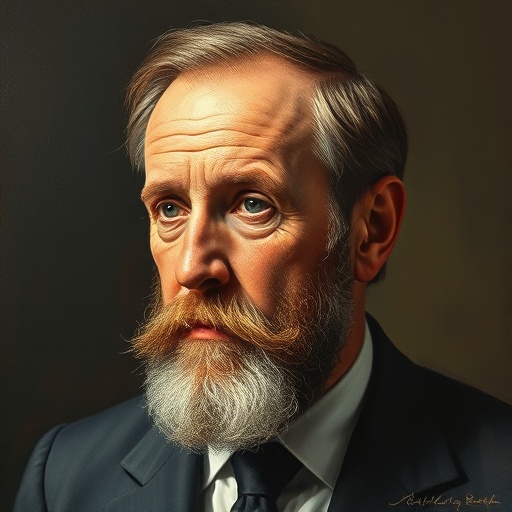
Niels Bohr — "We are suspended in language."
We are suspended in language.
We are suspended in language.
Click any product to generate a realistic preview. Up to 3 at a time.
* Initial load can take up to 90 seconds — revising the preview in another color is nearly instant.
"One must be clear that, as far as the atoms are concerned, we are not dealing with an analogy to everyday experience but with something quite different."
"Accuracy and clarity of expression are a matter of degree."
"The scientist's greatest reward is the joy of discovery."
"We are trapped by language to such a degree that every attempt to make progress in our understanding of the universe must also be an attempt to perfect our language."
"Prediction is very difficult, especially if it's about the future."
Highlighting the fundamental role of language in human understanding and communication.
Date: 1963 (Quoted in Aage Petersen, 'The Philosophy of Niels Bohr')
ShockingFound in 1 providers: gemini
1 source checked
Human understanding is entirely trapped within language. We cannot step outside words and concepts to observe reality directly — our descriptions always filter what we perceive. Language isn't just a tool; it's the medium we inhabit, like water for fish. This means no truly objective account of the world exists, only accounts shaped by the words and categories available to us, which inevitably limit what we can express or even think.
Bohr's atomic model and quantum mechanics forced him to describe phenomena that defied ordinary language — electrons in superposition, particles behaving as waves. His complementarity principle acknowledged that contradictory descriptions are both necessary. He recognized physicists were stuck using classical words like 'position' and 'momentum' for things that transcended them. This frustration — that language shapes and constrains physical theory — became central to his philosophy of science.
The 1920s–1930s saw quantum mechanics shatter classical physics. The Copenhagen debates forced scientists to ask whether reality exists independently of observation. Simultaneously, Wittgenstein was revolutionizing philosophy by arguing that the limits of language are the limits of thought, and logical positivists demanded verifiable meaning. Bohr's remark emerged at this exact intersection — a moment when physics and philosophy were colliding over what human language could actually capture about the world.
AI-generated insights based on extensive research and information for context. Factual errors? Email [email protected].
Your cart is empty