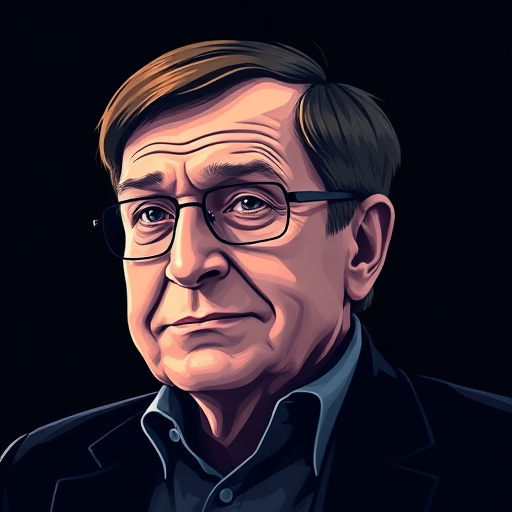
Stephen Hawking — "We are very, very small, but we are capable of understanding the universe."
We are very, very small, but we are capable of understanding the universe.
We are very, very small, but we are capable of understanding the universe.
Click any product to generate a realistic preview. Up to 3 at a time.
* Initial load can take up to 90 seconds — revising the preview in another color is nearly instant.
"Look up at the stars and not down at your feet. Try to make sense of what you see, and wonder about what makes the universe exist. Be curious."
"We are all driven by a desire to understand the universe."
"Slapstick is always funny. Oh yeah? How about now?"
"The universe is full of wonders, and we are lucky to be a part of it."
"The only advantage of my disability is that I do not get put on a lot of boring committees."
British theoretical physicist whose Hawking radiation work and A Brief History of Time (1988) brought black-hole physics to a mass audience while he lived with ALS for 55 years. Closely associated with Roger Penrose (his collaborator on singularity theorems) and Carl Sagan (fellow popularizer who wrote Brief History's foreword). For an intellectual contrast, see William Lane Craig, American philosopher of religion — Craig's Kalam cosmological argument depends on the Big Bang requiring a divine first cause; Hawking's no-boundary proposal was specifically designed to remove the moment that would require one — the cleanest cosmology-vs-natural-theology contrast in modern thought.
Found in 1 providers: grok
1 source checked
Despite humanity's insignificant physical scale in a cosmos spanning 93 billion light-years, our minds possess the remarkable capacity to comprehend the very laws governing that vastness. Intelligence and curiosity, not size or strength, define our worth. Understanding itself becomes a form of power — transforming ignorance into knowledge, and smallness into something that transcends physical limitation entirely.
Hawking spent his career revealing how extreme cosmic objects — black holes, the Big Bang singularity — operate under knowable mathematical laws. Paralyzed by ALS from age 21, confined to a wheelchair, communicating through a speech synthesizer, he embodied the paradox: a body diminished to near nothing, yet a mind that redrew humanity's map of spacetime and radiation physics.
Hawking worked through the Space Age, the cosmological revolution of the 1960s-2000s, and the rise of string theory debates. As physics unified quantum mechanics with relativity, humanity for the first time held genuine mathematical frameworks describing the universe's origin and fate — making his optimism about human comprehension not mere poetry but demonstrable scientific fact.
AI-generated insights based on extensive research and information for context. Factual errors? Email [email protected].
Your cart is empty