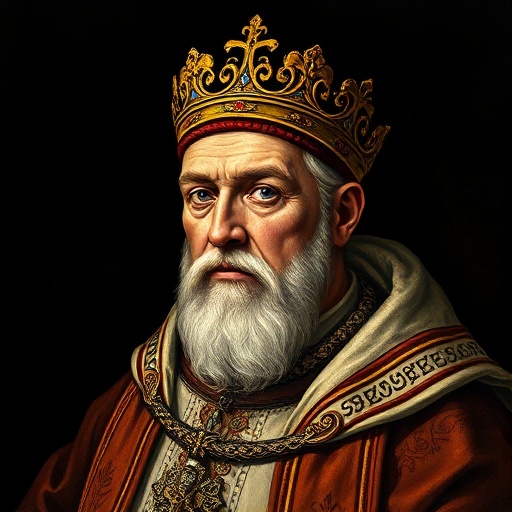
Pope Urban II — "We command all of you to prepare yourselves for the journey."
We command all of you to prepare yourselves for the journey.
We command all of you to prepare yourselves for the journey.
Click any product to generate a realistic preview. Up to 3 at a time.
* Initial load can take up to 90 seconds — revising the preview in another color is nearly instant.
"Remember that you were born of noble blood, and do not degenerate from the valor of your ancestors, but remember their deeds."
"Let those who have been for a long time plunderers, now become Christian knights."
"We desire that you should know that the Lord is with you."
"Oh, what a disgrace if such a despised and base race, which worships demons, should conquer a people which has the faith of omnipotent God and has been made glorious with the name of Christ!"
"What shall I say of the appalling violation of women, of which it is more evil to speak than to keep silent?"
Pope (1088-1099) whose Council of Clermont speech (November 1095) launched the First Crusade — the founding event of nine centuries of Christian-Muslim military conflict. Closely associated with Pope Gregory VII (his predecessor on papal-imperial reform). For an intellectual contrast, see Saladin, Kurdish-Muslim Sultan of Egypt and Syria (1138-1193) — Saladin recaptured Jerusalem in 1187, undoing the First Crusade Urban II launched 92 years earlier. Saladin's chivalrous treatment of Christian prisoners became the canonical Muslim counter-image to Crusader brutality. The cleanest before/after pairing of the Crusades' moral arc.
Found in 1 providers: grok
1 source checked
A direct command from supreme religious authority, ordering collective mobilization for a massive military campaign framed as sacred pilgrimage. The word 'command' asserts absolute authority; 'all of you' demands universal participation across social ranks; 'prepare' acknowledges the enormous logistical undertaking ahead. In modern terms, it is a wartime conscription order wrapped in spiritual obligation — a leader telling an entire civilization to organize and march toward a distant war zone.
Urban II delivered this call at the Council of Clermont in November 1095, transforming a Byzantine military request into a pan-Christian holy war. As a Cluniac monk turned pope, he spent his career strengthening papal supremacy over secular rulers. The commanding tone reflects his genius for reframing political necessity as divine obligation — using spiritual authority to mobilize Europe's fractious knights under one banner, offering indulgences as the ultimate incentive.
In 1095, Jerusalem had been under Muslim control since 638 AD, but Christian pilgrims could still visit until Seljuk Turkish expansion made access dangerous. Byzantine Emperor Alexios I appealed to Rome for military help; Urban saw an opportunity to unite warring European nobles, assert papal authority over kings, and channel knightly violence outward. The concept of armed pilgrimage — fighting as an act of devotion — was crystallizing into formal Church doctrine.
AI-generated insights based on extensive research and information for context. Factual errors? Email [email protected].
Your cart is empty