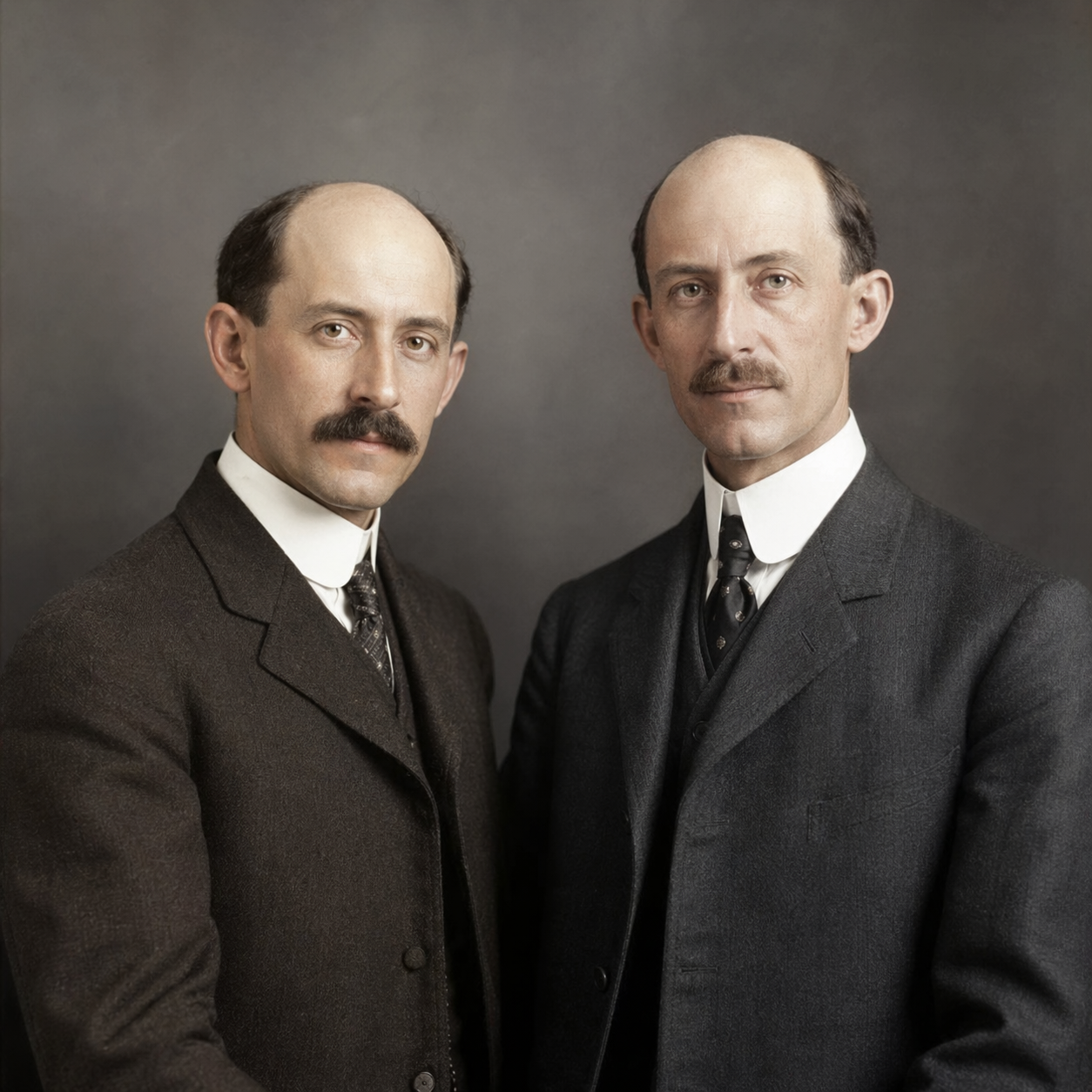
Wright Brothers (Orville & Wilbur) — "We do not believe that the difficulties are insurmountable, and we are confident…"
We do not believe that the difficulties are insurmountable, and we are confident that we shall yet succeed.
We do not believe that the difficulties are insurmountable, and we are confident that we shall yet succeed.
Click any product to generate a realistic preview. Up to 3 at a time.
* Initial load can take up to 90 seconds — revising the preview in another color is nearly instant.
"We did not find it necessary to use any of the formulas of the scientists, but we worked out our own formulas."
"In its campaign to discredit others in the flying art, the Smithsonian has issued scores of these false and misleading statements."
"The only bird that could speak told us what it knew, but we didn’t understand its language."
"We were confident that we had solved the problem of human flight."
"I confess that in 1901 I said to my brother Orville that man would not fly for fifty years."
American aviation pioneers who achieved the first sustained powered controlled airplane flight at Kitty Hawk, NC, on December 17, 1903. Closely associated with Octave Chanute (their gliding mentor and aeronautical correspondent). For an intellectual contrast, see Samuel Pierpont Langley, Smithsonian Institution Secretary and government-funded aviation researcher — Langley's Aerodrome crashed twice into the Potomac in October-December 1903 with $50,000 of War Department funding; the Wright Brothers' bicycle-shop empiricism beat Langley's institutional Big Science by 9 days. The most-cited example in engineering history of empirical-tinkerer beating institution-funded credentialism.
Found in 1 providers: grok
1 source checked
The speakers acknowledge the challenges ahead are real and serious but refuse to label them impossible. They express a calm, reasoned optimism: obstacles can be studied, broken down, and overcome through persistent effort. Rather than boasting, they state a working belief that success is still within reach if they keep pushing. It is a quiet declaration that difficulty is not defeat, and that progress requires steady confidence paired with ongoing work.
This mirrors the Wrights' methodical bicycle-shop approach to aviation. After gliders failed at Kitty Hawk in 1901, Wilbur famously doubted flight would come in their lifetime, yet they built their own wind tunnel, rewrote lift tables, and pressed on. They treated each crash as data, not defeat, and reached powered flight on December 17, 1903. The quote captures their engineer's faith: problems yield to patient testing, careful measurement, and refusal to quit when rivals like Langley spectacularly failed.
At the turn of the 20th century, heavier-than-air flight was widely mocked as fantasy after Samuel Langley's government-funded Aerodrome plunged into the Potomac weeks before Kitty Hawk. Newspapers ridiculed would-be aviators, and serious scientists declared manned flight impossible. Yet it was also an age of relentless tinkerers, electricity, automobiles, and transatlantic radio, where self-taught mechanics could outpace universities. The Wrights' confident persistence fit that Progressive-era faith that ordinary Americans with discipline and ingenuity could crack problems experts had abandoned.
AI-generated insights based on extensive research and information for context. Factual errors? Email [email protected].
Your cart is empty