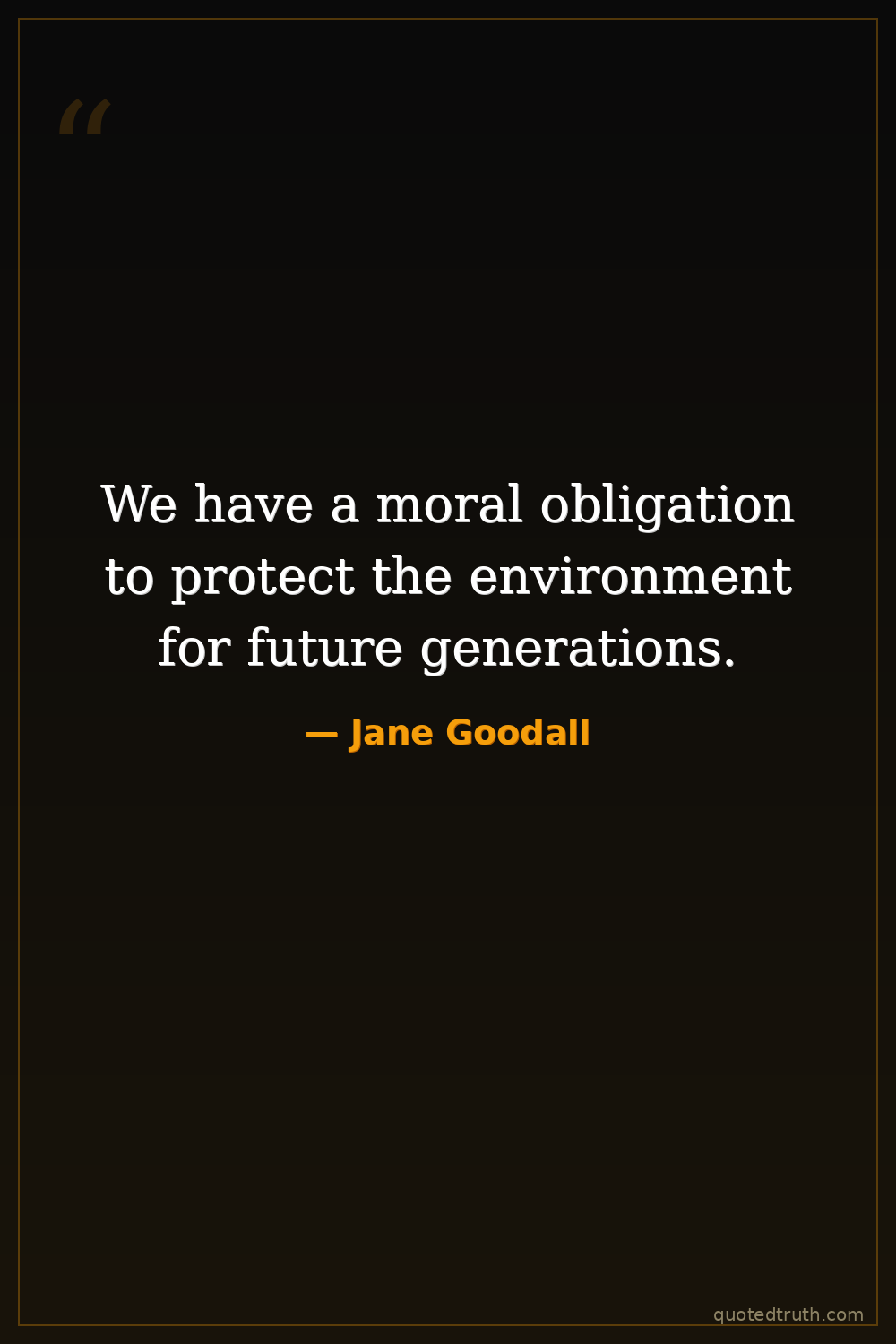
Jane Goodall — "We have a moral obligation to protect the environment for future generations."
We have a moral obligation to protect the environment for future generations.
We have a moral obligation to protect the environment for future generations.
Click any product to generate a realistic preview. Up to 3 at a time.
* Initial load can take up to 90 seconds — revising the preview in another color is nearly instant.
"I believe that every living creature has a soul, and that we should treat them with respect."
"We have so much to learn from the natural world. If we just open our eyes and listen."
"I believe that we can make a difference, if we just try."
"Chimpanzees have taught me that we are not the only beings with personalities, minds, and, above all, feelings."
"I'm not afraid of getting old. I'm afraid of not having enough time to do all the things I want to do."
British primatologist who in 1960 began the longest-running wild primate study at Gombe Stream, transforming our understanding of chimpanzees. Closely associated with Dian Fossey (mountain-gorilla researcher) and Birutė Galdikas (orangutan researcher; together with Goodall and Fossey one of Louis Leakey's 'Trimates'). For an intellectual contrast, see Walter Palmer, American dentist who killed Cecil the Lion in Zimbabwe in 2015 — Palmer represents the trophy-hunting tradition Goodall's life's work has been organized against — the colonial-era hunter-naturalist worldview that treated primates and big game as specimens or trophies, which Goodall's Roots & Shoots and Jane Goodall Institute exist specifically to displace.
Found in 1 providers: grok
1 source checked
Protecting nature isn't optional — it's an ethical duty owed to people not yet born. Every generation inherits the planet from its predecessors and holds it in trust. Consuming resources or degrading ecosystems without regard for long-term consequences isn't just shortsighted; it's a moral failure. The obligation transcends immediate self-interest and demands deliberate action even when the future beneficiaries cannot yet speak for themselves.
Goodall spent over six decades in Gombe, Tanzania, documenting chimpanzee behavior and watching deforestation shrink their habitat in real time. She founded the Jane Goodall Institute in 1977 and the Roots & Shoots youth program in 1991, driven by the conviction that scientific observation carries a responsibility to act. Her activism — lobbying governments, speaking globally — flows directly from watching the forests she studied disappear within her own lifetime.
Goodall came of age scientifically during the postwar industrial boom, when forests were cleared and rivers polluted with little regulation. Rachel Carson's Silent Spring in 1962 sparked modern environmentalism; the first Earth Day followed in 1970. By the 1990s, climate change and biodiversity loss were documented crises. The framing of environmental protection as moral — not merely practical — emerged precisely because economic growth was consistently prioritized over ecological preservation.
AI-generated insights based on extensive research and information for context. Factual errors? Email [email protected].
Your cart is empty