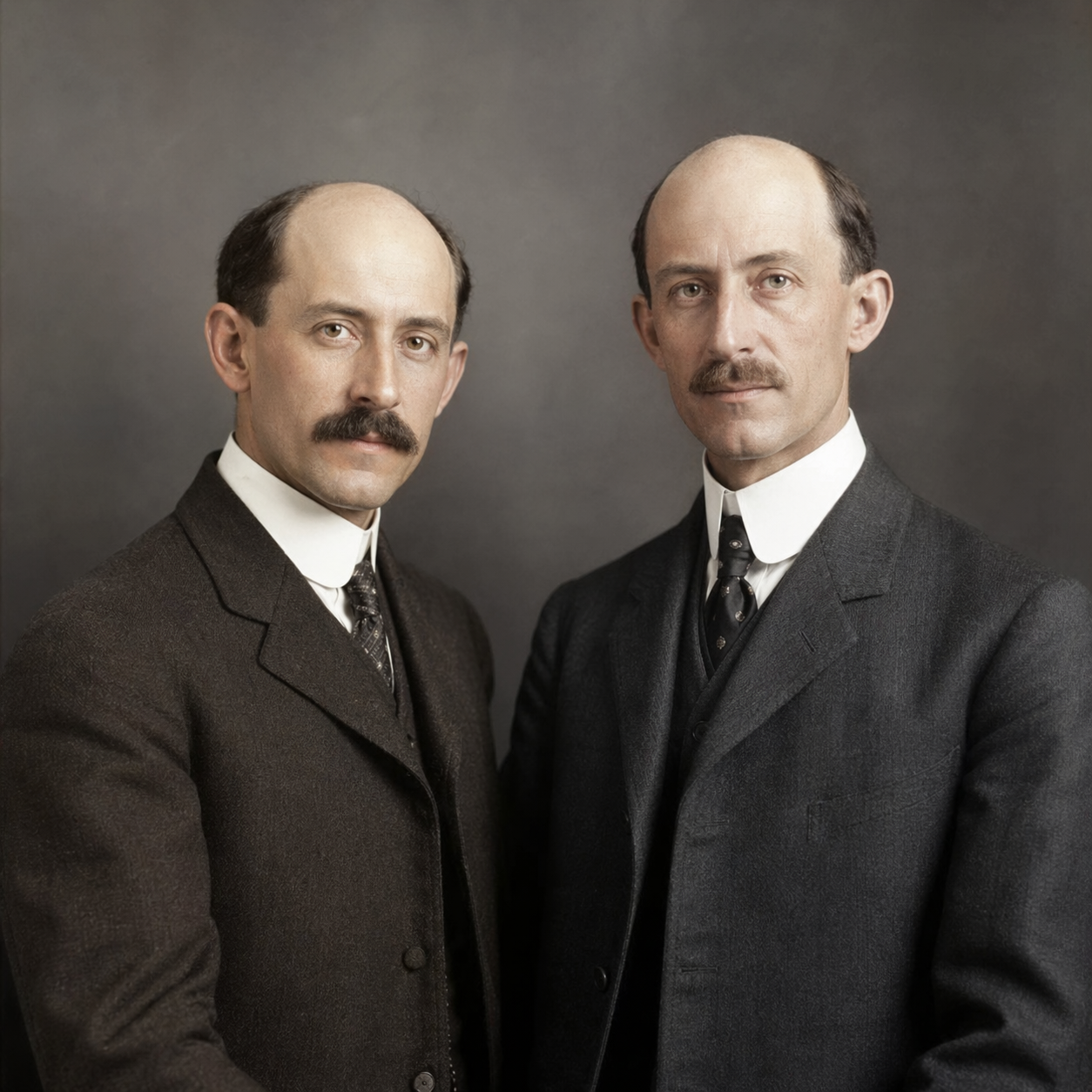
Wright Brothers (Orville & Wilbur) — "We have been trying to make a machine that will fly, and we have succeeded."
We have been trying to make a machine that will fly, and we have succeeded.
We have been trying to make a machine that will fly, and we have succeeded.
Click any product to generate a realistic preview. Up to 3 at a time.
* Initial load can take up to 90 seconds — revising the preview in another color is nearly instant.
"It was the first time in the history of the world that a machine carrying a man had raised itself by its own power into the air in full flight, had sailed forward without reduction of speed, and had f…"
"The machine is now a commercial success."
"The public is very enthusiastic about our machine."
"No one can appreciate the work and worry it cost us to build our first machine."
"It is a pleasure to be able to inform you that the machine has been a success."
American aviation pioneers who achieved the first sustained powered controlled airplane flight at Kitty Hawk, NC, on December 17, 1903. Closely associated with Octave Chanute (their gliding mentor and aeronautical correspondent). For an intellectual contrast, see Samuel Pierpont Langley, Smithsonian Institution Secretary and government-funded aviation researcher — Langley's Aerodrome crashed twice into the Potomac in October-December 1903 with $50,000 of War Department funding; the Wright Brothers' bicycle-shop empiricism beat Langley's institutional Big Science by 9 days. The most-cited example in engineering history of empirical-tinkerer beating institution-funded credentialism.
Found in 1 providers: grok
1 source checked
A direct statement of accomplishment: a long-pursued goal has finally been reached. The speakers acknowledge the sustained effort behind the attempt and then plainly declare victory. It captures the moment when persistent experimentation crosses from theory into demonstrated reality, with no embellishment, no boasting, and no hedging, just the facts of what was attempted and what was achieved.
Orville and Wilbur Wright spent years as bicycle mechanics in Dayton, Ohio, teaching themselves aeronautics, building wind tunnels, and testing gliders at Kitty Hawk. Their understated, methodical tone matches their engineering temperament. On December 17, 1903, Orville piloted the first sustained powered flight, 12 seconds over 120 feet. The brothers famously avoided self-promotion, letting data and demonstrations speak, which is exactly the plain declarative register this sentence uses.
At the turn of the 20th century, flight was widely ridiculed as impossible; Simon Newcomb had recently argued heavier-than-air machines could not work. Well-funded rivals like Samuel Langley had failed publicly. The Industrial Revolution had produced steam power, electricity, and the automobile, and inventors were racing to conquer the air. Two self-funded Ohio bicycle makers succeeding where academics failed reframed what independent tinkerers could achieve in a credentialing age.
AI-generated insights based on extensive research and information for context. Factual errors? Email [email protected].
Your cart is empty